
Understanding Payment Gateway Internal Mechanics
Dive into the technical architecture behind payment gateways, covering authorization flows, tokenization, fraud detection systems, and API-driven integrations that power modern payment processing.
Vayqube Team
FinTech compliance and secure systems engineering
Introduction
The Role of Payment Gateways in Digital Transactions
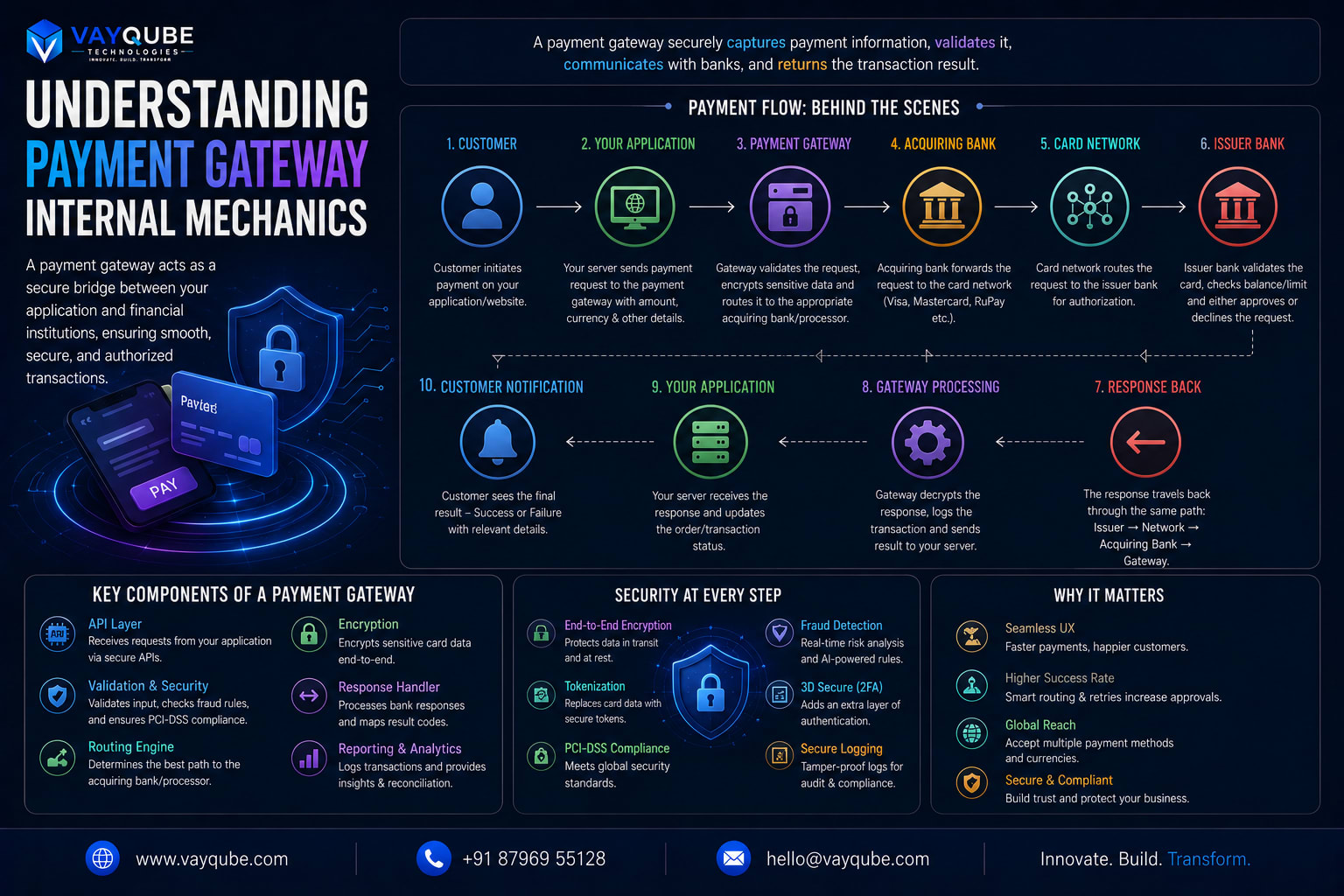
Payment gateways serve as the backbone of digital commerce, acting as intermediaries that securely process transactions between customers, merchants, and financial institutions. They handle critical functions such as card validation, fraud detection, tokenization, and funds settlement. For enterprise SaaS businesses, which often rely on recurring billing, global payments, and high-volume transaction processing, payment gateways are not just tools—they are strategic infrastructure. Understanding their internal mechanics ensures alignment with business objectives like scalability, compliance, and customer experience optimization.
Why Internal Mechanics Matter for Enterprise SaaS
Surface-level integration with a payment gateway may suffice for basic transaction handling, but enterprise SaaS companies require deeper insight to address complex challenges. Knowledge of internal workflows—such as how payments are routed, how data is encrypted, and how disputes are resolved—enables teams to:
- Optimize costs by selecting gateways with efficient pricing models.
- Enhance security through proactive risk management and compliance adherence.
- Improve system reliability by designing failover mechanisms and latency-reduction strategies.
This foundational understanding also supports informed vendor negotiations and technical roadmap planning, ensuring the gateway scales with the business.
Key Topics Covered
This article delves into the architectural and operational nuances of payment gateways, focusing on:
- Core Architecture: How front-end interfaces, back-end processors, and third-party networks interact.
- Scalability Dynamics: Ensuring performance during peak loads and global expansion.
- Implementation Strategies: Best practices for integration, testing, and deployment.
- Production Considerations: Monitoring, compliance, and disaster recovery in live environments.
By examining these elements, enterprise SaaS leaders gain actionable insights to streamline payment operations and drive long-term growth.
Why It Matters
Transaction Efficiency and Scalability
Payment gateways act as the backbone of digital commerce, directly influencing transaction speed and system reliability. A poorly optimized gateway can introduce latency, failed transactions, or bottlenecks during peak demand—issues that erode customer satisfaction and revenue. For SaaS businesses operating globally, gateways must scale seamlessly across regions, currencies, and payment methods. For example, a subscription platform serving users in 50+ countries requires a gateway that supports real-time processing in local currencies while maintaining low latency. This efficiency isn’t just technical—it’s a competitive differentiator that impacts customer retention and operational scalability.
Security and Risk Mitigation
Security breaches or compliance gaps in payment processing can devastate a SaaS company’s reputation and financial health. Gateways that lack robust encryption, tokenization, or fraud detection mechanisms expose businesses to data theft, chargeback disputes, and regulatory penalties. Consider a fintech SaaS platform handling sensitive financial data: a breach could trigger legal liabilities under GDPR or CCPA, not to mention loss of customer trust. Modern gateways integrate AI-driven anomaly detection and PCI DSS compliance tools, reducing the risk of fraud while ensuring adherence to evolving global standards. This proactive security posture directly ties to long-term customer loyalty and regulatory peace of mind.
Customer Trust and Global Expansion
Trust is currency in SaaS. A payment gateway that supports localized payment methods (e.g., Alipay in China, SEPA in Europe) signals to customers that a business understands and respects regional preferences. This localized approach isn’t just about convenience—it’s a strategic move to build trust in emerging markets. For instance, an e-commerce SaaS provider expanding into Southeast Asia must integrate gateways that accept OVO or GrabPay to compete effectively. Beyond localization, transparent transaction communications (e.g., real-time receipts, error handling) further reinforce reliability, turning one-time users into long-term advocates.
Alignment with Business Objectives
A payment gateway’s architecture should mirror a company’s strategic priorities. Businesses aiming for rapid global scaling need gateways with multi-currency support, dynamic currency conversion, and compliance with regional regulations. Those prioritizing cost optimization benefit from gateways offering competitive transaction fees, volume discounts, or pay-as-you-go pricing models. For example, a SaaS startup focused on cost efficiency might choose a gateway with usage-based pricing over a fixed-fee model to align expenses with growth. By aligning gateway capabilities with business goals, companies avoid costly retrofits and ensure infrastructure supports—not hinders—long-term vision.
Reducing Operational Complexity
Behind the scenes, payment gateways influence operational workflows, from reconciliation to dispute resolution. A gateway with poor APIs or limited reporting tools can create siloed data, manual interventions, and delayed insights. Modern SaaS businesses require gateways that integrate seamlessly with accounting systems (e.g., NetSuite), CRM platforms (e.g., Salesforce), and analytics tools, enabling automated reconciliation and real-time financial visibility. For instance, a B2B SaaS company with complex billing models (e.g., usage-based pricing) relies on gateways that can map transactions to specific customer contracts or product tiers, streamlining audits and reducing manual overhead. This operational efficiency translates to lower labor costs and fewer errors.
By understanding these dynamics, SaaS leaders can select and optimize payment gateways that don’t just process transactions but actively drive business growth, security, and global competitiveness.
Core Architecture
Front-End Integration
Payment gateways connect user-facing interfaces to backend systems through secure front-end components. Key elements include:
- Payment Forms: Hosted or embedded forms collect card details, leveraging PCI-compliant templates to minimize data exposure.
- APIs: RESTful endpoints enable seamless transaction initiation, supporting dynamic elements like dynamic currency conversion or 3D Secure authentication.
- Client-Side Security: Tokenization at the point of capture replaces sensitive data with tokens, reducing PCI scope and ensuring encrypted data transmission.
Modern gateways prioritize frictionless UX while adhering to security standards, often using JavaScript SDKs for custom checkout experiences.
Back-End Processing
The backend orchestrates transaction lifecycle management:
- Authorization: Real-time checks validate card details, assess fraud risk, and confirm fund availability via acquirer networks. Declines or approvals are routed back to the merchant system.
- Settlement Workflows: Batch processing aggregates authorized transactions, reconciles funds, and initiates transfers to merchant bank accounts, typically within 1–3 business days.
- Reconciliation: Automated systems match transaction records with settlement reports, flagging discrepancies for investigation.
Scalable architectures use distributed systems to handle high-volume spikes, ensuring sub-second response times during peak periods.
Security Layers
Robust security is foundational to payment gateway operations:
- Encryption: TLS 1.3+ protects data in transit, while AES-256 encrypts stored tokens and metadata.
- Tokenization: Replaces PANs (Primary Account Numbers) with non-sensitive tokens, enabling post-sale operations without exposing raw card data.
- Fraud Detection: Machine learning models analyze patterns (e.g., velocity checks, geolocation mismatches) to block suspicious transactions pre-authorization.
- Compliance: Adherence to PCI DSS, GDPR, and regional regulations ensures audit readiness and mitigates liability.
Advanced gateways integrate with third-party risk platforms for real-time threat intelligence sharing.
Database Management
Transaction data storage demands precision and scalability:
- Structured Data Models: Relational databases track transaction IDs, timestamps, settlement statuses, and merchant metadata, ensuring ACID compliance for financial integrity.
- Scalability: NoSQL solutions or sharded architectures handle high-throughput scenarios, such as Black Friday sales, without performance degradation.
- Compliance Storage: Sensitive logs and audit trails are isolated in encrypted vaults with role-based access controls.
- Real-Time Analytics: In-memory databases enable instant reporting for merchants to monitor chargebacks, success rates, and revenue streams.
Retention policies align with regulatory requirements, automatically purging obsolete data to reduce exposure risks.
This architecture balances speed, security, and compliance, enabling enterprises to scale payment operations globally while maintaining production-grade reliability.
Business Benefits
Scalable Infrastructure for High-Volume Transactions
A robust payment gateway ensures seamless transaction processing even during peak demand, such as holiday sales or flash promotions. Cloud-native architectures and auto-scaling capabilities allow businesses to handle sudden traffic surges without compromising speed or reliability. For SaaS platforms, this means reduced risk of downtime, which directly translates to preserved revenue streams and customer trust.
Key advantages include:
- Elastic capacity: Automatically adjusts resources to match transaction volume.
- Global redundancy: Distributed data centers minimize latency and ensure uptime.
- Future-proof growth: Supports expanding customer bases without infrastructure overhauls.
Enhanced Customer Experience Through Seamless Checkout
Frictionless payment processes are critical for conversion rate optimization. Modern payment gateways integrate with minimal code, offering features like one-click checkouts, saved payment methods, and mobile-optimized interfaces. By reducing steps and loading times, businesses lower cart abandonment rates and improve customer satisfaction.
For enterprise SaaS, this also means:
- Brand consistency: Customizable payment interfaces that align with user experience standards.
- Multi-channel support: Unified payment flows across web, mobile, and in-app environments.
- Real-time feedback: Instant transaction confirmations and error handling to guide users.
Reduced Fraud Risk and Operational Overhead
Advanced payment gateways embed machine learning-driven fraud detection, flagging suspicious activity before transactions are processed. This reduces chargebacks, protects customer data, and lowers the burden on internal teams to manually review transactions.
Business impacts include:
- Automated risk mitigation: AI models adapt to evolving fraud patterns in real time.
- Compliance automation: Built-in tools for PCI DSS, GDPR, and other regulatory requirements.
- Cost savings: Fewer fraudulent transactions mean lower dispute resolution costs.
Support for Multi-Currency and Cross-Border Transactions
Global SaaS businesses require payment gateways that handle diverse currencies, regional payment methods, and tax regulations. This capability enables seamless expansion into new markets without the complexity of managing multiple payment providers.
Key benefits:
- Dynamic currency conversion: Automatically displays prices in the customer’s local currency.
- Localized payment options: Support for region-specific methods (e.g., Alipay in China, SEPA in Europe).
- Regulatory adherence: Built-in compliance for cross-border tax reporting and anti-money laundering (AML) rules.
By integrating a payment gateway with these features, enterprises can focus on growth strategies rather than operational logistics, ensuring a competitive edge in dynamic markets.
Scalability
Handling Peak Transaction Volumes Without Downtime
Enterprise payment gateways must sustain performance during sudden traffic surges, such as holiday sales or flash promotions. This requires dynamic load balancing across distributed servers, auto-scaling infrastructure, and intelligent queue management. For example, a global e-commerce platform might handle Black Friday traffic by automatically spinning up additional server instances to process millions of transactions per minute without latency.
Key mechanisms include:
- Real-time monitoring to detect traffic spikes and trigger scaling protocols.
- Stateless microservices that allow horizontal scaling of transaction processing units.
- Caching layers (e.g., Redis) to reduce database load during high-volume periods.
Production readiness demands stress testing under simulated peak conditions to ensure zero downtime and compliance with SLAs.
Cloud-Based Elasticity for Fluctuating Demand
Modern payment gateways leverage cloud-native architectures to scale resources up or down based on demand. This elasticity ensures cost efficiency—avoiding over-provisioning during low-traffic periods while maintaining robust capacity for surges.
Major cloud providers (AWS, Azure, GCP) offer auto-scaling groups and serverless compute (e.g., AWS Lambda) to handle variable workloads. For instance, a SaaS company entering a new market might use cloud elasticity to rapidly scale payment processing infrastructure in response to regional demand spikes.
Business impact:
- Reduced infrastructure costs by paying only for resources used.
- Faster time-to-market for regional expansions or product launches.
- Seamless adaptation to seasonal or event-driven traffic patterns.
Global Network Redundancy and Failover Mechanisms
Scalability isn’t just about volume—it’s about geographic resilience. Payment gateways rely on globally distributed data centers and content delivery networks (CDNs) to minimize latency and ensure uptime.
Critical redundancy features include:
- Multi-region deployment: Data replicated across continents to comply with local regulations (e.g., GDPR) and reduce cross-border latency.
- Automated failover: If one node fails, traffic reroutes to the nearest healthy node without manual intervention.
- Edge computing: Processing transactions closer to users (e.g., using Cloudflare Workers) to improve speed and reliability.
Real-world example: A fintech startup operating in APAC and EMEA might deploy gateways in Singapore and Frankfurt to ensure low-latency processing and compliance with regional financial regulations.
API-Driven Flexibility for New Market Integrations
Scalable payment gateways use modular APIs to integrate with local payment methods, banks, and compliance frameworks. This allows businesses to expand into new markets without overhauling their core infrastructure.
Implementation strategies:
- Standardized API contracts: Ensuring consistency across regions while supporting local payment nuances (e.g., Alipay in China, UPI in India).
- Versioned APIs: Enabling backward compatibility as new features or regulations emerge.
- Partner ecosystem integration: Connecting with third-party services (e.g., tax compliance tools, fraud detection) via APIs to extend functionality.
For instance, a travel SaaS platform entering Latin America might use API-driven scalability to quickly add local payment options like PIX in Brazil or OXXO in Mexico, accelerating time-to-revenue in new markets.
By prioritizing scalability in these dimensions, payment gateways become not just technical infrastructure but strategic enablers of global growth and operational resilience.
Implementation Challenges
PCI DSS Compliance and Data Security Complexity
Achieving and maintaining PCI DSS compliance is a foundational challenge for payment gateways. The standard requires robust encryption, tokenization, and strict access controls for cardholder data. For global SaaS platforms, this complexity multiplies due to varying regional data sovereignty laws (e.g., GDPR in Europe, CCPA in California). Ensuring end-to-end encryption across distributed systems while minimizing latency demands significant engineering resources. Additionally, regular security audits, vulnerability scanning, and incident response planning add operational overhead. A single misstep can lead to costly fines, reputational damage, or service disruptions.
Legacy System Integration and Third-Party Dependencies
Many enterprises operate legacy payment infrastructure (e.g., mainframe-based billing systems or on-premise ERP solutions) that require seamless integration with modern payment gateways. Bridging these gaps often involves building custom middleware, API adapters, or maintaining parallel systems during transition phases. Third-party dependencies—such as banking APIs, fraud detection services, or regional payment processors—introduce additional risks. Version mismatches, rate limiting, or sudden API deprecations can disrupt workflows, requiring constant monitoring and contingency planning.
Latency Optimization in Distributed Networks
Payment gateways must process transactions in real time across geographically dispersed users. Network latency becomes a critical issue when synchronizing data between regional data centers or interacting with external partners (e.g., acquirers, card networks). Strategies like edge computing, content delivery networks (CDNs), and intelligent traffic routing help mitigate delays. However, balancing low-latency performance with data consistency—especially in multi-region deployments—requires careful architectural trade-offs. For example, asynchronous processing for non-critical tasks (e.g., receipt generation) can reduce bottlenecks while maintaining user-perceived responsiveness.
Testing and Monitoring for Failover Resilience
Ensuring high availability demands rigorous testing of failover mechanisms and disaster recovery protocols. Simulating network partitions, regional outages, or third-party service failures (via chaos engineering) helps validate system resilience. Real-time monitoring tools must track transaction success rates, API response times, and error patterns across the payment pipeline. Automated rollbacks and circuit-breaker patterns are essential to prevent cascading failures. For SaaS providers, maintaining SLA compliance while rolling out updates or scaling infrastructure during peak loads adds another layer of complexity. Proactive alerting and post-incident analysis are critical to minimizing mean time to recovery (MTTR).
Each of these challenges requires a strategic blend of technical expertise, cross-functional collaboration, and continuous investment in scalable infrastructure. Addressing them effectively ensures the payment gateway remains secure, reliable, and adaptable to evolving business needs.
Use Cases
E-commerce Platforms Processing Millions of Transactions
High-volume e-commerce operations demand payment gateways that scale seamlessly while maintaining security and speed. For platforms handling millions of transactions daily, internal mechanics like distributed processing, load balancing, and asynchronous payment handling are critical. These systems ensure minimal latency during peak periods (e.g., Black Friday sales) while mitigating fraud through real-time risk assessment engines. Integration with inventory management and order fulfillment systems further streamlines operations, reducing reconciliation errors and improving customer checkout experiences.
SaaS Subscription Services with Automated Recurring Billing
SaaS businesses rely on payment gateways to automate recurring billing cycles, proration, and dunning management. Internal workflows must support dynamic pricing models, tax compliance across regions, and seamless retries for failed payments. For example, a global SaaS platform might use a gateway’s webhooks and API-first design to trigger invoice generation, update subscription tiers, or notify customers of payment failures. The gateway’s ability to handle tax calculations (e.g., VAT, sales tax) and currency conversion in real time ensures compliance and reduces operational overhead.
Mobile Payment Apps Requiring Real-Time Authorization
Mobile payment apps prioritize speed and security for on-the-go transactions. Payment gateways serving this use case often employ tokenization to replace sensitive card data with unique identifiers, reducing PCI DSS compliance scope. Real-time authorization engines process transactions in milliseconds, leveraging biometric authentication (e.g., fingerprint, facial recognition) and device-specific security protocols. For instance, a ride-sharing app might integrate a gateway that supports instant refunds or split payments between drivers and platform fees, all while maintaining low latency and high availability.
Cross-Border Marketplaces Needing Multi-Currency Support
Global marketplaces require payment gateways that support multi-currency transactions, dynamic currency conversion (DCC), and compliance with regional financial regulations. Internal systems must handle foreign exchange rate fluctuations, minimize currency conversion fees, and adhere to local payment methods (e.g., Alipay in China, SEPA in Europe). A marketplace like a global e-commerce hub might use a gateway’s API to automatically detect a customer’s location and present pricing in their local currency, while also reconciling funds across multiple banking partners. This reduces friction for international buyers and simplifies financial reporting for sellers.
Best Practices
Prioritize End-to-End Encryption and Tokenization
Secure data transmission is foundational to payment gateway reliability. Implement AES-256 encryption for data in transit and at rest, ensuring compliance with PCI DSS and other regulatory standards. Tokenization further reduces risk by replacing sensitive card data with unique, non-decryptable tokens. This minimizes exposure during transactions and storage, lowering liability in the event of a breach. For SaaS platforms handling recurring billing, tokenization ensures seamless customer retention without storing raw payment details.
Implement Real-Time Monitoring and Alerting Systems
Proactive oversight is critical for maintaining uptime and fraud prevention. Deploy monitoring tools that track transaction volumes, error rates, and latency in real time. Set alerts for anomalies—such as sudden spikes in declined transactions or unusual geolocation patterns—to enable rapid response. For enterprise SaaS providers, integrating these systems with existing DevOps workflows ensures cross-team visibility. Automated alerts reduce mean time to resolution (MTTR), safeguarding revenue streams and customer trust.
Conduct Regular Security Audits and Penetration Testing
Scheduled security assessments identify vulnerabilities before they’re exploited. Engage third-party auditors to perform comprehensive vulnerability scans and penetration tests, simulating real-world attack vectors. Align these efforts with frameworks like ISO 27001 or SOC 2 to validate compliance. For high-volume payment gateways, quarterly audits are recommended, with results feeding into iterative security improvements. Document findings and remediation steps to demonstrate due diligence and support internal audits.
Choose Vendors with Robust API Documentation and Support
Seamless integration hinges on vendor reliability. Prioritize payment gateway providers offering well-documented APIs, SDKs, and real-time testing environments. Clear documentation reduces development time and minimizes integration errors. Look for vendors with 24/7 support SLAs and a track record of uptime exceeding 99.9%. For global SaaS operations, ensure vendors support multi-currency transactions, regional compliance requirements (e.g., GDPR, PSD2), and scalable infrastructure to match growth.
Optimize for Scalability and Failover Resilience
Design payment workflows to handle peak loads without performance degradation. Use load balancing and auto-scaling to distribute traffic across servers, ensuring consistent throughput during high-demand periods. Implement failover mechanisms—such as redundant data centers or backup payment processors—to maintain operations during outages. For mission-critical SaaS applications, test disaster recovery protocols regularly to validate resilience.
Leverage Analytics for Continuous Improvement
Harness payment data to refine processes and reduce friction. Track metrics like conversion rates, decline rates, and average transaction latency to identify bottlenecks. Use A/B testing to evaluate UI/UX changes or new payment methods. For subscription-based models, analyze churn patterns linked to payment failures and adjust retry logic or customer communication strategies accordingly. Integrating analytics with CRM systems provides a holistic view of customer behavior and payment health.
FAQ
How do payment gateways handle declined transactions?
Payment gateways manage declined transactions by first relaying the decline reason from the card issuer or acquirer to the merchant. This could include codes like "insufficient funds" or "card expired." Advanced gateways often implement retry logic for soft declines (e.g., temporary network issues) and provide merchants with tools to customize retry rules or notify customers directly. For hard declines, gateways may suggest alternative payment methods or escalate the issue to the merchant’s support team. The goal is to minimize friction while maintaining compliance and security.
What’s the difference between a payment gateway and a payment processor?
A payment gateway acts as the intermediary between a merchant’s platform and the payment processing network. It secures transaction data, routes payments to the appropriate processor, and handles customer interactions (e.g., payment forms). A payment processor, on the other hand, executes the transaction by communicating with card networks (Visa, Mastercard) and banks to approve or decline payments. For example, Stripe or PayPal are gateways, while companies like First Data or Adyen often serve as both gateways and processors. The gateway focuses on front-end integration, while the processor manages back-end fund transfers.
How long does a typical transaction take to settle?
Settlement times vary by region, payment method, and merchant agreement. In most cases, funds from credit/debit card transactions settle within 1–3 business days. For example:
- Domestic cards (US/EU): 1–2 days.
- International cards: 3–5 days due to currency conversion and additional checks.
- Alternative payment methods (e.g., PayPal, Alipay): Often instant or same-day.
Merchants can negotiate faster settlement terms with their payment service providers, though this may incur additional fees. Real-time payment systems (e.g., UPI in India, FedNow in the US) are reducing settlement times globally, but traditional card networks remain the standard for cross-border transactions.
What factors influence payment gateway costs for enterprises?
Enterprise payment gateway costs depend on several variables:
- Transaction volume: High-volume merchants often secure discounted per-transaction rates.
- Payment methods: Cross-border transactions, local payment options (e.g., Sofort, PIX), or alternative currencies (e.g., crypto) may incur higher fees.
- Fraud prevention tools: Advanced risk assessment or 3D Secure 2.0 can increase costs but reduce chargebacks.
- Integration complexity: Custom API integrations or legacy system compatibility may require additional setup or maintenance fees.
- Contract terms: Monthly subscription fees, minimum volume commitments, or early termination penalties.
Enterprises should evaluate providers based on total cost of ownership (TCO), including hidden fees for chargebacks, refunds, or data analytics tools. Negotiating tiered pricing or revenue-sharing models can optimize costs at scale.
Conclusion
Understanding the internal mechanics of a payment gateway is not just a technical exercise—it’s a strategic imperative for businesses operating in today’s digital economy. By grasping how transactions flow, how security protocols are enforced, and how scalability is engineered, organizations can make informed decisions that directly impact revenue, customer trust, and operational efficiency.
Aligning with Scalability and Security Needs
A payment gateway’s architecture is the backbone of a business’s ability to grow without friction. Whether expanding into new markets, handling seasonal traffic spikes, or integrating with emerging payment methods, the underlying mechanics determine how seamlessly these transitions occur. Equally critical is the role of security frameworks—tokenization, encryption, and compliance standards like PCI DSS—are non-negotiable for protecting sensitive data and mitigating fraud risks. Businesses that prioritize understanding these elements position themselves to scale securely, avoiding costly disruptions or breaches.
Ready to Optimize Your Payment Infrastructure?
For enterprises aiming to future-proof their payment systems, the next steps are clear:
- Audit existing workflows to identify bottlenecks or compliance gaps.
- Engage with payment gateway providers that align with your scalability and security requirements.
- Invest in continuous monitoring to adapt to evolving threats and regulatory changes.
By aligning technical capabilities with business objectives, companies can transform their payment infrastructure from a cost center into a competitive advantage. If you’re ready to streamline operations, enhance security, or explore new payment modalities, partnering with experts who specialize in payment gateway optimization can accelerate your journey toward long-term growth.
Related Vayqube Resources
- Best Mobile App Development Company In Singapore City
- How To Build Fintech Application Payments Security Scaling
- Top Mobile App Development Company In Singapore City
- Best Saas Development Company In Singapore City
- Best Fintech Software Development Company In Singapore City
- Best Mobile App Development Company In India
Next Step
If your systems are struggling with scalability, automation, architecture complexity, or operational efficiency, it's time to modernize your infrastructure and workflows.
👉 Talk to a Vayqube solution architect and build systems designed for long-term production growth:
Additional implementation notes
<!-- merged-from:how-payment-gateways-work-internally -->Data Exchange and Protocols
Data exchange and protocols play a crucial role in the core architecture of a payment gateway, ensuring secure and reliable communication between stakeholders. This includes:
- APIs: enabling integration with merchants and financial institutions
- Messaging protocols: facilitating communication between stakeholders, such as ISO 8583
- Data encryption: protecting sensitive payment information, such as TLS and SSL
- Tokenization: replacing sensitive payment information with unique tokens, enhancing security and reducing risk
The core architecture of a payment gateway must be designed to accommodate various payment methods, including credit cards, debit cards, and alternative payment methods, while ensuring scalability, reliability, and security. By understanding the payment processing flow, key components and stakeholders, and data exchange and protocols, businesses can better navigate the complexities of payment gateways and optimize their implementation strategy.
Troubleshooting Tips
When issues arise with your payment gateway, it's essential to have a systematic approach to troubleshooting. Here are some tips:
- Verify that your payment gateway is properly configured and that all necessary settings are correctly implemented.
- Check for any updates or patches that may be required to ensure compatibility and security.
- Monitor your transaction logs to identify any patterns or trends that may indicate the source of the issue.
- Reach out to your payment gateway's support team for assistance, as they often have extensive knowledge and resources to help resolve problems.
The Future of Payment Gateways
As the payments landscape continues to evolve, payment gateways must adapt to meet the changing needs of businesses and consumers. Some trends that will shape the future of payment gateways include:
- Increased focus on security and compliance, driven by the need to protect sensitive customer data and prevent fraud.
- Growing demand for omnichannel payment experiences, which will require payment gateways to support a wide range of devices and platforms.
- Rising importance of emerging technologies such as blockchain, artificial intelligence, and the Internet of Things (IoT), which will enable new payment methods and use cases.
- Greater emphasis on customer experience and user interface, as businesses seek to create seamless and intuitive payment processes that drive conversions and loyalty.