
Unlocking Efficiency: API-First Development Explained
API-first development is a paradigm shift in software design, prioritizing APIs as the foundation for building scalable, integrated, and efficient applications. By adopting an API-first approach, businesses can unlock new levels of productivity and innovation.
Vayqube Team
Author
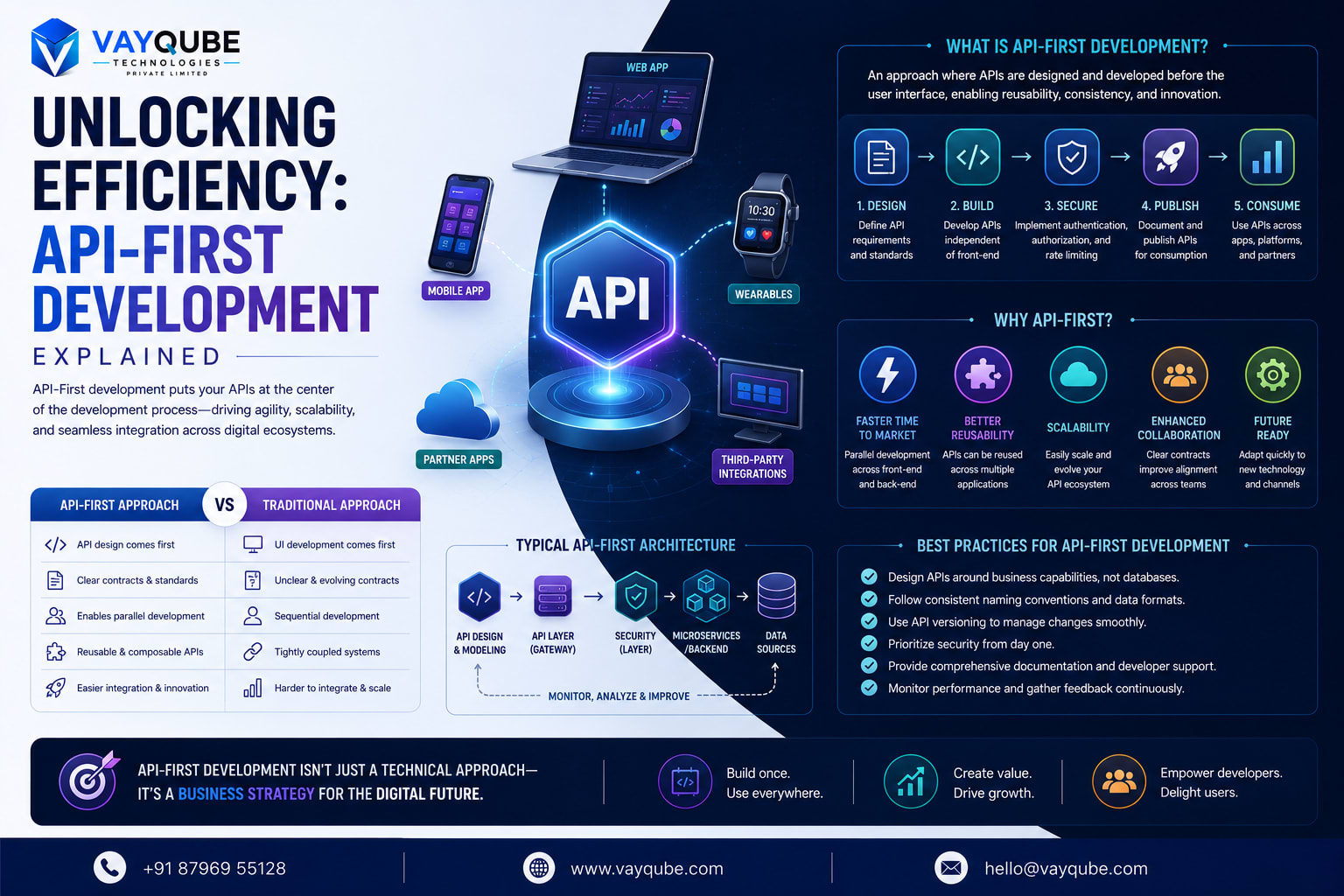
Introduction to API-First Development
API-First development is an approach that prioritizes the design and implementation of APIs as the primary interface for interacting with an application or system. This methodology has gained significant traction in recent years due to its ability to unlock efficiency, scalability, and flexibility in software development.
Overview of API-First Development
In traditional software development, the user interface (UI) is often the primary focus, with the API being an afterthought. In contrast, API-First development flips this approach on its head, focusing on designing and building robust, well-documented APIs that can be easily consumed by various clients, such as web applications, mobile apps, or even other services. This approach enables developers to create a single, unified API that can be used across multiple channels and platforms.
Importance of API-First Approach
The API-First approach is important for several reasons:
- Improved scalability: By designing APIs that can handle a large volume of requests, developers can ensure that their applications can scale more efficiently.
- Increased flexibility: APIs provide a standardized interface for interacting with an application, making it easier to integrate with other services or systems.
- Enhanced collaboration: Well-documented APIs enable different teams or organizations to work together more effectively, reducing the risk of misunderstandings or miscommunication.
- Faster time-to-market: With a focus on API design and development, organizations can quickly create new applications or services that leverage existing APIs, reducing the time and effort required to bring new products to market.
By adopting an API-First approach, organizations can unlock significant benefits, including improved efficiency, scalability, and flexibility. In the following sections, we will delve deeper into the implementation strategy and real-world use cases of API-First development, exploring how this approach can be applied in production environments to drive business success.
Why It Matters
API-first development is a paradigm shift in software development that has significant implications for businesses. By prioritizing APIs, organizations can unlock efficiency, drive innovation, and stay competitive in a rapidly changing market.
Improved Development Efficiency
API-first development enables teams to work more efficiently by allowing them to focus on building robust, scalable, and well-documented APIs. This approach reduces the complexity of development, as APIs can be designed, tested, and deployed independently of the user interface. As a result, development teams can:
- Work in parallel, reducing dependencies and wait times
- Reuse code and reduce duplication of effort
- Focus on building high-quality APIs that meet business needs
Enhanced Collaboration
API-first development promotes collaboration among cross-functional teams, including developers, product managers, and designers. By defining APIs upfront, teams can ensure that everyone is aligned on the project's goals and requirements. This collaborative approach leads to:
- Better communication and reduced misunderstandings
- Increased empathy and understanding of different team members' needs
- More effective prioritization and decision-making
Faster Time-to-Market
API-first development enables organizations to get their products to market faster. By building APIs that are modular, scalable, and well-documented, businesses can:
- Quickly integrate new features and services
- Easily deploy and test new APIs
- Reduce the time and effort required to launch new products or services
By adopting an API-first approach, businesses can achieve significant benefits, including improved development efficiency, enhanced collaboration, and faster time-to-market. This, in turn, can lead to increased competitiveness, revenue growth, and customer satisfaction. As organizations continue to navigate the complexities of digital transformation, API-first development is becoming an essential strategy for unlocking efficiency and driving success.
Core Architecture
To achieve efficiency in API-first development, a well-designed core architecture is crucial. This involves several key components that work together to provide a scalable and maintainable system.
API Design Principles
API design principles are the foundation of a successful API-first development strategy. These principles include:
- Clear and concise API endpoints
- Standardized data formats, such as JSON or XML
- Robust error handling and logging mechanisms
- Implementing security measures, like authentication and rate limiting
- Continuous testing and validation to ensure API reliability
A well-designed API is essential for providing a seamless experience for developers and users alike. By following established API design principles, organizations can ensure their APIs are easy to use, maintain, and scale.
Microservices Architecture
Microservices architecture is a key component of API-first development. This approach involves breaking down a monolithic application into smaller, independent services that communicate with each other through APIs. Microservices architecture offers several benefits, including:
- Improved scalability and fault tolerance
- Enhanced flexibility and maintainability
- Faster development and deployment cycles
- Better support for multiple programming languages and frameworks
By adopting a microservices architecture, organizations can create a more agile and responsive system that is better equipped to handle changing business requirements.
API Gateway and Management
An API gateway and management system is critical for ensuring the security, scalability, and reliability of APIs. This system acts as an entry point for API requests, providing features such as:
- API key management and authentication
- Rate limiting and quota management
- API analytics and monitoring
- Security features, like encryption and access control
A well-designed API gateway and management system helps organizations to manage their APIs more effectively, providing a centralized point of control and visibility into API usage and performance. This enables organizations to optimize their APIs for better performance, security, and user experience.
Business Benefits
The API-first development approach offers numerous benefits for businesses, driving growth, improvement, and cost savings.
Increased Revenue Opportunities
By adopting an API-first strategy, companies can unlock new revenue streams through innovative products and services. This approach enables the creation of modular, reusable components that can be easily integrated into various applications, facilitating partnerships and expanding market reach. For instance, a company can expose its APIs to third-party developers, allowing them to build new applications and services that leverage the company's core capabilities, thereby generating additional revenue.
Better Customer Experience
API-first development also enables businesses to provide a better customer experience by facilitating seamless integration across different channels and devices. With APIs acting as the backbone of the application, companies can ensure consistency and cohesion in their services, regardless of how customers interact with them. This leads to increased customer satisfaction, loyalty, and ultimately, retention.
Reduced Development Costs
The API-first approach can significantly reduce development costs in the long run. By building APIs as the primary interface, businesses can reuse and repurpose existing code, reducing the need for duplicated effort and minimizing the complexity associated with maintaining multiple, disparate systems. This modular architecture also allows for more efficient testing, debugging, and deployment of new features, further decreasing development time and costs.
As businesses continue to evolve and expand their digital presence, the importance of API-first development in driving efficiency, innovation, and growth will only continue to increase. By prioritizing APIs, companies can position themselves for success in an increasingly competitive and interconnected market.
Implementation and Production Considerations
When implementing an API-first strategy, it's essential to consider the production readiness of the APIs, ensuring they are scalable, secure, and well-documented. This involves careful planning, design, and testing to guarantee that the APIs can handle increased traffic and usage without compromising performance. Additionally, businesses must establish clear guidelines and governance around API development, usage, and maintenance to ensure consistency and quality across all APIs.
By focusing on these critical aspects, companies can harness the full potential of API-first development, driving business growth, improving customer experience, and reducing development costs.
Scalability
To achieve scalability in API-first development, several strategies can be employed.
Horizontal Scaling
Horizontal scaling involves adding more resources, such as servers or instances, to handle increased traffic or workload. This approach allows for the distribution of workload across multiple resources, ensuring that no single point of failure exists. By adding more resources, the system can handle more requests, making it highly scalable.
Load Balancing
Load balancing plays a crucial role in scalability by distributing incoming traffic across multiple resources. This ensures that no single resource is overwhelmed, reducing the risk of downtime or slow performance. Load balancing can be implemented using various algorithms, such as round-robin or least connection, to optimize traffic distribution.
Auto-Scaling
Auto-scaling takes horizontal scaling to the next level by automatically adding or removing resources based on demand. This approach ensures that the system is always optimized for the current workload, reducing waste and improving efficiency. Auto-scaling can be triggered by various metrics, such as CPU utilization or request latency, to ensure that the system scales up or down as needed.
Key considerations for implementing scalable API-first development include:
- Monitoring and analytics to track performance and identify bottlenecks
- Automated testing and deployment to ensure rapid iteration and deployment
- Containerization and orchestration to simplify resource management and scaling
- Service discovery and registration to manage service instances and endpoints
By implementing these strategies, businesses can build highly scalable APIs that support growing traffic and workload, ensuring a seamless user experience and improved reliability.
Real-world examples of scalable API-first development include:
- E-commerce platforms that handle large volumes of traffic during sales or promotions
- Social media platforms that support millions of users and interactions
- Financial services that require high availability and scalability to support transactions and data processing
Production considerations for scalable API-first development include:
- Ensuring high availability and redundancy to minimize downtime
- Implementing robust security measures to protect against threats and vulnerabilities
- Optimizing performance and latency to ensure a responsive user experience
- Continuously monitoring and improving the system to ensure it meets evolving business needs.
Implementation Challenges
Implementing an API-first development approach can be a game-changer for businesses, but it also comes with its own set of challenges. To ensure a smooth transition, it's essential to address these challenges head-on.
Change Management
Change management is a critical aspect of implementing an API-first development approach. It requires a significant shift in the way teams work, and it's essential to have a clear plan in place to manage this change. This includes:
- Defining new roles and responsibilities
- Providing training and support for developers
- Establishing clear communication channels
- Setting realistic expectations and timelines
Technical Debt
Technical debt is another challenge that teams may face when implementing an API-first development approach. This can include:
- Legacy system integration
- Data migration and consolidation
- API design and documentation
- Testing and quality assurance
Security and Compliance
Security and compliance are top priorities when implementing an API-first development approach. This includes:
- Ensuring API security and authentication
- Implementing data encryption and access controls
- Meeting regulatory requirements and industry standards
- Conducting regular security audits and testing
To overcome these challenges, businesses must be proactive and strategic in their approach. This includes:
- Developing a clear implementation plan and timeline
- Establishing a cross-functional team to manage the transition
- Providing ongoing training and support for developers
- Continuously monitoring and evaluating the implementation process
By addressing these implementation challenges, businesses can unlock the full potential of an API-first development approach and achieve greater efficiency, scalability, and innovation.
Real-World Examples
Real-world examples of successful API-first development implementations can provide valuable insights and lessons learned. For instance, companies like Amazon and Netflix have successfully implemented API-first development approaches, resulting in significant improvements in efficiency, scalability, and innovation.
Production Considerations
When implementing an API-first development approach in production, it's essential to consider factors such as:
- API performance and scalability
- Error handling and logging
- Monitoring and analytics
- Continuous integration and delivery
By carefully considering these production considerations, businesses can ensure a smooth and successful implementation of their API-first development approach.
Use Cases
API-first development has numerous applications across various industries, enabling businesses to unlock efficiency and drive innovation.
Real-Time Data Integration
Real-time data integration is a key use case for API-first development, allowing businesses to access and process data from multiple sources instantly. This enables organizations to make data-driven decisions, improve operational efficiency, and enhance customer experiences. For instance, a company can use APIs to integrate data from social media, customer relationship management (CRM) systems, and marketing automation platforms, providing a unified view of customer interactions.
Omnichannel Experience
API-first development also enables businesses to create seamless omnichannel experiences, allowing customers to interact with brands across multiple channels and devices. This includes websites, mobile apps, social media, and physical stores, ensuring a consistent and personalized experience. By using APIs to integrate different channels and systems, businesses can provide customers with a cohesive and engaging experience, driving loyalty and revenue growth.
IoT and Device Integration
The Internet of Things (IoT) and device integration is another significant use case for API-first development, enabling businesses to connect and manage devices, sensors, and other IoT-enabled systems. This allows organizations to collect and analyze data from these devices, creating new opportunities for innovation and revenue growth. For example, a company can use APIs to integrate IoT devices with its CRM system, providing real-time insights into customer behavior and preferences.
Some of the key benefits of API-first development in these use cases include:
- Improved data consistency and accuracy
- Enhanced customer experiences
- Increased operational efficiency
- Better decision-making
- New revenue streams and business models
By adopting an API-first approach, businesses can unlock these benefits and drive innovation, scalability, and growth.
Production Considerations
When implementing API-first development in production environments, businesses must consider several factors, including:
- Security and authentication
- Scalability and performance
- Data governance and compliance
- Monitoring and analytics
- Developer experience and adoption
By carefully evaluating these factors, organizations can ensure successful API-first development implementations, driving business value and innovation.
Implementation Strategy
To implement API-first development effectively, businesses should:
- Define clear goals and objectives
- Develop a robust API strategy
- Establish a culture of API-first development
- Invest in API management and security
- Monitor and analyze API performance and usage
By following this approach, organizations can unlock the full potential of API-first development, driving efficiency, innovation, and growth.
Best Practices
To ensure a successful API-first development approach, it's essential to follow best practices that promote efficiency, scalability, and reliability.
API Documentation and Testing
Proper API documentation is crucial for developers to understand how to interact with the API. This includes clear descriptions of endpoints, request and response formats, and error handling. Additionally, thorough testing is necessary to ensure the API functions as expected. This can be achieved through automated testing, such as unit tests and integration tests, to catch bugs and errors early in the development cycle. Some key considerations include:
- Using tools like Swagger or API Blueprint to generate documentation
- Implementing testing frameworks like Postman or Jest
- Conducting regular code reviews to ensure consistency and quality
Continuous Integration and Deployment
Continuous Integration (CI) and Continuous Deployment (CD) are critical components of API-first development. CI involves automatically building and testing the API whenever code changes are made, while CD involves automatically deploying the API to production after it has passed testing. This ensures that the API is always up-to-date and stable. Some key considerations include:
- Using tools like Jenkins or CircleCI for CI/CD pipelines
- Implementing automated deployment scripts to reduce manual errors
- Monitoring deployment metrics to ensure smooth rollout
Monitoring and Analytics
Monitoring and analytics are vital for understanding how the API is performing in production. This includes tracking metrics such as response times, error rates, and usage patterns. By analyzing these metrics, developers can identify areas for improvement and optimize the API for better performance. Some key considerations include:
- Using tools like New Relic or Datadog for monitoring and analytics
- Implementing logging and error tracking to identify issues
- Conducting regular performance audits to ensure the API is running efficiently
By following these best practices, organizations can ensure their API-first development approach is efficient, scalable, and reliable, ultimately leading to better business outcomes.
Frequently Asked Questions
As organizations embark on their API-first development journey, several questions arise. Addressing these concerns is crucial for a successful implementation.
What is API-First Development?
API-first development is an approach where the API is designed and built before the user interface or other components. This methodology prioritizes the creation of a robust, scalable, and well-documented API that can be easily consumed by various applications and services. By focusing on the API first, developers can ensure a consistent and reliable interface for data exchange, reducing the complexity and costs associated with integrating multiple systems.
How to Get Started with API-First?
To get started with API-first development, consider the following steps:
- Define the API's purpose, scope, and requirements
- Design a robust and scalable API architecture
- Develop a comprehensive API documentation strategy
- Implement automated testing and validation
- Establish a continuous integration and deployment pipeline
What are the Common Pitfalls?
When adopting an API-first approach, organizations should be aware of common pitfalls, including:
- Insufficient documentation and testing
- Inadequate security measures
- Poor API design and architecture
- Inconsistent API governance and management
- Lack of monitoring and analytics
By understanding these potential pitfalls, organizations can proactively address them and ensure a successful API-first development implementation. This approach enables businesses to unlock efficiency, improve scalability, and enhance their overall digital transformation strategy.
Real-World Examples and Production Considerations
In real-world scenarios, API-first development has been successfully applied in various industries, such as finance, healthcare, and e-commerce. For instance, a company like Stripe has built its entire business around a robust API-first platform, enabling seamless payment processing and integration with other services. When considering production readiness, it's essential to focus on aspects like high availability, fault tolerance, and performance optimization to ensure the API can handle large volumes of traffic and data exchange.
Conclusion
In summary, API-first development is a paradigm shift that enables organizations to unlock efficiency, scalability, and innovation in their software development processes. The key takeaways from this discussion include the importance of treating APIs as first-class citizens, designing APIs with a product mindset, and implementing a robust core architecture that supports scalability and security.
Summary of Key Takeaways
- API-first development enables organizations to create modular, reusable, and scalable software systems
- A well-designed API is essential for unlocking business benefits, such as increased agility, improved customer experience, and reduced costs
- Implementation challenges, such as cultural shift, technical debt, and security concerns, can be addressed with careful planning, execution, and best practices
Future of API-First Development
As the software development landscape continues to evolve, API-first development is poised to play an increasingly important role in shaping the future of digital transformation. With the rise of emerging technologies, such as serverless computing, artificial intelligence, and Internet of Things (IoT), the demand for scalable, secure, and flexible APIs will only continue to grow.
Call to Action
To stay ahead of the curve, organizations must adopt an API-first mindset and prioritize the development of robust, well-designed APIs that can support their business goals and objectives. By doing so, they can unlock new opportunities for innovation, growth, and competitiveness in a rapidly changing digital landscape. Some key next steps include:
- Assessing current API capabilities and identifying areas for improvement
- Developing a comprehensive API strategy that aligns with business objectives
- Investing in API development tools, platforms, and talent to support scalability and innovation
- Continuously monitoring and evaluating API performance to ensure optimal results and identify opportunities for improvement.
Related Vayqube Resources
- Best Mobile App Development Company In Usa
- Best Mobile App Development Company In New York
- Top Mobile App Development Company In Usa
- Top Mobile App Development Company In New York
- Startups Building Ai Products Without Large Teams
- Best Software Development Company In Usa
Next Step
If your systems are struggling with scalability, automation, architecture complexity, or operational efficiency, it's time to modernize your infrastructure and workflows.
👉 Talk to a Vayqube solution architect and build systems designed for long-term production growth: