
Build SaaS MVP Faster with Proven Strategies
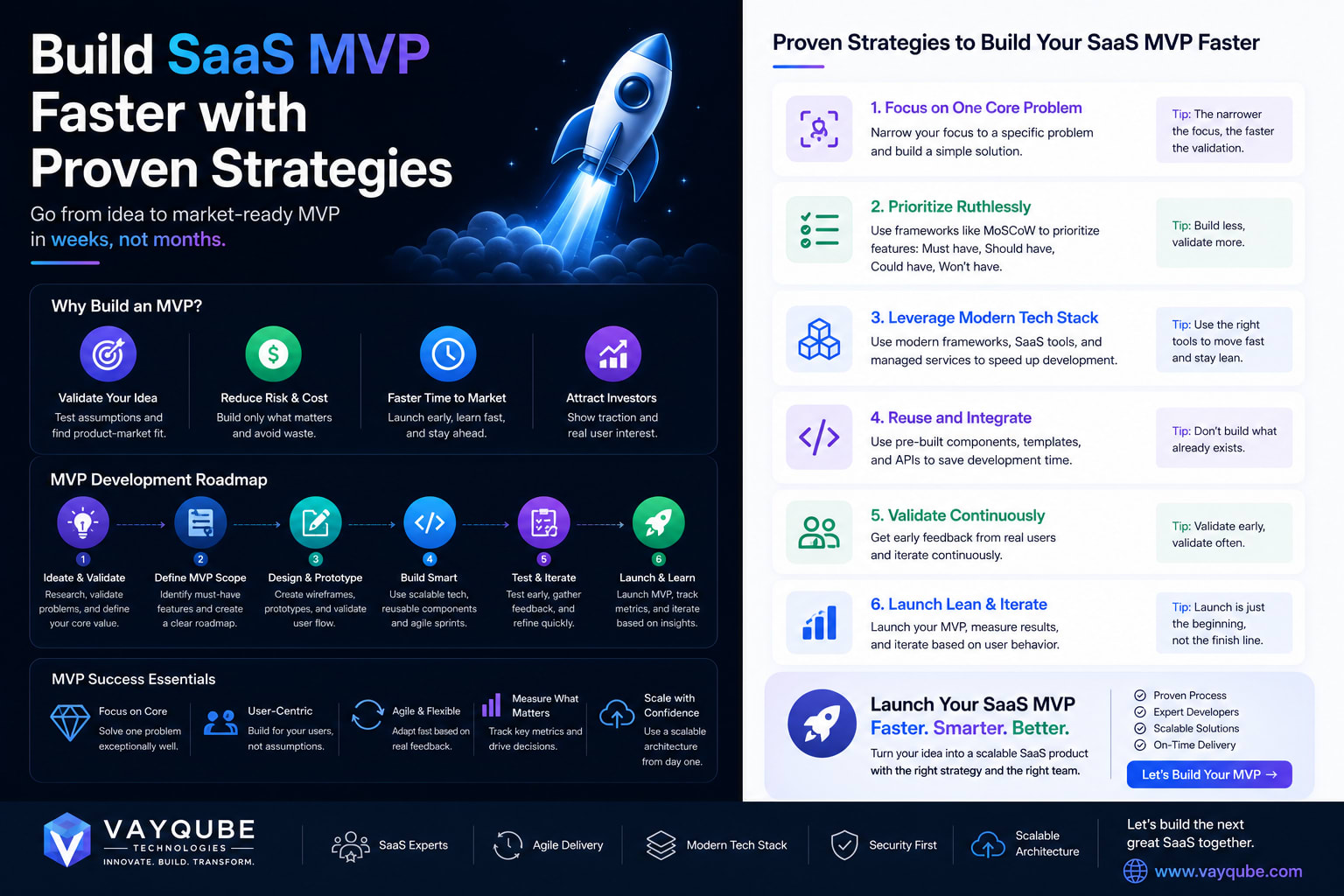
Building a SaaS MVP requires careful planning and execution to ensure a successful launch. By following proven strategies and best practices, you can develop a minimum viable product that meets your customers' needs and sets your business up for success
Vayqube Team
Author
Introduction to SaaS MVP Development
The SaaS industry is highly competitive, with new products emerging every day. To stay ahead, companies need to develop and launch their Minimum Viable Products (MVPs) quickly. SaaS MVP development involves creating a basic version of the product with just enough features to satisfy early customers and gather feedback for future development.
The Importance of Speed
Rapid development is crucial in the SaaS industry because it allows companies to test their products in the market quickly, gather feedback, and make necessary adjustments before competitors do. A slower development process can result in a product that is no longer relevant or has been surpassed by similar products.
Some key considerations for SaaS MVP development include:
- Defining the minimum set of features required for the product to be viable
- Identifying the target audience and their needs
- Developing a scalable architecture to support future growth
- Implementing a feedback loop to gather insights from early customers
Overview of SaaS MVP Development
SaaS MVP development typically involves a cross-functional team, including product managers, designers, developers, and quality assurance engineers. The process begins with defining the product vision, identifying the target market, and outlining the minimum features required for the MVP.
The development process should be iterative, with continuous testing and refinement to ensure the product meets customer needs. This approach enables companies to launch their MVPs faster, reducing the time and resources required for development.
Key benefits of rapid SaaS MVP development include:
- Reduced time-to-market
- Lower development costs
- Increased customer engagement and feedback
- Improved product-market fit
By prioritizing speed and agility in SaaS MVP development, companies can gain a competitive edge and increase their chances of success in the highly competitive SaaS market.
Why It Matters
Early market entry is crucial for SaaS startups, as it allows them to establish a presence and gain traction before competitors enter the scene. By launching a minimum viable product (MVP) quickly, SaaS companies can reap several benefits, including:
- Faster time-to-market, enabling them to capitalize on emerging trends and customer needs
- Increased visibility, which can lead to more customers, partnerships, and revenue opportunities
- Improved competitiveness, as early movers can set the standard for the market and influence customer expectations
Benefits of Early Market Entry
The advantages of early market entry are numerous. Some of the key benefits include:
- First-mover advantage, which can lead to increased brand recognition and customer loyalty
- Ability to shape the market and establish industry standards
- More time to iterate and refine the product, based on customer feedback and market trends
Competitive Advantage through Rapid Iteration
Rapid iteration is essential for SaaS companies to stay ahead of the competition. By continuously gathering customer feedback and iterating on the product, SaaS companies can:
- Identify and address customer pain points, leading to increased satisfaction and retention
- Stay ahead of competitors, who may be slower to respond to changing market conditions
- Develop a culture of innovation, which can lead to new features, products, and revenue streams
The key to rapid iteration is to establish a feedback loop, where customer input is continuously collected and incorporated into the product development process. This can be achieved through various means, such as:
- Regular customer surveys and interviews
- Analysis of customer support tickets and feedback forums
- A/B testing and experimentation, to validate product hypotheses and identify areas for improvement
By prioritizing early market entry and rapid iteration, SaaS companies can establish a strong foundation for success and stay ahead of the competition in a rapidly evolving market.
Core Architecture
To build a SaaS MVP faster, it's essential to focus on a core architecture that supports scalability, flexibility, and maintainability. A well-designed architecture enables developers to work efficiently, reduces technical debt, and allows for easier integration of new features.
Modular Design Principles
A modular design approach is crucial for building a SaaS MVP. This involves breaking down the application into smaller, independent modules, each with its own specific functionality. Modular design principles offer several benefits, including:
- Improved scalability: Modules can be developed, tested, and deployed independently, reducing the complexity of the overall system.
- Enhanced maintainability: With a modular design, updates and bug fixes can be applied to individual modules without affecting the entire application.
- Increased flexibility: Modules can be easily reused or replaced, allowing for greater flexibility in responding to changing requirements.
Microservices and Containerization
Microservices and containerization are key technologies for implementing a modular design. Microservices involve breaking down the application into smaller, independent services, each responsible for a specific business capability. Containerization, using tools like Docker, enables developers to package these services into lightweight, portable containers that can be easily deployed and managed. The benefits of microservices and containerization include:
- Improved fault tolerance: If one service experiences issues, it won't bring down the entire application.
- Enhanced scalability: Services can be scaled independently to meet changing demand.
- Faster deployment: Containers enable rapid deployment and rollback of services, reducing the time and risk associated with traditional deployment approaches.
Business Benefits
The business benefits of building a SaaS MVP quickly are numerous. By reducing the time-to-market, companies can gain a competitive edge and capitalize on emerging trends. This, in turn, can lead to increased revenue and market share.
Reduced Time-to-Market
A faster time-to-market enables companies to respond quickly to changing customer needs and preferences. This agility allows businesses to stay ahead of the competition and establish themselves as industry leaders. Some key advantages of reduced time-to-market include:
- Faster feedback from customers, enabling data-driven decision making
- Increased opportunities for innovation and experimentation
- Improved ability to pivot when necessary, reducing the risk of investing in a failed product
Increased Agility and Adaptability
Building a SaaS MVP quickly also increases agility and adaptability. This allows companies to respond rapidly to changes in the market, customer needs, and technology advancements. Some benefits of increased agility and adaptability include:
- Improved ability to integrate new technologies and features
- Enhanced collaboration between teams, such as development, marketing, and sales
- Increased efficiency in responding to customer support requests and resolving issues
Improved Customer Satisfaction
By building a SaaS MVP quickly, companies can also improve customer satisfaction. This is achieved by providing customers with a functional product that meets their needs, while also continually gathering feedback and iterating to improve the product. Some key advantages of improved customer satisfaction include:
- Increased customer loyalty and retention
- Positive word-of-mouth and online reviews
- Improved customer engagement and participation in the product development process
Overall, building a SaaS MVP quickly can have a significant impact on a company's bottom line. By reducing time-to-market, increasing agility and adaptability, and improving customer satisfaction, businesses can establish themselves as industry leaders and drive long-term growth and success.
Scalability
To achieve scalability in a SaaS MVP, it's essential to implement strategies that allow your application to handle increased traffic and usage without compromising performance.
Horizontal Scaling Strategies
Horizontal scaling involves adding more resources, such as servers or instances, to your infrastructure to distribute the workload. This approach enables your application to handle increased traffic and usage without sacrificing performance. Key considerations for horizontal scaling include:
- Identifying bottlenecks in your application and addressing them proactively
- Implementing automated deployment scripts to streamline the addition of new resources
- Ensuring that your database is designed to scale horizontally, using techniques such as sharding or replication
Load Balancing and Autoscaling
Load balancing and autoscaling are critical components of a scalable SaaS MVP. Load balancing distributes incoming traffic across multiple resources, ensuring that no single resource is overwhelmed and becomes a bottleneck. Autoscaling enables your application to automatically add or remove resources in response to changes in traffic or usage. Best practices for load balancing and autoscaling include:
- Using a cloud provider's built-in load balancing and autoscaling features, such as Amazon ELB or Google Cloud Load Balancing
- Implementing monitoring and logging tools to track performance and identify areas for optimization
- Establishing clear thresholds and triggers for autoscaling, to ensure that resources are added or removed in a timely and efficient manner
Effective implementation of horizontal scaling, load balancing, and autoscaling requires careful planning and monitoring. By prioritizing these strategies, you can build a SaaS MVP that is highly scalable, performant, and capable of handling rapid growth and increased usage.
Some real-world examples of successful scalability implementations include:
- Using containerization tools like Docker to streamline deployment and management of resources
- Implementing a microservices architecture to enable more efficient scaling and maintenance of individual components
- Leveraging cloud-based services, such as AWS Lambda or Google Cloud Functions, to provide serverless computing and reduce infrastructure management overhead
By applying these strategies and techniques, you can build a highly scalable SaaS MVP that is well-positioned for success in the market.
Implementation Challenges
When building a SaaS MVP, several implementation challenges can arise, hindering the development process and ultimately affecting the product's quality and timely release. Two key challenges that SaaS developers often face are technical debt management and team collaboration and communication.
Technical Debt Management
Technical debt refers to the costs associated with implementing quick fixes or workarounds that need to be revisited later. Managing technical debt is crucial to prevent it from accumulating and becoming a significant obstacle to the project's progress. Effective technical debt management involves:
- Prioritizing debt repayment based on business value and risk
- Implementing a debt tracking system to monitor and analyze debt
- Allocating dedicated time for debt repayment in the development schedule
- Encouraging a culture of technical excellence and accountability among team members
Team Collaboration and Communication
Team collaboration and communication are essential for successful SaaS MVP development. When team members work together seamlessly, they can share knowledge, expertise, and resources more efficiently, leading to better decision-making and faster problem-solving. Strategies for enhancing team collaboration and communication include:
- Establishing clear goals, roles, and expectations
- Implementing collaboration tools and platforms that facilitate open communication and feedback
- Fostering a culture of transparency, trust, and respect among team members
- Encouraging continuous learning and professional development to ensure the team stays up-to-date with the latest technologies and best practices
By addressing these implementation challenges, SaaS developers can minimize delays, reduce costs, and ensure the delivery of a high-quality MVP that meets the needs of their target audience.
Use Cases
Successful SaaS MVPs can be found in various industries, each with its unique set of challenges and lessons learned.
Real-World Examples
Some notable examples include:
- Project management tools like Trello, which started as a simple Kanban board and evolved into a full-fledged project management platform
- Customer support software like Zendesk, which began as a simple help desk solution and expanded to include a wide range of customer service features
- Marketing automation platforms like HubSpot, which started as a simple website grader and grew into a comprehensive marketing, sales, and customer service platform
These examples demonstrate how a simple, focused MVP can evolve into a successful SaaS product by iteratively adding features and functionality based on customer feedback and market demand.
Industry-Specific Applications
Different industries have unique requirements and challenges that a SaaS MVP must address. For instance:
- Healthcare SaaS solutions must comply with strict regulations like HIPAA, requiring robust security and data protection measures
- Financial SaaS solutions must ensure the highest levels of security and reliability, as they often handle sensitive financial data
- E-commerce SaaS solutions must be highly scalable and able to handle large volumes of traffic and transactions
By understanding these industry-specific requirements, SaaS developers can create MVPs that meet the unique needs of their target market, increasing the chances of success.
Lessons Learned
Analyzing successful SaaS MVPs reveals several key lessons:
- Focus on solving a specific, well-defined problem for a target audience
- Keep the initial feature set simple and limited to the most essential functionality
- Iterate rapidly based on customer feedback and market demand
- Prioritize scalability, security, and reliability from the outset
- Be prepared to pivot or adjust the product strategy as needed based on market feedback and conditions
By applying these lessons, SaaS developers can increase the chances of creating a successful MVP that meets the needs of their target market and sets the stage for long-term growth and success.
Best Practices
To build a SaaS MVP faster, it's essential to focus on prioritization and feature management. This involves identifying the most critical features that will deliver the most value to your customers and deprioritizing non-essential features. By doing so, you can streamline your development process, reduce costs, and get to market faster.
Prioritization and Feature Management
Effective prioritization involves considering factors such as customer needs, market trends, and technical feasibility. You can use frameworks like MoSCoW or Kano to categorize features into must-haves, should-haves, could-haves, and won't-haves. This helps ensure that your MVP includes the most important features that will drive customer adoption and revenue.
Some key considerations for prioritization and feature management include:
- Focusing on a minimum lovable product (MLP) that delivers a delightful user experience
- Using data-driven decision making to inform feature prioritization
- Continuously gathering customer feedback to refine your feature roadmap
- Embracing a culture of experimentation and learning from failure
Continuous Testing and Feedback Loops
Continuous testing and feedback loops are critical to building a successful SaaS MVP. This involves testing your product with real customers, gathering feedback, and iterating on your product roadmap. By doing so, you can identify and address potential issues early on, reduce the risk of product failure, and ensure that your product meets the needs of your target market.
Some key strategies for continuous testing and feedback loops include:
- Using agile development methodologies to facilitate rapid iteration and feedback
- Implementing automated testing and continuous integration/continuous deployment (CI/CD) pipelines
- Conducting regular customer interviews, surveys, and usability testing to gather feedback
- Fostering a culture of transparency and collaboration between development, design, and customer-facing teams
FAQ
Common questions and misconceptions about SaaS MVP development can hinder the progress of even the most experienced teams. Here are some key points to consider:
- What is the ideal timeframe for developing a SaaS MVP? The answer varies depending on the complexity of the product, the size of the team, and the technology stack. However, with a focused approach, it's possible to develop a SaaS MVP in 3-6 months.
- How do I balance the need for speed with the need for quality? Prioritize the most critical features, and use agile development methodologies to iterate and improve the product over time.
- What are the key metrics to track when developing a SaaS MVP? Focus on metrics such as customer acquisition costs, customer lifetime value, and retention rates to gauge the product's viability.
Additional Resources
For further learning, consider the following resources:
- The Lean Startup by Eric Ries: a comprehensive guide to building and launching successful startups
- SaaS Metrics by Pacific Crest Securities: a detailed report on key SaaS metrics and benchmarks
- The SaaS Growth Handbook by SaaS Capital: a collection of strategies and tactics for driving growth in SaaS businesses
When evaluating these resources, keep in mind that every SaaS business is unique, and what works for one company may not work for another. It's essential to stay focused on your specific goals and priorities, and to adapt strategies and tactics accordingly.
Common Misconceptions
Some common misconceptions about SaaS MVP development include:
- Assuming that an MVP must have a full set of features to be successful
- Believing that speed and quality are mutually exclusive
- Overemphasizing the importance of technology over customer needs and market validation
By avoiding these misconceptions and staying focused on the key principles of SaaS MVP development, you can build a successful product that meets the needs of your target market and drives business growth.
Next Steps
To continue on your SaaS MVP development journey, consider the following next steps:
- Validate your product idea with potential customers and industry experts
- Develop a detailed product roadmap and prioritization framework
- Assemble a skilled and experienced development team to bring your vision to life
Conclusion
Building a successful SaaS MVP requires careful planning, strategic decision-making, and a deep understanding of the core architecture and business benefits.
In this article, we have explored the key elements of building a SaaS MVP, including the importance of scalability, implementation challenges, and best practices.
Some of the key takeaways include:
- Focus on building a minimum viable product that meets the needs of your target audience
- Prioritize scalability and flexibility in your core architecture
- Develop a deep understanding of your business benefits and value proposition
- Be prepared to iterate and adapt to changing market conditions and user feedback
As you embark on building your SaaS MVP, keep in mind that it's a journey, not a destination.
Final Thoughts
Building a successful SaaS MVP is a complex and challenging process, but with the right strategies and mindset, it can be a highly rewarding experience.
Some final thoughts to consider:
- Stay focused on your target audience and their needs
- Be willing to take calculated risks and experiment with new approaches
- Prioritize continuous learning and improvement
- Build a strong team with a diverse range of skills and expertise
By following these principles and staying committed to your vision, you can build a successful SaaS MVP that meets the needs of your target audience and drives long-term growth and success.
Real-World Examples
Many successful SaaS companies have built their products using these strategies, including:
- HubSpot, which started as a simple website grader tool and evolved into a full-fledged marketing, sales, and customer service platform
- Zoom, which began as a simple video conferencing tool and grew into a comprehensive communication platform
- Atlassian, which started as a small project management tool and expanded into a suite of products for software development, collaboration, and issue tracking
These companies demonstrate the power of building a successful SaaS MVP and iterating and adapting to changing market conditions and user feedback.
By studying their examples and applying the strategies outlined in this article, you can build a successful SaaS MVP that drives long-term growth and success.
Production Considerations
As you build and launch your SaaS MVP, it's essential to consider production readiness and the ability to scale and adapt to changing market conditions.
Some key production considerations include:
- Ensuring high availability and uptime
- Implementing robust security and compliance measures
- Developing a comprehensive monitoring and analytics strategy
- Building a strong customer support and success team
By prioritizing these production considerations, you can ensure that your SaaS MVP is well-positioned for long-term success and can adapt to changing market conditions and user feedback.
Next Steps
Now that you have a deeper understanding of the strategies and principles for building a successful SaaS MVP, it's time to take action.
Some next steps to consider:
- Define your target audience and value proposition
- Develop a comprehensive business plan and revenue model
- Build a strong team with a diverse range of skills and expertise
- Start building your SaaS MVP and iterating and adapting to changing market conditions and user feedback
By following these next steps and staying committed to your vision, you can build a successful SaaS MVP that drives long-term growth and success.
Related Vayqube Resources
- Cloud Cost Optimization Strategies For Saas Startups
- Startups Building Ai Products Without Large Teams
- Case Study Saas Platform Scaling
- Best Software Development Company In Usa
- Best Software Development Company In New York
- Best Saas Development Company In Usa
Next Step
If your systems are struggling with scalability, automation, architecture complexity, or operational efficiency, it's time to modernize your infrastructure and workflows.
👉 Talk to a Vayqube solution architect and build systems designed for long-term production growth: