
Cloud Security Mistakes Startups Make
Startups often overlook critical cloud security measures, putting their businesses at risk. Learn about the most common cloud security mistakes and how to prevent them.
Vayqube Team
FinTech compliance and secure systems engineering
Introduction
Cloud security is a critical aspect of any organization's infrastructure, and startups are no exception. As more businesses move their operations to the cloud, the risk of security breaches and data losses increases. Startups, in particular, are vulnerable to cloud security mistakes due to limited resources, lack of expertise, and rapid scaling.
Overview of Cloud Security
Cloud security refers to the practices, technologies, and controls designed to protect cloud computing environments, data, and applications from unauthorized access, use, disclosure, disruption, modification, or destruction. Effective cloud security measures ensure the confidentiality, integrity, and availability of cloud-based assets. Startups must prioritize cloud security to prevent financial losses, reputational damage, and legal liabilities.
Common Mistakes Startups Make
Startups often make critical cloud security mistakes, including:
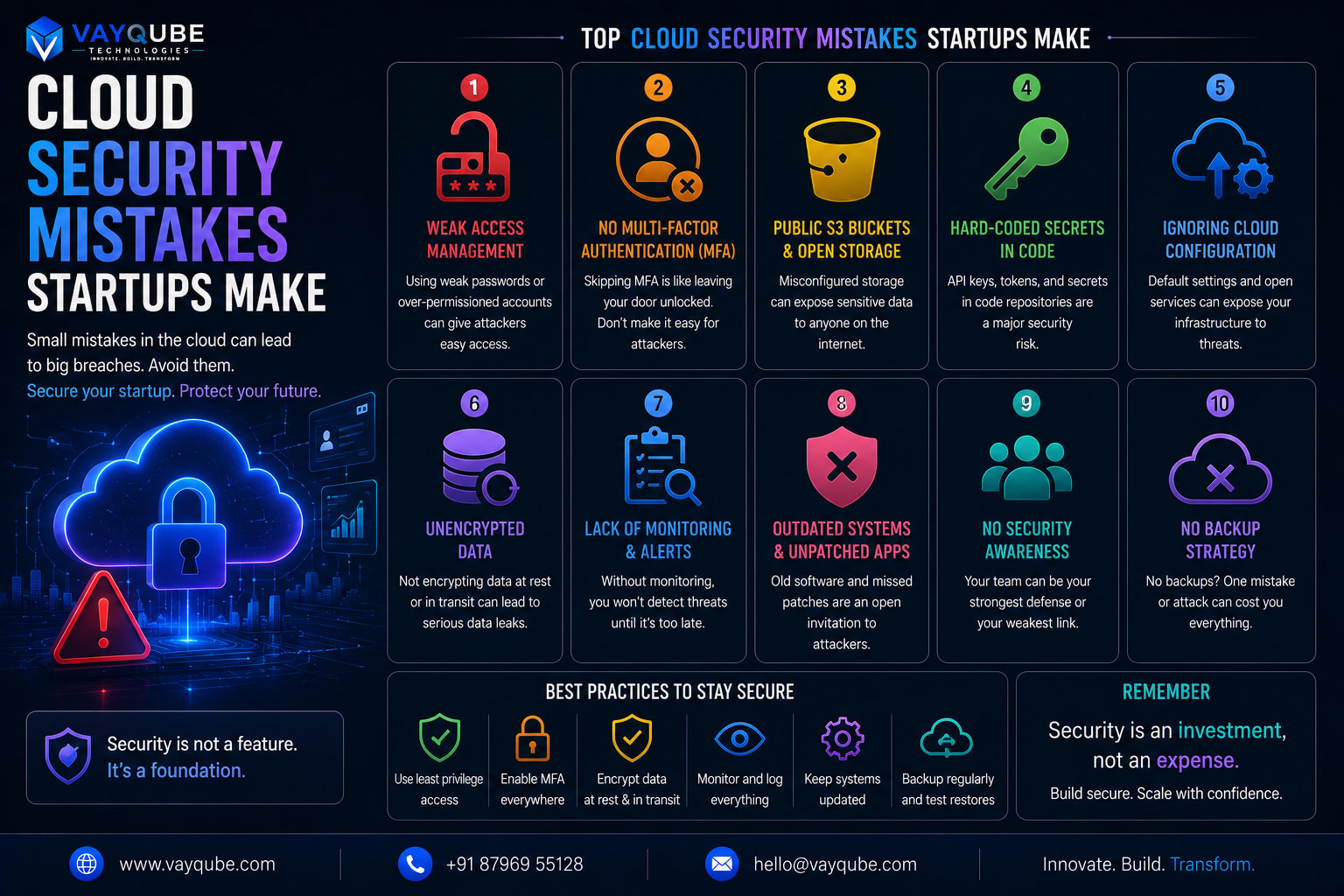
- Inadequate access controls, allowing unauthorized users to access sensitive data and systems
- Insufficient data encryption, leaving sensitive information vulnerable to interception and exploitation
- Poorly configured cloud storage, leading to data breaches and unauthorized access
- Inadequate monitoring and logging, making it difficult to detect and respond to security incidents
- Failure to implement secure development practices, introducing vulnerabilities into cloud-based applications
These mistakes can have devastating consequences, including data breaches, financial losses, and reputational damage. Startups must be aware of these common mistakes and take proactive steps to mitigate them. By prioritizing cloud security and implementing effective measures, startups can protect their assets, ensure business continuity, and maintain customer trust.
Key Considerations
When evaluating cloud security, startups should consider the following key factors:
- Data sovereignty and compliance with relevant regulations
- Cloud service provider security controls and certifications
- Network security and segmentation
- Identity and access management
- Incident response and disaster recovery planning
By understanding these factors and avoiding common cloud security mistakes, startups can ensure a secure and reliable cloud infrastructure that supports their business growth and success.
Why It Matters
Poor cloud security can have severe consequences for startups, affecting not only their reputation but also their bottom line. Data breaches, for instance, can result in significant financial losses, with the average cost of a breach ranging from hundreds of thousands to millions of dollars. Moreover, the loss of sensitive customer data can lead to a loss of trust, ultimately driving away business.
Consequences of Poor Cloud Security
Some of the key consequences of poor cloud security include:
- Financial losses due to data breaches and downtime
- Damage to brand reputation and loss of customer trust
- Regulatory penalties for non-compliance with data protection laws
- Intellectual property theft, which can undermine a startup's competitive advantage
- Increased risk of cyber attacks, which can spread to other parts of the business
Importance of Security in Cloud Infrastructure
Security is a critical component of cloud infrastructure, as it protects sensitive data and prevents unauthorized access. A robust cloud security strategy can help startups avoid the consequences of poor security, ensuring the confidentiality, integrity, and availability of their data. Furthermore, a secure cloud infrastructure can provide a competitive advantage, as customers increasingly expect businesses to prioritize data protection.
Startups that prioritize cloud security can also benefit from improved compliance with regulatory requirements, reduced risk of cyber attacks, and enhanced incident response capabilities. By integrating security into their cloud infrastructure from the outset, startups can avoid the costly and time-consuming process of retrofitting security measures later on. This proactive approach to cloud security can also facilitate scalability, as startups can quickly adapt to changing business needs without compromising on security.
Core Architecture
The core architecture of cloud security is crucial for startups to ensure the protection of their data and applications. A well-designed architecture can help prevent security breaches and minimize the risk of data loss.
Key Components
The key components of cloud security architecture include:
- Identity and Access Management (IAM) systems
- Network security controls, such as firewalls and virtual private networks (VPNs)
- Data encryption and key management systems
- Monitoring and logging tools, such as security information and event management (SIEM) systems
- Compliance and governance frameworks
Design and Implementation Best Practices
When designing and implementing a cloud security architecture, startups should follow best practices, including:
- Implementing a zero-trust security model, where all users and devices are authenticated and authorized before being granted access to cloud resources
- Using a defense-in-depth approach, where multiple layers of security controls are implemented to protect against different types of threats
- Conducting regular security assessments and risk analyses to identify vulnerabilities and prioritize remediation efforts
- Ensuring that all cloud security controls are automated and integrated with other security tools and systems
- Providing ongoing security training and awareness programs for employees and contractors
Startups should also consider the shared responsibility model, where the cloud provider is responsible for securing the underlying infrastructure, and the customer is responsible for securing their data and applications. By understanding this model, startups can ensure that they are meeting their security responsibilities and taking advantage of the security controls and features provided by their cloud provider.
In addition, startups should prioritize scalability and flexibility when designing their cloud security architecture. This can be achieved by using cloud-native security controls and services, such as cloud security gateways and cloud access security brokers (CASBs). These services can provide startups with the agility and flexibility they need to quickly respond to changing security threats and business requirements.
Business Benefits
Secure cloud infrastructure is crucial for startups, as it provides numerous benefits that can drive business growth. Two key advantages of prioritizing cloud security are cost savings and enhanced customer trust.
Cost Savings
Implementing secure cloud infrastructure can help startups reduce costs in several ways. For instance, a secure infrastructure can minimize the risk of data breaches, which can be costly to remediate. According to recent studies, the average cost of a data breach is substantial, and can be a significant burden for startups with limited resources. By investing in cloud security, startups can avoid these costs and allocate their resources more efficiently.
Some of the key cost savings associated with secure cloud infrastructure include:
- Reduced risk of data breaches and associated remediation costs
- Lower insurance premiums for cybersecurity insurance
- Minimized downtime and lost productivity due to security incidents
- Reduced need for costly security personnel and equipment
Enhanced Customer Trust
In addition to cost savings, secure cloud infrastructure can also enhance customer trust and loyalty. When customers feel that their data is secure, they are more likely to trust a startup with their business. This can lead to increased customer loyalty, positive word-of-mouth, and ultimately, revenue growth. Startups that prioritize cloud security can differentiate themselves from competitors and establish a reputation as a trusted and reliable partner.
Some of the key ways that secure cloud infrastructure can enhance customer trust include:
- Transparent security practices and protocols
- Regular security audits and compliance certifications
- Proactive communication about security incidents and remediation efforts
- Investment in security education and awareness training for employees
By prioritizing cloud security, startups can reap these business benefits and establish a strong foundation for growth and success.
Scalability
As startups grow, their infrastructure expands, and so does the attack surface. Scaling cloud security is crucial to protect sensitive data and maintain compliance.
Scaling Cloud Security
To scale cloud security with growing infrastructure, startups should adopt a proactive approach. This includes:
- Implementing automated security tools to monitor and respond to threats in real-time
- Conducting regular security audits to identify vulnerabilities and address them before they can be exploited
- Ensuring that security protocols are integrated into the development process, from design to deployment
Strategies for Rapid Growth
During rapid growth, startups face unique security challenges. Some strategies for maintaining security include:
- Using cloud-native security services that can scale with the infrastructure
- Implementing a zero-trust security model to minimize the attack surface
- Providing ongoing security training to employees to prevent human error and ensure compliance with security protocols
Real-World Considerations
In real-world scenarios, startups often face trade-offs between security and speed. However, compromising on security can have devastating consequences. Startups should prioritize security from the outset and build it into their infrastructure, rather than trying to bolt it on later.
Implementation Considerations
When implementing cloud security measures, startups should consider the following:
- The need for scalability and flexibility in security solutions
- The importance of integrating security into the development process
- The requirement for ongoing monitoring and incident response to ensure the security of the infrastructure and data
Production Readiness
To ensure production readiness, startups should:
- Conduct thorough testing of security measures
- Implement continuous monitoring and incident response
- Ensure that security protocols are well-documented and easily accessible to all teams
- Continuously review and update security measures to stay ahead of emerging threats
Implementation Challenges
Implementing cloud security measures can be a daunting task for startups, and several obstacles can hinder the process. Some common challenges include:
- Limited resources: Startups often have limited budgets and personnel, making it difficult to allocate sufficient resources for cloud security.
- Lack of expertise: Cloud security requires specialized knowledge and skills, which can be a challenge for startups to find and retain.
- Complexity of cloud infrastructure: Cloud infrastructure can be complex and difficult to manage, making it hard to implement and maintain effective security measures.
Overcoming Implementation Challenges
To overcome these challenges, startups can consider the following solutions:
- Partner with cloud security experts: Startups can partner with cloud security experts or managed security service providers to gain access to specialized knowledge and skills.
- Leverage cloud-native security tools: Cloud-native security tools can provide startups with scalable and cost-effective security solutions that are easy to implement and manage.
- Implement a phased approach: Startups can implement cloud security measures in phases, starting with the most critical assets and gradually expanding to other areas.
Best Practices for Implementation
When implementing cloud security measures, startups should follow best practices such as:
- Conducting regular security assessments and risk analyses to identify vulnerabilities and prioritize remediation efforts.
- Implementing a robust identity and access management (IAM) system to control access to cloud resources.
- Using encryption and key management to protect sensitive data in transit and at rest.
- Monitoring cloud security logs and analytics to detect and respond to security incidents in a timely manner.
Real-World Examples
For example, a startup can use a cloud security platform to automate security monitoring and incident response, freeing up resources to focus on other areas of the business. Another example is using a cloud-based IAM system to manage access to cloud resources, reducing the risk of unauthorized access and data breaches.
Production Considerations
When implementing cloud security measures in production, startups should consider factors such as:
- Scalability: Cloud security measures should be able to scale with the startup's growing infrastructure and user base.
- Performance: Cloud security measures should not impact the performance of cloud resources and applications.
- Compliance: Cloud security measures should comply with relevant regulations and standards, such as HIPAA or PCI-DSS.
Use Cases
Effective cloud security is crucial for startups, and there are many real-world examples of companies that have implemented robust security measures.
Successful Implementations
Some notable examples include:
- Dropbox, which uses a multi-layered approach to security, including encryption, access controls, and monitoring
- Airbnb, which has implemented a robust identity and access management system to protect user data
- Stripe, which uses a combination of encryption, tokenization, and access controls to secure sensitive payment information
These companies have learned valuable lessons about the importance of cloud security, and have implemented measures to protect their users' data.
Lessons Learned
Some key takeaways from these successful implementations include:
- The importance of encryption and access controls in protecting sensitive data
- The need for robust monitoring and incident response plans to quickly respond to security incidents
- The value of implementing a culture of security within the organization, with regular training and awareness programs for employees
By studying these examples, startups can gain valuable insights into the importance of cloud security and how to implement effective measures to protect their users' data.
Real-World Examples
For example, a startup that provides a cloud-based project management tool can learn from the example of Dropbox, which has implemented a robust security framework to protect user data. By implementing similar measures, such as encryption and access controls, the startup can protect its users' data and build trust with its customers.
Production Considerations
When implementing cloud security measures, startups should consider the production implications of their choices. This includes considering the scalability of their security measures, as well as the potential impact on user experience and performance. By carefully considering these factors, startups can implement effective cloud security measures that protect their users' data without compromising the performance of their application.
Implementation Strategy
To implement effective cloud security measures, startups should develop a comprehensive strategy that includes:
- Conducting regular security assessments and risk analyses
- Implementing robust security controls, such as encryption and access controls
- Developing incident response plans and conducting regular training and awareness programs for employees
- Continuously monitoring and evaluating the effectiveness of their security measures.
By following this strategy, startups can protect their users' data and build trust with their customers, while also ensuring the scalability and performance of their application.
Best Practices
To ensure the security of their cloud infrastructure, startups should adopt proven strategies that prioritize protection and compliance. Implementing these best practices can significantly reduce the risk of security breaches and data losses.
Proven Security Strategies
Some key strategies for securing cloud infrastructure include:
- Implementing a robust identity and access management (IAM) system to control user access and permissions
- Conducting regular security audits and risk assessments to identify vulnerabilities
- Utilizing encryption technologies to protect sensitive data both in transit and at rest
- Deploying advanced threat detection and response tools to identify and mitigate potential security threats
Recommendations for Startups
Startups can follow these recommendations to enhance their cloud security posture:
- Adopt a cloud security framework that aligns with industry standards and best practices
- Develop a comprehensive incident response plan to ensure timely and effective response to security incidents
- Provide ongoing security awareness training to employees to prevent social engineering attacks and other types of security breaches
- Engage with cloud security experts and managed security service providers to leverage their expertise and stay up-to-date with the latest security threats and trends
Implementation Considerations
When implementing these best practices, startups should consider their unique business needs and cloud infrastructure requirements. This includes:
- Assessing the security controls and features provided by their cloud service providers
- Evaluating the trade-offs between security, compliance, and operational efficiency
- Developing a phased implementation plan to ensure minimal disruption to business operations
- Continuously monitoring and evaluating the effectiveness of their cloud security controls and making adjustments as needed
Real-World Examples
Many startups have successfully implemented these best practices to secure their cloud infrastructure. For example, a fintech startup may implement a robust IAM system to control access to sensitive financial data, while a healthcare startup may utilize encryption technologies to protect patient data and comply with regulatory requirements. By following these proven strategies and recommendations, startups can ensure the security and integrity of their cloud infrastructure and protect their business from potential security threats.
FAQ
Cloud security is a top concern for startups, and many have questions about how to protect their data and applications. Here are some frequently asked questions about cloud security for startups, along with guidance and answers to common concerns.
Common Cloud Security Concerns
Some of the most common concerns startups have about cloud security include:
- Data breaches and unauthorized access
- Compliance with regulatory requirements
- Protecting sensitive data and intellectual property
- Ensuring business continuity and disaster recovery
- Managing user identities and access controls
Addressing Cloud Security Concerns
To address these concerns, startups should prioritize the following:
- Implementing robust access controls and identity management
- Encrypting sensitive data both in transit and at rest
- Conducting regular security audits and risk assessments
- Developing incident response and disaster recovery plans
- Staying up-to-date with the latest cloud security best practices and standards
Cloud Security and Compliance
Startups often worry about compliance with regulatory requirements, such as HIPAA, PCI-DSS, and GDPR. To ensure compliance, startups should:
- Familiarize themselves with relevant regulations and standards
- Implement controls and procedures to meet compliance requirements
- Regularly review and update their compliance posture
- Consider working with a cloud security expert or compliance specialist
Cloud Security for Small Teams
Small teams and startups often have limited resources and budget for cloud security. To overcome these challenges, startups can:
- Leverage cloud-native security services and tools
- Automate security tasks and workflows wherever possible
- Prioritize security awareness and training for all team members
- Consider outsourcing cloud security to a managed security service provider
Real-World Cloud Security Examples
Real-world examples of cloud security in action include:
- Using cloud-based identity and access management (IAM) tools to control user access
- Implementing cloud-native security information and event management (SIEM) systems to detect and respond to threats
- Leveraging cloud-based data loss prevention (DLP) tools to protect sensitive data
- Conducting regular cloud security audits and risk assessments to identify vulnerabilities and improve security posture
Conclusion
In summary, startups must prioritize cloud security to avoid common mistakes that can have devastating consequences. Key takeaways include:
- Implementing a robust security framework from the outset
- Conducting regular security audits and risk assessments
- Ensuring compliance with relevant regulations and standards
- Providing ongoing training and education for employees
- Continuously monitoring and evaluating cloud security posture
The importance of cloud security for startups cannot be overstated. A single security breach can result in significant financial losses, damage to reputation, and loss of customer trust. Furthermore, the consequences of a security breach can be long-lasting, making it essential for startups to prioritize cloud security from the beginning.
Final Thoughts
Startups must recognize that cloud security is an ongoing process that requires continuous attention and effort. By prioritizing cloud security and avoiding common mistakes, startups can minimize the risk of security breaches and ensure the integrity of their data and systems. This, in turn, can help to build trust with customers, protect reputation, and drive long-term success.
Some additional considerations for startups include:
- Developing a cloud security strategy that aligns with business goals and objectives
- Establishing clear policies and procedures for cloud security
- Ensuring that all employees understand their roles and responsibilities in maintaining cloud security
- Staying up-to-date with the latest cloud security threats and trends
- Continuously evaluating and improving cloud security posture to stay ahead of potential threats
By taking a proactive and comprehensive approach to cloud security, startups can help to protect their businesses, customers, and reputation, and set themselves up for long-term success.
Related Vayqube Resources
- How To Build Fintech Application Payments Security Scaling
- Cloud Cost Optimization Strategies For Saas Startups
- Why Most Ai Projects Fail Before Production
- Real Time Application Development
- Case Study Saas Platform Scaling
- Case Study Fintech Lending Platform
Next Step
If your systems are struggling with scalability, automation, architecture complexity, or operational efficiency, it's time to modernize your infrastructure and workflows.
👉 Talk to a Vayqube solution architect and build systems designed for long-term production growth: