
Next.js vs React for SaaS
Next.js and React are popular frameworks for building SaaS platforms, but they have distinct differences. Choosing the right framework can significantly impact the scalability and success of your SaaS business.
Vayqube Team
Software architecture and product engineering
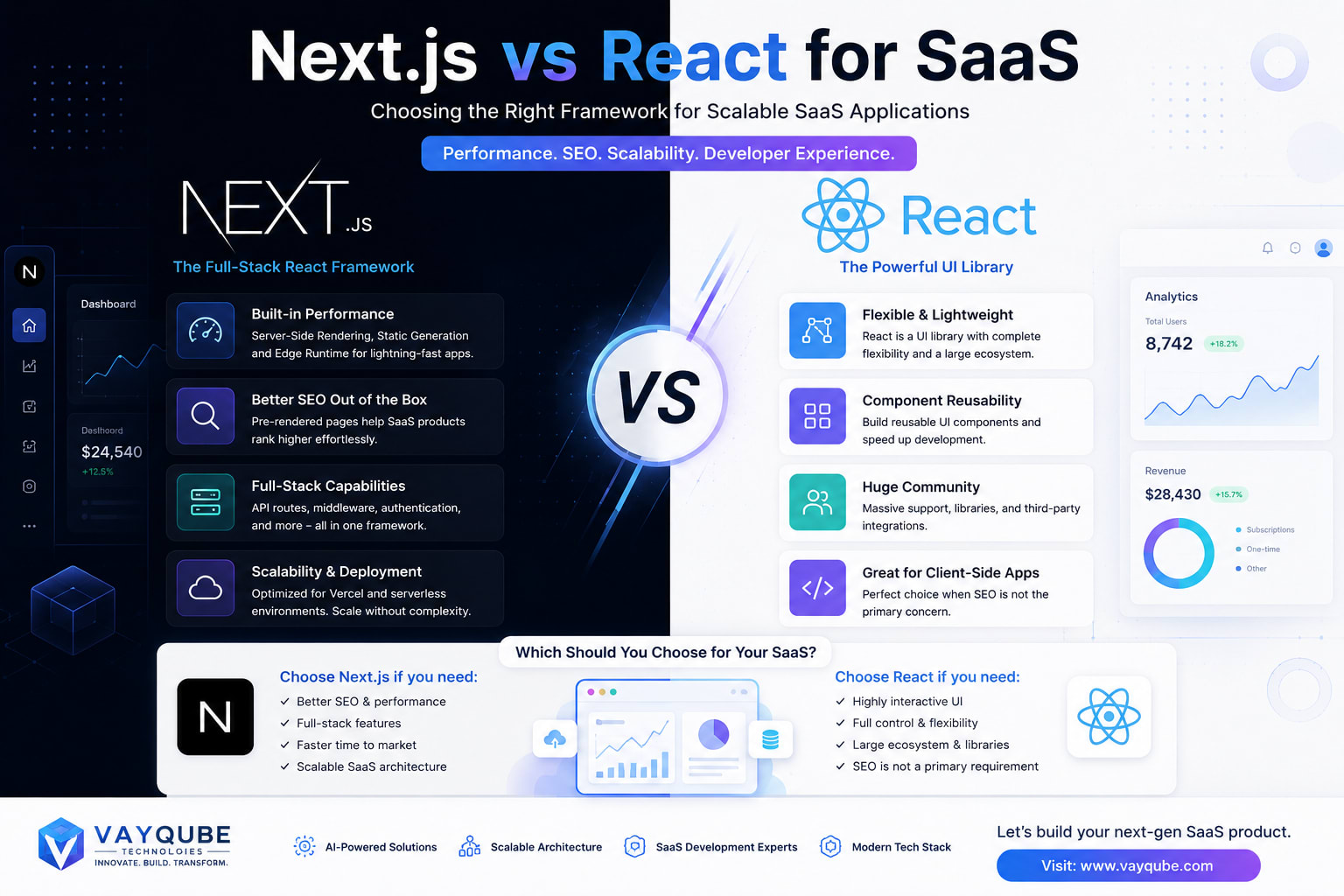
Introduction to Framework Selection
When building a SaaS application, choosing the right frontend framework is crucial for success. Two popular options are Next.js and React. While both are developed by Facebook and share some similarities, they have distinct differences that can significantly impact the development process and overall performance of a SaaS application.
Overview of Next.js and React
Next.js is a React-based framework that enables developers to build server-side rendered, static, and performance-optimized applications. It provides a set of features out of the box, such as internationalization, routing, and image optimization, making it an attractive choice for complex applications. React, on the other hand, is a JavaScript library for building user interfaces. It's a more lightweight option that requires additional setup and configuration to achieve the same level of functionality as Next.js.
Importance of Choosing the Right Framework
Selecting the right framework for a SaaS application can have a significant impact on the business. A well-chosen framework can improve development efficiency, reduce maintenance costs, and enhance the overall user experience. Conversely, a poorly chosen framework can lead to increased development time, higher costs, and a subpar user experience. Some key considerations when evaluating Next.js and React for a SaaS application include:
- Performance requirements
- Development team expertise
- Scalability needs
- Integration with existing infrastructure
Evaluating Frameworks for SaaS Applications
When evaluating Next.js and React for a SaaS application, it's essential to consider the specific needs of the business. Some questions to ask include:
- What are the performance requirements of the application?
- What is the level of expertise of the development team?
- How will the application need to scale to meet growing demand?
- What existing infrastructure will the application need to integrate with?
By carefully considering these factors and evaluating the strengths and weaknesses of each framework, businesses can make an informed decision about which framework is best suited for their SaaS application. In the next section, we will delve deeper into the key differences between Next.js and React and explore how these differences impact the development process and overall performance of a SaaS application.
Why It Matters
The choice between Next.js and React for a SaaS application has significant implications for the success of the project.
User Experience Impact
The user experience is a critical factor in determining the adoption and retention rates of a SaaS application. Next.js and React differ in their approach to rendering and updating the user interface. Next.js provides server-side rendering and static site generation capabilities, which can improve the initial load time and SEO of the application. On the other hand, React relies on client-side rendering, which can lead to faster subsequent loads but may have a slower initial load time.
Some key considerations for user experience include:
- Page load times
- Responsiveness and interactivity
- Accessibility features
- Mobile optimization
Development Time and Costs
The development time and costs associated with Next.js and React can vary significantly. React is a more mature framework with a larger community and a wider range of third-party libraries and tools. This can make it easier to find developers and reduce the time and cost of development. Next.js, on the other hand, is a newer framework that is specifically designed for building server-side rendered and statically generated applications. While it can provide significant performance and SEO benefits, it may require more expertise and development time to implement correctly.
Key factors to consider when evaluating development time and costs include:
- Learning curve for developers
- Availability of third-party libraries and tools
- Complexity of the application architecture
- Need for custom optimizations and fixes
Scalability and Performance
Scalability and performance are critical considerations for SaaS applications, which often need to handle a large number of users and requests. Next.js provides built-in support for server-side rendering and static site generation, which can improve the performance and scalability of the application. React, on the other hand, relies on client-side rendering, which can lead to slower performance and scalability issues if not implemented correctly.
Some key considerations for scalability and performance include:
- Server-side rendering and static site generation
- Caching and content delivery networks (CDNs)
- Load balancing and autoscaling
- Database optimization and query performance
By carefully evaluating these factors, developers can make an informed decision about whether to use Next.js or React for their SaaS application, and ensure that their choice aligns with their business goals and technical requirements.
Core Architecture
The core architecture of Next.js and React differs significantly, despite both being built on top of React.
Next.js Architecture
Next.js is a React-based framework that enables server-side rendering, static site generation, and performance optimization. Its architecture is designed to handle complex, data-driven applications with ease. Key components of the Next.js architecture include:
- Pages: Representing individual routes in the application
- Components: Reusable pieces of code that make up the pages
- getStaticProps and getServerSideProps: Methods for pre-rendering pages at build time or request time
- Internationalized Routing: Built-in support for internationalized routing
React Architecture
React, on the other hand, is a JavaScript library for building user interfaces. Its architecture is centered around components, which are the building blocks of any React application. The key components of the React architecture include:
- Components: Reusable pieces of code that make up the application
- JSX: A syntax extension for JavaScript that allows HTML-like code in JavaScript files
- State and Props: Mechanisms for managing data and communication between components
- Virtual DOM: A lightweight in-memory representation of the real DOM
Key Differences and Similarities
The key differences between Next.js and React lie in their approach to rendering and data fetching. Next.js provides built-in support for server-side rendering and static site generation, whereas React relies on third-party libraries for these features. However, both frameworks share a common foundation in React and its component-based architecture. Some key similarities include:
- Component-driven architecture
- Use of JSX for templating
- Support for state and props management
- Large, active communities and ecosystems
In terms of real-world applications, Next.js is often used for complex, data-driven SaaS applications that require server-side rendering and performance optimization. React, on the other hand, is commonly used for building user interfaces and single-page applications. When choosing between Next.js and React, it's essential to consider the specific requirements of your application and the trade-offs between the two frameworks.
Some popular use cases for Next.js include:
- E-commerce platforms with complex product catalogs and search functionality
- News websites with high traffic and dynamic content
- SaaS applications with multiple tiers and subscription-based models
In contrast, React is often used for:
- Single-page applications with simple, static content
- Progressive web apps with offline support and push notifications
- Enterprise applications with complex workflows and integrations
Ultimately, the choice between Next.js and React depends on the specific needs of your application and your team's expertise and experience. By understanding the core architecture and key differences between these two frameworks, you can make an informed decision and build a scalable, high-performance SaaS application.
Business Benefits
The choice between Next.js and React for SaaS applications has significant implications for business outcomes.
User Engagement
Improved user engagement is a key benefit of using Next.js or React for SaaS applications. By providing a seamless and interactive user experience, businesses can increase customer satisfaction and loyalty. Some key factors that contribute to improved user engagement include:
- Fast page loads and responsive design
- Interactive and dynamic user interfaces
- Personalized content and recommendations
- Real-time updates and notifications
Conversion Rates
Increased conversion rates are another important business benefit of using Next.js or React. By optimizing the user experience and streamlining the conversion process, businesses can increase the number of users who complete desired actions. Some strategies for increasing conversion rates include:
- Simplifying and streamlining the user interface
- Providing clear and prominent calls-to-action
- Offering personalized content and recommendations
- Using A/B testing and analytics to optimize the user experience
Developer Productivity
Enhanced developer productivity is a significant benefit of using Next.js or React for SaaS applications. By providing a robust and flexible framework for building user interfaces, developers can work more efficiently and effectively. Some key factors that contribute to enhanced developer productivity include:
- Pre-built components and libraries
- Automated testing and debugging tools
- Streamlined deployment and integration processes
- Large and active developer communities
By considering these business benefits, SaaS companies can make informed decisions about whether to use Next.js or React for their applications. Ultimately, the choice between these two frameworks will depend on the specific needs and goals of the business.
Implementation Considerations
When implementing Next.js or React for SaaS applications, businesses should consider a range of factors, including:
- Development time and cost
- Scalability and performance
- Integration with existing systems and tools
- Maintenance and support requirements By carefully evaluating these factors, businesses can ensure a successful implementation and achieve the desired business benefits.
Real-World Examples
Many SaaS companies have successfully implemented Next.js or React to improve user engagement, increase conversion rates, and enhance developer productivity. For example, companies like Airbnb and Dropbox have used React to build fast and interactive user interfaces, while companies like GitHub and Netflix have used Next.js to optimize their web applications for search engines and improve user experience. By studying these examples and applying the lessons learned, businesses can create their own successful SaaS applications using Next.js or React.
Scalability
When it comes to building a SaaS application, scalability is a critical factor to consider. Both Next.js and React can be used to build scalable applications, but they differ in their approach.
Horizontal Scaling
Horizontal scaling involves adding more machines to the cluster to handle increased traffic. Next.js, with its built-in support for server-side rendering and static site generation, makes it easier to scale horizontally. By using a load balancer and a cluster of servers, Next.js applications can handle a large number of requests without a significant decrease in performance. In contrast, React applications require more manual configuration to achieve horizontal scaling.
Vertical Scaling
Vertical scaling, on the other hand, involves increasing the power of individual machines to handle more traffic. While both Next.js and React can be used for vertical scaling, Next.js provides more built-in features to support this approach. For example, Next.js supports internationalized routing and automatic code splitting, which can help reduce the load on individual servers.
Server-side Rendering and Static Site Generation
Server-side rendering and static site generation are two key features that contribute to the scalability of Next.js applications. Server-side rendering allows for faster page loads and improved SEO, while static site generation enables the pre-rendering of pages at build time, reducing the load on the server. React, while capable of being used for server-side rendering, requires more manual configuration and does not have built-in support for static site generation.
Some key benefits of using Next.js for scalability include:
- Improved page load times
- Increased traffic handling capacity
- Simplified configuration for horizontal and vertical scaling
- Built-in support for server-side rendering and static site generation
In real-world scenarios, companies like GitHub and HashiCorp have used Next.js to build highly scalable applications. For example, GitHub's documentation site, which is built using Next.js, handles a large volume of traffic without any issues.
When implementing Next.js for scalability, it's essential to consider production readiness and implementation strategy. This includes setting up a load balancer, configuring server-side rendering, and optimizing database queries. By following best practices and using the built-in features of Next.js, developers can build highly scalable SaaS applications that meet the needs of their users.
Key considerations for implementing Next.js for scalability include:
- Setting up a load balancer to distribute traffic
- Configuring server-side rendering for faster page loads
- Optimizing database queries for improved performance
- Monitoring application performance and adjusting configuration as needed
By taking a thoughtful and strategic approach to scalability, developers can build SaaS applications that are highly performant, reliable, and meet the needs of their users.
Implementation Challenges
When deciding between Next.js and React for a SaaS application, several implementation challenges must be considered.
Learning Curve
The learning curve for Next.js can be steep, especially for developers without prior experience with server-side rendering or static site generation. Next.js requires a good understanding of React, as well as additional concepts such as getStaticProps, getServerSideProps, and Internationalized Routing. This can lead to increased development time and costs, especially if the development team needs to learn Next.js from scratch.
Integration with Existing Applications
Another challenge is integrating Next.js with existing React applications. While Next.js is built on top of React, it has its own set of conventions and requirements. This can make it difficult to integrate Next.js with existing React codebases, especially if the existing application uses a different architecture or set of libraries. However, Next.js provides a number of tools and features to make this process easier, such as the next/link component for client-side routing and the getStaticProps method for pre-rendering pages.
Optimizing Performance and SEO
Optimizing performance and SEO is also a key challenge when using Next.js. Next.js provides a number of built-in features to improve performance, such as code splitting and server-side rendering. However, these features must be used correctly in order to achieve optimal performance. Additionally, Next.js provides a number of features to improve SEO, such as automatic generation of sitemap.xml and robots.txt files.
- Use of
getStaticPropsto pre-render pages - Use of
getServerSidePropsto render pages on the server - Optimization of images and other media
- Use of caching to reduce the number of requests to the server
To overcome these challenges, it's essential to have a clear understanding of the trade-offs between Next.js and React, as well as a well-planned implementation strategy. This includes assessing the learning curve for the development team, planning for integration with existing applications, and optimizing performance and SEO. By taking a thoughtful and strategic approach to implementation, SaaS companies can unlock the full potential of Next.js and React, and build fast, scalable, and maintainable applications that meet the needs of their users.
Real-World Examples
In real-world scenarios, companies like GitHub and Ticketmaster have successfully implemented Next.js to improve performance, scalability, and SEO. For instance, GitHub used Next.js to build a fast and scalable documentation site, while Ticketmaster used Next.js to improve the performance and SEO of its ticket sales platform. These examples demonstrate the potential of Next.js to drive business impact and improve user experience.
Production Considerations
When moving to production, it's crucial to consider factors such as deployment, monitoring, and logging. Next.js provides a number of features to make deployment easier, such as support for Docker and Kubernetes. However, these features must be used correctly in order to achieve optimal results. Additionally, monitoring and logging are critical to ensuring the health and performance of the application, and tools such as New Relic and Splunk can be used to monitor and log application performance.
Use Cases
When deciding between Next.js and React for a SaaS application, it's essential to consider the specific use cases for each framework.
Suitable Applications for Next.js
Next.js is particularly well-suited for applications that require:
- Server-side rendering for improved SEO
- Static site generation for faster page loads
- Internationalization and localization
- Large-scale, complex applications with multiple pages and routes Examples of applications that benefit from Next.js include e-commerce platforms, blogs, and marketing websites.
Suitable Applications for React
React, on the other hand, is a better fit for applications that:
- Require a high degree of customization and flexibility
- Involve complex, data-driven interfaces
- Need to integrate with other libraries and frameworks
- Are primarily single-page applications with minimal routing requirements Examples of applications that benefit from React include dashboards, analytics tools, and social media platforms.
Real-World Examples
Several successful SaaS companies have implemented Next.js and React in their applications. For instance:
- Airbnb uses React for its web application, leveraging its flexibility and customization capabilities to create a unique user experience.
- Dropbox uses Next.js for its website, taking advantage of its server-side rendering and static site generation to improve SEO and page load times.
- GitHub uses a combination of both React and Next.js in its web application, utilizing React for its complex interfaces and Next.js for its marketing website and documentation. These examples demonstrate the effectiveness of both frameworks in real-world SaaS applications, highlighting the importance of choosing the right tool for the specific use case.
When evaluating Next.js and React for a SaaS application, consider the specific requirements and goals of the project. By understanding the strengths and weaknesses of each framework, developers can make informed decisions and create high-quality, scalable applications that meet the needs of their users.
Some key factors to consider when choosing between Next.js and React include:
- Performance requirements: If the application requires fast page loads and server-side rendering, Next.js may be a better choice.
- Complexity: If the application involves complex, data-driven interfaces, React may be more suitable.
- Customization: If the application requires a high degree of customization and flexibility, React may be a better fit.
- Scalability: If the application needs to handle large amounts of traffic and scale quickly, Next.js may be a better choice. By carefully evaluating these factors and considering the specific use cases for each framework, developers can create successful SaaS applications that meet the needs of their users and drive business growth.
Best Practices
To get the most out of Next.js or React for your SaaS application, it's crucial to follow best practices that ensure your codebase is maintainable, scalable, and secure.
Code Organization and Structure
Proper code organization is vital for large-scale SaaS applications. This involves setting up a clear directory structure, separating concerns into different modules, and using a consistent naming convention. For example, you can organize your code into features, components, and utilities, making it easier to navigate and update. Some key considerations include:
- Separating server-side and client-side code
- Using a modular approach to components
- Implementing a consistent coding style throughout the project
Performance Optimization Techniques
Optimizing performance is critical for SaaS applications, as it directly impacts user experience and retention. Some techniques to consider include:
- Code splitting and lazy loading to reduce initial load times
- Optimizing images and other media to minimize file sizes
- Using caching mechanisms, such as Redis or in-memory caching, to reduce database queries
- Implementing efficient data fetching and pagination strategies
Security Considerations
Security is a top priority for SaaS applications, as they often handle sensitive user data. Some security considerations to keep in mind include:
- Implementing authentication and authorization mechanisms to control access to sensitive data
- Using encryption to protect data in transit and at rest
- Validating and sanitizing user input to prevent common web vulnerabilities, such as SQL injection and cross-site scripting (XSS)
- Regularly updating dependencies and patching vulnerabilities to prevent exploitation
By following these best practices, you can ensure your Next.js or React SaaS application is well-structured, performant, and secure, providing a solid foundation for growth and scalability.
In real-world scenarios, companies like Airbnb and Dropbox have successfully implemented these best practices to build scalable and secure SaaS applications using React. Similarly, companies like GitHub and Ticketmaster have used Next.js to build high-performance web applications.
When implementing these best practices, it's essential to consider the specific needs and requirements of your SaaS application. This includes evaluating trade-offs between development speed, performance, and security, as well as ensuring that your application is production-ready and can handle a large volume of users.
Some additional considerations include:
- Monitoring and logging to detect and respond to security incidents
- Implementing a continuous integration and continuous deployment (CI/CD) pipeline to streamline development and deployment
- Conducting regular security audits and penetration testing to identify vulnerabilities
- Providing training and resources to developers to ensure they are aware of security best practices and can implement them effectively.
FAQ
To address common questions and concerns, let's delve into some of the most frequently asked topics regarding Next.js and React for SaaS applications.
Common Misconceptions
There are several misconceptions about Next.js and React that can influence the decision-making process. Some of the most common include:
- The belief that Next.js is a replacement for React, when in fact it is a framework built on top of React.
- The assumption that React is only suitable for small applications, when it can be used for complex and scalable SaaS solutions.
- The notion that Next.js is only for static site generation, when it also supports server-side rendering and dynamic content.
Comparison for Specific Use Cases
When choosing between Next.js and React for specific use cases, consider the following:
- Static Site Generation: Next.js is a better choice when you need to generate static sites, as it provides built-in support for this feature.
- Server-Side Rendering: Both Next.js and React can be used for server-side rendering, but Next.js provides more built-in features and optimizations.
- Complex, Data-Driven Applications: React is a better choice when building complex, data-driven applications that require a high degree of customization and control.
Future Developments and Updates
As the SaaS landscape continues to evolve, it's essential to consider future developments and updates when choosing between Next.js and React. Some key areas to watch include:
- Server Components: Next.js is introducing server components, which will allow for more efficient and scalable server-side rendering.
- React Server Components: React is also working on server components, which will provide a more seamless and integrated experience for server-side rendering.
- Edge Computing: Both Next.js and React are exploring edge computing, which will enable faster and more efficient content delivery and processing.
Some real-world examples of companies using Next.js and React for their SaaS applications include:
- Dropbox: Using React for their web application, Dropbox has built a scalable and customizable solution that meets their specific needs.
- Airbnb: Using Next.js for their web application, Airbnb has built a fast and efficient solution that provides a seamless user experience.
- GitHub: Using a combination of React and Next.js, GitHub has built a complex and data-driven application that requires a high degree of customization and control.
When evaluating Next.js and React for your SaaS application, consider your specific use case, scalability requirements, and implementation strategy to make an informed decision.
Conclusion
In the debate between Next.js and React for SaaS applications, it's essential to summarize the key points that can help businesses make an informed decision.
Summary of Key Points
The main differences between Next.js and React lie in their architecture, scalability, and implementation challenges.
- Next.js offers a more comprehensive framework with built-in support for server-side rendering, static site generation, and internationalization.
- React, on the other hand, provides a lightweight and flexible library for building user interfaces.
- When it comes to scalability, Next.js has a slight edge due to its optimized server-side rendering and automatic code splitting.
- However, React's flexibility and customizability make it a popular choice for complex and dynamic applications.
Final Thoughts
Choosing between Next.js and React ultimately depends on the specific needs and goals of the SaaS application. Businesses should consider factors such as development time, scalability requirements, and maintenance costs when making their decision. For applications that require fast page loads, SEO optimization, and easy internationalization, Next.js might be the better choice. On the other hand, applications with complex and dynamic user interfaces might benefit more from React's flexibility and customizability. By weighing the pros and cons of each framework and considering real-world examples, businesses can make an informed decision that aligns with their technical and business goals.
Real-World Considerations
In real-world scenarios, many businesses have successfully implemented both Next.js and React for their SaaS applications. For instance, companies like GitHub and Dropbox have used React to build complex and dynamic user interfaces. On the other hand, companies like Ticketmaster and Starbucks have used Next.js to build fast and scalable web applications. By studying these examples and considering the specific needs of their application, businesses can make a more informed decision about which framework to use.
Production Readiness
When it comes to production readiness, both Next.js and React have their own set of considerations. For Next.js, businesses need to consider factors such as server-side rendering, static site generation, and internationalization. For React, businesses need to consider factors such as state management, routing, and optimization. By carefully evaluating these factors and considering the specific needs of their application, businesses can ensure a smooth and successful production deployment.
Implementation Strategy
To ensure a successful implementation, businesses should develop a clear strategy that aligns with their technical and business goals. This strategy should include factors such as development time, scalability requirements, and maintenance costs. By prioritizing these factors and considering the specific needs of their application, businesses can develop a comprehensive implementation strategy that sets them up for success. Ultimately, the choice between Next.js and React depends on the specific needs and goals of the SaaS application, and businesses should carefully evaluate their options before making a decision.
Related Vayqube Resources
- Case Study Saas Platform Scaling
- Building Enterprise Ai Systems That Actually Scale
- Best Mobile App Development Company In Singapore City
- How To Build Fintech Application Payments Security Scaling
- Best Mobile App Development Company In Usa
- Best Mobile App Development Company In New York
Next Step
If your systems are struggling with scalability, automation, architecture complexity, or operational efficiency, it's time to modernize your infrastructure and workflows.
👉 Talk to a Vayqube solution architect and build systems designed for long-term production growth: