
Subscription Billing Systems Made Easy
Building a subscription billing system can be complex, but with the right approach, you can create a scalable and efficient solution. Discover how to design and implement a system that meets your business needs and drives growth.
Vayqube Team
Author
Introduction
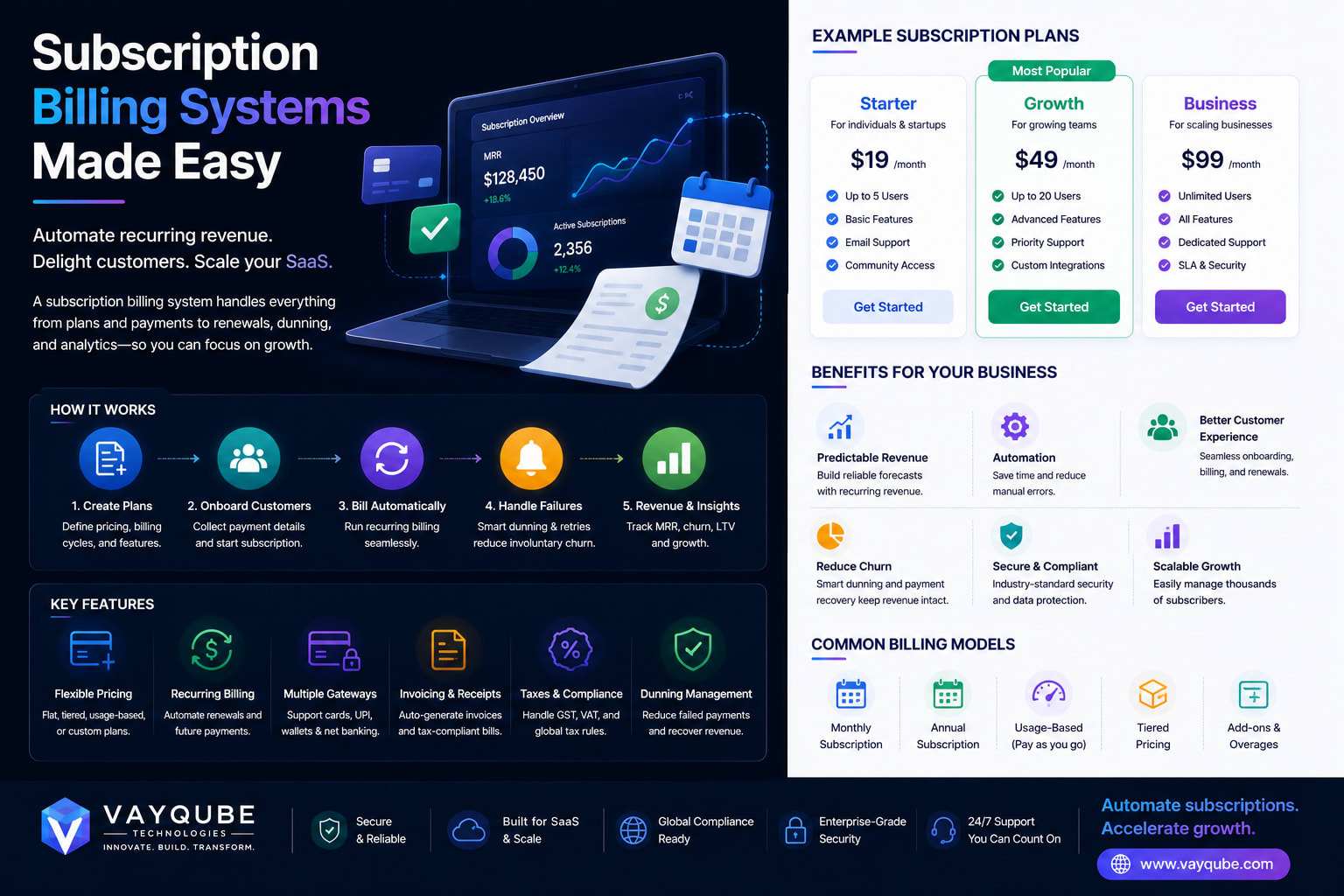
Subscription billing systems are a crucial component of any organization that offers recurring services or products. These systems enable businesses to manage and automate their billing processes, ensuring that customers are invoiced correctly and on time. In this section, we will provide an overview of subscription billing systems and highlight the importance of efficient billing processes.
Overview of Subscription Billing Systems
A subscription billing system is a software solution that allows businesses to manage their recurring revenue streams. These systems typically include features such as plan and pricing management, billing cycle management, payment processing, and revenue recognition. They also provide real-time visibility into customer subscriptions, payments, and revenue, enabling businesses to make informed decisions about their pricing strategies and customer relationships.
Importance of Efficient Billing Processes
Efficient billing processes are critical for businesses that offer recurring services or products. Manual billing processes can be time-consuming, prone to errors, and costly. They can also lead to delayed or lost payments, which can have a significant impact on a business's cash flow and revenue. In contrast, automated billing systems can help businesses to streamline their billing processes, reduce errors, and improve customer satisfaction. They can also provide real-time visibility into billing and payment data, enabling businesses to identify trends and areas for improvement. Some key benefits of efficient billing processes include:
- Improved cash flow and revenue
- Reduced billing errors and disputes
- Enhanced customer satisfaction and loyalty
- Increased operational efficiency and productivity
- Better visibility into billing and payment data
By implementing a subscription billing system, businesses can simplify their billing processes, reduce costs, and improve customer relationships. In the next section, we will explore the key features and functionalities of subscription billing systems in more detail.
Why It Matters
Accurate and efficient subscription billing systems are crucial for businesses that want to scale and grow. One of the primary reasons is that it enables revenue growth through accurate billing. When billing is done correctly, businesses can ensure that they are capturing all the revenue they are entitled to, without leaving any money on the table.
Revenue Growth
This can be achieved by implementing a subscription billing system that can handle complex pricing models, discounts, and promotions. For example, a company that offers tiered pricing plans can use a subscription billing system to automatically charge customers based on their usage, ensuring that revenue is maximized. Some key benefits of accurate billing include:
- Reduced revenue leakage
- Improved forecasting and planning
- Increased customer satisfaction
Enhanced Customer Experience
In addition to revenue growth, a well-designed subscription billing system can also enhance the customer experience. When customers receive accurate and transparent bills, they are more likely to trust the company and continue their subscription. This can lead to increased customer loyalty and retention, which is critical for businesses that rely on recurring revenue.
Compliance and Regulatory Requirements
Finally, a subscription billing system can help businesses comply with regulatory requirements, such as tax laws and accounting standards. By using a system that can handle complex billing scenarios and generate accurate financial reports, businesses can ensure that they are meeting all the necessary compliance requirements. This can help to reduce the risk of audits and fines, and ensure that the business is operating in a compliant and transparent manner. Some key compliance considerations include:
- Tax compliance and reporting
- Accounting standards and financial reporting
- Data security and privacy regulations
Core Architecture
The core architecture of a subscription billing system consists of several key components that work together to provide a seamless and efficient billing experience.
Key Components
The key components of a subscription billing system include:
- Billing engines that calculate charges and generate invoices
- Payment gateways that process transactions and handle payment methods
- Subscription management tools that track and manage subscription plans and customer accounts
- Revenue recognition and reporting tools that provide insights into revenue and customer behavior
These components must be integrated with existing infrastructure, such as customer relationship management (CRM) systems, enterprise resource planning (ERP) systems, and e-commerce platforms.
Integration with Existing Infrastructure
Integration with existing infrastructure is critical to ensure a cohesive and efficient billing process. This can be achieved through APIs, webhooks, and other integration methods that enable seamless data exchange between systems.
For example, integrating a subscription billing system with a CRM system can provide a single customer view, enabling businesses to track customer interactions, subscription plans, and payment history in one place.
Scalability and Flexibility
Scalability and flexibility are essential considerations when designing a subscription billing system. Businesses must be able to scale their billing systems to accommodate growing customer bases and increasing transaction volumes.
This can be achieved through cloud-based infrastructure, distributed architecture, and automated scaling. Additionally, businesses must be able to adapt their billing systems to changing market conditions, customer needs, and regulatory requirements.
Some key considerations for scalability and flexibility include:
- Support for multiple payment methods and currencies
- Ability to handle high volumes of transactions and customer data
- Flexibility to accommodate changing subscription plans and pricing models
- Compliance with relevant regulations, such as GDPR and PCI-DSS
By considering these factors, businesses can design a subscription billing system that is scalable, flexible, and able to meet the evolving needs of their customers and the market.
Business Benefits
The implementation of a subscription billing system can have a significant impact on a business's bottom line. By automating the billing process, companies can reduce revenue leakage and increase revenue. This is achieved through accurate and timely billing, as well as the ability to easily track and manage subscriptions.
Revenue Growth
Some of the key benefits of subscription billing systems include:
- Reduced revenue leakage due to incorrect or missed billing
- Increased revenue through upselling and cross-selling opportunities
- Improved forecasting and planning capabilities
Improved customer satisfaction and retention are also key benefits of subscription billing systems. By providing customers with flexible payment options and transparent billing, companies can build trust and loyalty with their customers.
Operational Efficiency
Streamlined financial operations are another significant advantage of subscription billing systems. These systems can help to:
- Automate manual billing processes, reducing the risk of human error
- Provide real-time visibility into customer subscriptions and billing
- Enable easy tracking and management of recurring revenue
This can lead to significant cost savings and improved efficiency, allowing companies to focus on growth and innovation rather than manual billing processes. Additionally, subscription billing systems can provide valuable insights into customer behavior and preferences, enabling companies to make data-driven decisions to drive business growth.
Real-World Applications
In real-world applications, subscription billing systems have been shown to have a significant impact on business operations. For example, companies that have implemented subscription billing systems have seen significant reductions in revenue leakage and improvements in customer satisfaction. By leveraging these systems, businesses can drive growth, improve efficiency, and build strong relationships with their customers.
Implementation Considerations
When implementing a subscription billing system, there are several key considerations to keep in mind. These include:
- Integration with existing systems and processes
- Scalability and flexibility to support growth and changing business needs
- Security and compliance to protect sensitive customer data
By carefully evaluating these factors and selecting a subscription billing system that meets the needs of the business, companies can ensure a successful implementation and maximize the benefits of these systems.
Scalability
To ensure seamless growth, a subscription billing system must be able to handle increasing customer bases and transaction volumes. This involves designing a system that can scale horizontally, adding more resources as needed to maintain performance. A scalable system should be able to process a high volume of transactions without a decrease in performance, ensuring that customers can access their accounts and make payments without interruption.
Handling Growing Customer Bases
A key aspect of scalability is the ability to handle growing customer bases. This requires a system that can efficiently manage large amounts of customer data, including subscription plans, payment methods, and billing histories. The system should be able to quickly retrieve and update customer information, ensuring that customers receive accurate and timely billing.
Support for Multiple Pricing Models and Currencies
Scalability also involves supporting multiple pricing models and currencies. This allows businesses to expand their customer base globally, offering pricing plans that cater to different regions and customer segments. A scalable system should be able to handle various pricing models, such as tiered pricing, usage-based pricing, and flat-rate pricing, as well as support multiple currencies and exchange rates.
Automated Billing and Payment Processing
Automated billing and payment processing is critical to scalability. This involves setting up a system that can automatically generate invoices, send payment reminders, and process payments. Automated billing and payment processing reduces the risk of human error, ensures timely payments, and frees up staff to focus on other areas of the business. A scalable system should be able to integrate with various payment gateways, handle different payment methods, and provide real-time payment tracking and reporting.
Some key considerations for implementing a scalable subscription billing system include:
- Using cloud-based infrastructure to easily scale resources up or down as needed
- Implementing automated testing and deployment scripts to ensure smooth and efficient system updates
- Utilizing load balancing and content delivery networks to distribute traffic and reduce the load on individual servers
- Implementing robust security measures to protect customer data and prevent unauthorized access
- Providing real-time analytics and reporting to monitor system performance and identify areas for improvement
By prioritizing scalability, businesses can ensure that their subscription billing system can handle growing customer bases and transaction volumes, support multiple pricing models and currencies, and automate billing and payment processing. This enables businesses to focus on growth and expansion, rather than being held back by inflexible and inefficient billing systems.
Implementation Challenges
Implementing a subscription billing system can be a complex process, and several challenges may arise. One of the primary concerns is data migration and integration complexities. When transitioning to a new billing system, businesses must ensure a seamless transfer of existing customer data, payment information, and subscription plans. This can be a daunting task, especially for large enterprises with vast amounts of data.
Data Migration and Integration
To overcome data migration challenges, businesses should:
- Develop a comprehensive data migration strategy
- Ensure data consistency and accuracy
- Implement automated data validation and testing
- Provide ongoing support and monitoring
Change management and training requirements are also crucial aspects of implementation. As employees adapt to new processes and systems, they may require training and support to ensure a smooth transition. This can include training on new billing workflows, payment processing, and customer management.
Security and Compliance
Ensuring security and compliance is paramount when implementing a subscription billing system. Businesses must adhere to industry standards and regulations, such as PCI-DSS and GDPR, to protect sensitive customer data. This includes:
- Implementing robust security measures, such as encryption and access controls
- Conducting regular security audits and risk assessments
- Maintaining transparency and accountability in data handling and storage
By addressing these implementation challenges, businesses can minimize disruptions, ensure a successful transition, and maximize the benefits of their subscription billing system. Effective planning, execution, and ongoing support are essential to overcoming these challenges and achieving long-term success.
Real-World Examples
Real-world examples of successful implementations can provide valuable insights and lessons learned. For instance, companies like Netflix and Spotify have effectively implemented subscription billing systems, leveraging automation, scalability, and security to drive business growth and customer satisfaction. By studying these examples and applying best practices, businesses can develop a tailored implementation strategy that meets their unique needs and goals.
Production Considerations
In a production environment, it is essential to consider factors such as system performance, scalability, and reliability. Businesses should ensure that their subscription billing system can handle high volumes of transactions, accommodate growing customer bases, and maintain uptime and availability. This includes:
- Monitoring system performance and optimizing as needed
- Implementing load balancing and redundancy to ensure high availability
- Conducting regular backups and disaster recovery planning to minimize downtime and data loss.
Use Cases
Subscription billing systems have a wide range of applications across various industries. Two primary types of businesses that can benefit from these systems are B2B and B2C subscription-based companies.
B2B and B2C Subscription-Based Businesses
B2B businesses, such as software as a service (SaaS) providers, can utilize subscription billing systems to manage recurring payments from their clients. This can include monthly or yearly subscriptions to access certain software features or services. On the other hand, B2C businesses, like streaming services or monthly box subscription companies, can also leverage these systems to handle customer payments and subscriptions.
Usage-Based Billing and Metered Pricing
Usage-based billing and metered pricing are also key use cases for subscription billing systems. This model allows businesses to charge customers based on their actual usage of a product or service, rather than a fixed monthly fee. For example, a cloud computing company might charge customers based on the amount of storage or bandwidth they use. This approach can help businesses to better align their pricing with the value they provide to customers.
Recurring Revenue Models and Loyalty Programs
Recurring revenue models and loyalty programs are additional use cases for subscription billing systems. By offering loyalty programs or rewards to customers who maintain their subscriptions over time, businesses can incentivize customer loyalty and reduce churn. Recurring revenue models can also provide a predictable and stable source of income for businesses, allowing them to better plan and budget for the future. Some examples of recurring revenue models include:
- Monthly or yearly subscription plans
- Automatic renewal of subscriptions
- Tiered pricing plans with increasing levels of service or features
- Add-ons or upgrades to existing subscriptions
- Loyalty rewards or discounts for long-term customers
These use cases demonstrate the flexibility and versatility of subscription billing systems, and how they can be applied to a wide range of businesses and industries. By implementing a subscription billing system, businesses can streamline their payment processes, improve customer satisfaction, and increase revenue.
Best Practices
To get the most out of a subscription billing system, it's essential to follow best practices that ensure efficiency, transparency, and growth.
Review and Optimize
Regularly reviewing and optimizing billing processes is crucial for identifying areas of improvement and reducing errors. This involves assessing the current billing workflow, identifying bottlenecks, and streamlining processes to improve customer satisfaction and reduce revenue leakage. By doing so, businesses can ensure that their billing system is aligned with their overall business strategy and goals.
Transparent Communications
Providing transparent and clear billing communications is vital for building trust with customers and reducing disputes. This includes sending timely and detailed invoices, providing clear payment terms, and offering multiple payment options. Transparent communications also help to reduce customer churn and improve overall customer experience.
Leveraging Analytics
Leveraging analytics and insights is critical for driving business growth and making informed decisions. A subscription billing system should provide real-time analytics and insights on revenue, customer behavior, and payment trends. By analyzing these insights, businesses can identify new revenue streams, optimize pricing strategies, and improve customer engagement. Some key metrics to track include:
- Monthly Recurring Revenue (MRR)
- Average Revenue Per User (ARPU)
- Customer Lifetime Value (CLV)
- Churn Rate
By following these best practices, businesses can unlock the full potential of their subscription billing system and drive long-term growth and success. Effective implementation of these strategies requires a deep understanding of the business and its customers, as well as the ability to adapt to changing market conditions and customer needs.
Implementation Considerations
When implementing a subscription billing system, it's essential to consider the unique needs and requirements of the business. This includes assessing the current billing infrastructure, identifying potential integration points, and developing a comprehensive implementation plan. By taking a thoughtful and strategic approach to implementation, businesses can minimize disruption to their operations and ensure a smooth transition to the new system.
Some key considerations include:
- Integration with existing CRM and ERP systems
- Support for multiple payment gateways and methods
- Ability to handle complex pricing and discount structures
- Scalability and reliability of the system
- Security and compliance with relevant regulations, such as PCI-DSS and GDPR.
By carefully evaluating these factors and following best practices, businesses can ensure a successful implementation of their subscription billing system and achieve their goals.
FAQ
Common questions and concerns about subscription billing systems are addressed below.
Addressing Misconceptions
Some businesses believe that implementing a subscription billing system is complex and time-consuming. However, with the right approach and tools, it can be a straightforward process.
- Misconception: Subscription billing systems are only suitable for large enterprises.
- Reality: Businesses of all sizes can benefit from subscription billing systems, from small startups to large corporations.
- Misconception: Implementing a subscription billing system requires significant technical expertise.
- Reality: Many subscription billing systems offer user-friendly interfaces and straightforward implementation processes.
Additional Resources
For businesses looking to learn more about subscription billing systems, there are numerous resources available.
- Industry reports and research studies can provide valuable insights into the benefits and best practices of subscription billing systems.
- Online forums and communities can connect businesses with experts and peers who have experience with subscription billing systems.
- Webinars and workshops can offer hands-on training and guidance on implementing and optimizing subscription billing systems.
Real-World Examples
Real-world examples of businesses that have successfully implemented subscription billing systems can be instructive.
- A software company that offers a monthly subscription for access to its products and services.
- A streaming service that provides a range of subscription plans to suit different customer needs.
- A fitness center that offers monthly membership subscriptions with varying levels of access to facilities and services.
Production Considerations
When implementing a subscription billing system, there are several production considerations to keep in mind.
- Integration with existing systems and processes, such as accounting and customer relationship management software.
- Security and compliance, including data protection and payment card industry (PCI) standards.
- Scalability and flexibility, to accommodate growing customer bases and changing business needs.
Conclusion
In summary, implementing an efficient subscription billing system is crucial for businesses that want to streamline their revenue management and improve customer satisfaction. The key takeaways from this discussion include:
- The importance of a scalable and flexible billing architecture
- The need for real-time billing and payment processing
- The benefits of automated revenue recognition and compliance management
- The role of data analytics in optimizing billing operations and improving customer engagement
The implementation of a robust subscription billing system has a significant impact on a company's bottom line, enabling it to reduce revenue leakage, minimize compliance risks, and improve customer retention. By leveraging modern billing technologies and best practices, businesses can create a competitive advantage and drive long-term growth.
As businesses continue to evolve and expand their subscription-based offerings, the need for efficient and scalable billing systems will only continue to grow. It is essential for companies to prioritize the implementation of a robust billing solution that can meet the demands of a rapidly changing market. By doing so, they can ensure that their billing operations are optimized for performance, reliability, and security, and that they are well-positioned to capitalize on new revenue opportunities.
To get started with implementing a robust subscription billing system, businesses should consider the following steps:
- Assess their current billing infrastructure and identify areas for improvement
- Evaluate modern billing technologies and platforms that can support their growth objectives
- Develop a comprehensive implementation plan that addresses key requirements such as scalability, security, and compliance
- Engage with experienced billing professionals and system integrators who can provide guidance and support throughout the implementation process
By taking a proactive and strategic approach to subscription billing, businesses can unlock new revenue streams, improve customer satisfaction, and drive long-term success. With the right billing solution in place, companies can focus on what matters most - delivering exceptional products and services that meet the evolving needs of their customers.
Related Vayqube Resources
- Cloud Cost Optimization Strategies For Saas Startups
- How To Build Fintech Application Payments Security Scaling
- Case Study Saas Platform Scaling
- Building Enterprise Ai Systems That Actually Scale
- Startups Building Ai Products Without Large Teams
- Ai Powered Crm Systems Future Of Customer Management
Next Step
If your systems are struggling with scalability, automation, architecture complexity, or operational efficiency, it's time to modernize your infrastructure and workflows.
👉 Talk to a Vayqube solution architect and build systems designed for long-term production growth: