
Avoiding Common Pitfalls: Architecture Mistakes in Startup Products
Startup products often face scalability issues due to poor architecture. Identify and avoid common mistakes to ensure your product's success.
Vayqube Team
Author
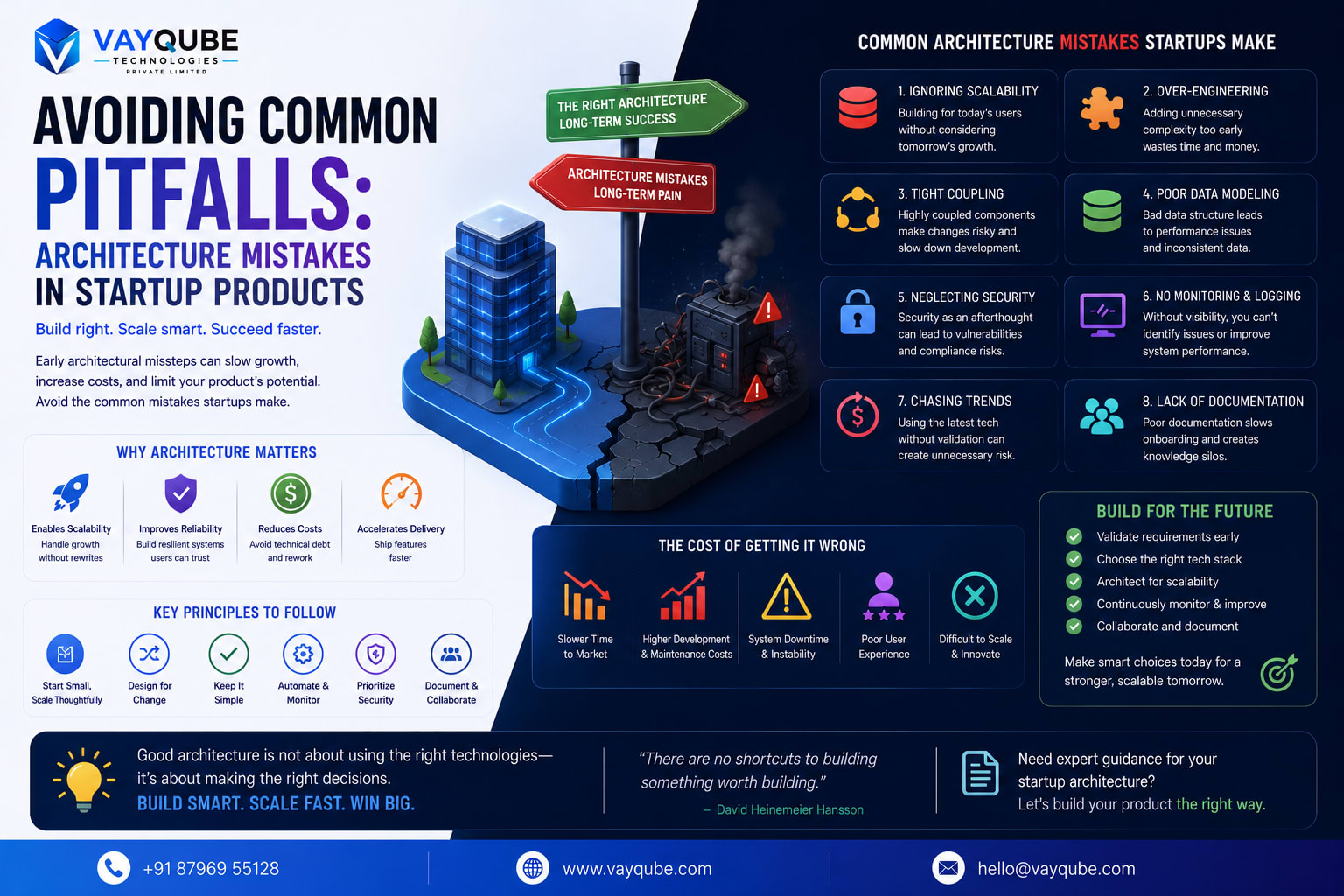
Introduction to Architecture Mistakes
When building startup products, the architecture is the foundation upon which the entire solution is constructed. A well-designed architecture can make all the difference in the scalability, maintainability, and overall success of the product. However, common architecture mistakes can lead to significant pitfalls, hindering the product's ability to meet its intended goals and ultimately affecting its long-term viability.
The Impact of Poor Architecture
Poor architecture can result in a multitude of issues, including but not limited to, performance bottlenecks, increased latency, and higher operational costs. These issues can lead to a poor user experience, driving away potential customers and damaging the reputation of the startup. Furthermore, a poorly designed architecture can make it challenging to implement new features or updates, limiting the product's ability to evolve and adapt to changing market conditions.
Key considerations for avoiding common pitfalls include:
- Understanding the importance of scalability in architecture design
- Recognizing the need for flexibility to accommodate future changes and updates
- Implementing robust security measures to protect user data and prevent breaches
- Ensuring the architecture is designed with performance optimization in mind
Long-Term Success
Avoiding common architecture mistakes is crucial for the long-term success of startup products. A well-designed architecture can provide a competitive edge, enabling the product to scale efficiently, perform optimally, and adapt quickly to changing market demands. By prioritizing architecture and avoiding common pitfalls, startups can set themselves up for success, driving business growth, and establishing a strong foundation for future innovation and expansion.
The importance of avoiding architecture mistakes cannot be overstated, as the consequences of poor design can be far-reaching and detrimental to the product's overall success. By understanding the common pitfalls and taking a proactive approach to architecture design, startups can mitigate these risks and create a solid foundation for their products to thrive.
Real-World Implications
In real-world scenarios, the implications of poor architecture can be seen in products that struggle to scale, experience frequent downtime, or are vulnerable to security threats. These issues can lead to a loss of customer trust, negative reviews, and ultimately, a decline in revenue. By learning from these examples and prioritizing good architecture practices, startups can avoid similar pitfalls and ensure their products are well-positioned for long-term success.
The focus should be on creating an architecture that is not only functional but also scalable, secure, and performant. This requires a deep understanding of the product's requirements, the market's demands, and the technical capabilities of the team. By combining this knowledge with a commitment to avoiding common architecture mistakes, startups can build products that are poised for success and capable of driving business growth.
Why It Matters
Poor architecture can have a significant impact on the scalability and performance of a startup's product. As the user base grows, a poorly designed architecture can lead to increased latency, downtime, and ultimately, a loss of revenue.
Scalability Concerns
Neglecting architecture in the early stages can result in a number of consequences, including:
- Inability to handle increased traffic, leading to crashes and downtime
- Difficulty in adding new features, resulting in a slower time-to-market
- Inefficient use of resources, leading to increased costs and reduced profitability
- Reduced competitiveness, as users seek out more reliable and performant alternatives
Performance Implications
The consequences of poor architecture can be far-reaching, affecting not only the user experience but also the overall business. Some of the key performance implications include:
- Slow load times, leading to increased bounce rates and reduced engagement
- Increased error rates, resulting in a poor user experience and reduced customer satisfaction
- Inability to adapt to changing market conditions, resulting in a loss of competitiveness
- Reduced ability to innovate, as resources are diverted to addressing architectural issues rather than developing new features and functionality
Real-World Examples
Many startups have fallen victim to poor architecture, resulting in significant losses and damage to their reputation. For example, a company that experiences rapid growth may find that their architecture is unable to handle the increased traffic, resulting in downtime and lost revenue. Similarly, a company that neglects to consider scalability in their architecture may find that they are unable to add new features or adapt to changing market conditions, resulting in a loss of competitiveness.
Production Considerations
In order to avoid these pitfalls, it is essential to consider architecture from the outset, taking into account the potential for growth and scalability. This includes:
- Designing an architecture that is modular and flexible, allowing for easy addition of new features and functionality
- Implementing automated testing and deployment, to ensure that changes are thoroughly tested and validated
- Monitoring performance and scalability, to identify potential issues before they become major problems
- Continuously evaluating and refining the architecture, to ensure that it remains aligned with the needs of the business and the users.
Core Architecture
A well-designed core architecture is crucial for the success of a startup product. It serves as the foundation upon which all other components are built, and its quality can significantly impact the product's scalability, maintainability, and overall performance.
Key Components
The key components of a well-designed architecture include:
- A modular design that allows for flexibility and ease of maintenance
- A scalable infrastructure that can handle increased traffic and user growth
- A robust security framework that protects user data and prevents unauthorized access
- A reliable data storage system that ensures data consistency and availability
- A well-defined API that enables seamless integration with other services and applications
Key Considerations
When designing the core architecture of a startup product, there are several key considerations to keep in mind. These include:
- The need for scalability and flexibility, to accommodate rapid growth and changing user needs
- The importance of security and data protection, to maintain user trust and prevent reputational damage
- The role of data analytics and insights, in informing product development and optimization
- The impact of technical debt, on the product's long-term maintainability and performance
- The need for continuous testing and validation, to ensure the product meets user needs and expectations
Real-World Examples
Many successful startup products have demonstrated the importance of a well-designed core architecture. For example, companies like Airbnb and Uber have built their products around scalable and flexible architectures, allowing them to handle rapid growth and changing user needs. In contrast, companies that have neglected their core architecture have often struggled with scalability and performance issues, ultimately impacting their ability to deliver a high-quality user experience.
Implementation Strategy
To avoid common pitfalls and ensure a well-designed core architecture, startup teams should prioritize a thoughtful and intentional approach to architecture design. This includes:
- Taking the time to understand user needs and define clear product requirements
- Developing a modular and scalable infrastructure that can handle growth and change
- Implementing robust security and data protection measures, to maintain user trust and prevent reputational damage
- Continuously testing and validating the product, to ensure it meets user needs and expectations
- Prioritizing technical debt management, to maintain the product's long-term maintainability and performance.
Business Benefits
Implementing a well-designed architecture in startup products can have a significant impact on the business. By avoiding common pitfalls, companies can reap numerous benefits that contribute to their overall success.
Scalability and Reliability
Improved scalability and reliability are two of the most significant advantages of a well-architected product. This enables businesses to handle increased traffic, user growth, and data volume without compromising performance. As a result, companies can focus on expanding their customer base and exploring new markets, rather than being held back by technical limitations.
Maintainability and Flexibility
Enhanced maintainability and flexibility are also crucial benefits of a well-designed architecture. By building a modular and adaptable system, businesses can quickly respond to changing market conditions, update features, and fix issues without affecting the entire product. This agility allows companies to stay competitive and innovate faster, which is essential in today's fast-paced business landscape.
Alignment with Business Goals
Better alignment with business goals is another key advantage of a well-architected product. By understanding the company's objectives and priorities, architects can design a system that supports and enables the achievement of those goals. This includes:
- Identifying key performance indicators (KPIs) and metrics that drive business decisions
- Developing features and functionality that address specific business needs
- Ensuring that the product's technical capabilities align with the company's overall strategy
By prioritizing business benefits and avoiding common architecture mistakes, startups can create products that are not only technically sound but also strategically aligned with their goals and objectives. This, in turn, can lead to increased customer satisfaction, revenue growth, and long-term success.
Real-World Examples
Many successful companies have demonstrated the importance of a well-designed architecture in achieving business benefits. For instance:
- Netflix's microservices-based architecture allows for greater scalability and flexibility, enabling the company to handle massive traffic and user growth.
- Amazon's service-oriented architecture enables the company to quickly develop and deploy new features, supporting its rapid innovation and expansion into new markets.
By learning from these examples and prioritizing business benefits, startups can create products that drive real value and support long-term growth.
Scalability
To ensure startup products can handle increased traffic and demand, designing for scalability is crucial. This involves adopting strategies that enable the system to grow and adapt to changing requirements.
Horizontal Scaling
Horizontal scaling, also known as scaling out, involves adding more resources, such as servers or instances, to the system to distribute the workload. This approach allows for easier addition of new resources as demand increases, making it a highly effective strategy for handling sudden spikes in traffic. Key considerations for horizontal scaling include:
- Load balancing to distribute traffic evenly across resources
- Auto-scaling to automatically add or remove resources based on demand
- Ensuring consistency and synchronization across multiple resources
Vertical Scaling
Vertical scaling, or scaling up, involves increasing the power of existing resources, such as upgrading server hardware or increasing instance size. This approach can provide a quick fix for increasing demand but may have limitations, such as hardware capacity limits and increased costs. Important factors to consider when implementing vertical scaling include:
- Monitoring resource utilization to identify bottlenecks
- Right-sizing resources to avoid over-provisioning
- Planning for potential future upgrades and migrations
Strategies for Handling Increased Traffic
When handling increased traffic and demand, several strategies can be employed to ensure the system remains performant and reliable. These include:
- Caching frequently accessed data to reduce database queries
- Implementing content delivery networks (CDNs) to distribute static content
- Using queue-based architectures to handle asynchronous tasks and reduce load on core systems
- Conducting regular performance testing and monitoring to identify areas for optimization
Real-World Examples
Many successful startups have implemented scalable architectures to handle rapid growth and increased demand. For example, companies like Netflix and Airbnb have employed a combination of horizontal and vertical scaling strategies, along with advanced caching and queue-based architectures, to ensure their systems remain performant and reliable even under extreme loads. By studying these examples and applying the principles of scalability, startups can better prepare their products for success and avoid common pitfalls associated with architecture mistakes.
Production Considerations
When implementing scalable architectures in production environments, several key considerations must be taken into account. These include:
- Ensuring consistency and reliability across multiple resources and environments
- Implementing robust monitoring and logging to quickly identify and respond to issues
- Planning for potential failures and developing strategies for disaster recovery and business continuity
- Continuously testing and optimizing the system to ensure it remains performant and efficient as demand grows.
Implementation Challenges
Implementing a robust architecture for a startup product can be a daunting task, especially when faced with common obstacles that can hinder progress. Some of the most significant challenges include:
- Technical debt: the accumulation of quick fixes, workarounds, and inefficient solutions that can lead to system instability and maintenance nightmares
- Legacy code: outdated, poorly maintained, or obsolete code that can be difficult to integrate with new systems or technologies
- Insufficient resources: limited budget, talent, or time, which can constrain the ability to design and implement a scalable architecture
- Evolving requirements: changing business needs, market conditions, or customer expectations that can require significant adjustments to the architecture
Overcoming Technical Debt
To overcome technical debt, it's essential to prioritize refactoring and modernization efforts. This can involve:
- Identifying and addressing critical technical debt items that are causing the most significant problems
- Implementing automated testing and continuous integration to reduce the risk of introducing new technical debt
- Establishing a culture of technical excellence, where developers are encouraged to write clean, modular, and well-documented code
- Allocating dedicated resources and budget for technical debt reduction and modernization initiatives
Strategies for Legacy Code
When dealing with legacy code, it's crucial to develop a strategic approach to modernization. This can include:
- Conducting a thorough assessment of the legacy codebase to identify areas of high risk, complexity, or maintenance burden
- Developing a phased modernization plan, where critical components are prioritized and updated first
- Implementing a microservices architecture, where legacy components can be gradually replaced or integrated with newer systems
- Leveraging cloud-native services and platforms to reduce the technical debt associated with legacy infrastructure and maintenance
Production Readiness
To ensure production readiness, it's essential to focus on scalability, reliability, and performance. This can involve:
- Designing and implementing automated testing, monitoring, and deployment pipelines to reduce the risk of errors and downtime
- Conducting regular security audits and penetration testing to identify vulnerabilities and weaknesses
- Implementing load balancing, caching, and content delivery networks to improve performance and scalability
- Developing a disaster recovery and business continuity plan to ensure minimal downtime and data loss in the event of an outage or disaster.
Use Cases
Successful architecture implementations can make or break a startup's product. In this section, we will explore real-world examples of companies that got it right, and those that didn't.
Lessons from Success Stories
Companies like Netflix and Airbnb have demonstrated the importance of a well-designed architecture in achieving scalability and reliability.
- Netflix's microservices-based architecture allows for seamless integration of new features and services, enabling the company to expand its offerings quickly.
- Airbnb's use of a service-oriented architecture enables the company to handle massive traffic and provide a seamless user experience.
Learning from Failures
On the other hand, companies like Friendster and Orkut failed to scale due to poor architecture design.
- Friendster's monolithic architecture led to performance issues and scalability problems, ultimately causing the site to crash under heavy traffic.
- Orkut's failure to adopt a cloud-based infrastructure led to significant downtime and data loss, resulting in a loss of user trust.
Real-World Examples
Other notable examples include:
- Dropbox's use of a distributed file system to handle large amounts of user data, ensuring high availability and reliability.
- Twitter's implementation of a distributed database to handle high traffic and large amounts of user-generated content.
Production Considerations
When designing an architecture, it's essential to consider production readiness and the potential for scalability.
- Companies should prioritize automation, monitoring, and logging to ensure smooth operation and quick issue resolution.
- A well-designed architecture should also take into account security, compliance, and data governance to protect user data and prevent potential breaches.
Implementation Strategies
To avoid common pitfalls, startups should focus on:
- Adopting a modular architecture to enable seamless integration of new features and services.
- Implementing automated testing and deployment to reduce downtime and improve overall system reliability.
- Prioritizing scalability and performance to handle increased traffic and user growth.
Key Takeaways
By studying successful and failed architecture implementations, startups can gain valuable insights into the importance of a well-designed architecture.
- A scalable and reliable architecture is crucial for handling increased traffic and user growth.
- Prioritizing automation, monitoring, and logging can help ensure smooth operation and quick issue resolution.
- Companies should focus on adopting a modular architecture and implementing automated testing and deployment to reduce downtime and improve overall system reliability.
Best Practices
To ensure a scalable and efficient architecture, it's essential to follow established guidelines and recommendations. This section outlines the best practices for designing and implementing a scalable architecture, as well as recommendations for continuous monitoring and improvement.
Designing a Scalable Architecture
When designing a scalable architecture, consider the following key factors:
- Define clear goals and objectives for the system
- Identify potential bottlenecks and areas for optimization
- Choose the right technologies and tools for the job
- Implement a modular and flexible design
- Plan for scalability and growth from the outset
Implementing a Scalable Architecture
Implementing a scalable architecture requires careful planning and execution. Some key considerations include:
- Using cloud-based services and infrastructure to reduce costs and increase flexibility
- Implementing automated testing and deployment processes
- Using containerization and orchestration tools to simplify management and scaling
- Ensuring adequate monitoring and logging to facilitate troubleshooting and optimization
Continuous Monitoring and Improvement
Continuous monitoring and improvement are critical to ensuring the long-term health and scalability of the system. This includes:
- Implementing real-time monitoring and alerting systems
- Conducting regular performance and security audits
- Gathering feedback from users and stakeholders to identify areas for improvement
- Using data and analytics to inform decision-making and optimize system performance
Recommendations for Improvement
To take your architecture to the next level, consider the following recommendations:
- Adopt a culture of continuous learning and improvement
- Stay up-to-date with the latest technologies and trends
- Encourage collaboration and knowledge-sharing across teams
- Prioritize simplicity and elegance in design and implementation
- Plan for failure and have a clear strategy for disaster recovery and business continuity
By following these best practices and recommendations, you can help ensure that your startup's product is built on a solid foundation, with a scalable and efficient architecture that can support growth and success.
Frequently Asked Questions
To help startup founders and developers navigate the complexities of architecture mistakes, we've compiled a list of frequently asked questions and expert insights.
Common Misconceptions
Some common misconceptions about architecture mistakes include:
- Assuming that a scalable architecture is only necessary for large, established companies
- Believing that a monolithic architecture is simpler and more cost-effective
- Overlooking the importance of continuous testing and monitoring in ensuring system reliability
Expert Advice
Experts in the field recommend that startup founders and developers:
- Prioritize scalability and flexibility from the outset
- Adopt a modular, microservices-based architecture to facilitate easier maintenance and updates
- Implement automated testing and monitoring to ensure system reliability and performance
Real-World Examples
Real-world examples of companies that have successfully avoided common architecture mistakes include:
- Netflix, which adopted a microservices-based architecture to support its rapid growth and expansion
- Airbnb, which prioritized scalability and flexibility in its architecture to accommodate increasing demand
- Dropbox, which implemented automated testing and monitoring to ensure system reliability and performance
Best Practices for Startup Founders
Startup founders can avoid common architecture mistakes by:
- Working closely with developers to ensure that architecture decisions align with business goals
- Prioritizing scalability, flexibility, and reliability in architecture design
- Continuously monitoring and evaluating system performance to identify areas for improvement
Additional Considerations
Additional considerations for startup founders and developers include:
- The importance of security and compliance in architecture design
- The need for ongoing training and education to stay up-to-date with the latest technologies and best practices
- The value of seeking outside expertise and guidance when navigating complex architecture decisions
Implementation Strategy
When implementing a new architecture, it's essential to have a clear strategy in place, including:
- A detailed roadmap for rollout and deployment
- A plan for ongoing monitoring and evaluation
- A process for incorporating feedback and making adjustments as needed
Production Readiness
To ensure production readiness, startup founders and developers should:
- Conduct thorough testing and quality assurance
- Implement automated deployment and rollback procedures
- Establish clear incident response and management procedures
Business Impact
The business impact of avoiding common architecture mistakes cannot be overstated, as it can:
- Improve system reliability and performance
- Increase scalability and flexibility
- Enhance overall customer experience and satisfaction
Scalability Considerations
When it comes to scalability, startup founders and developers should consider:
- The importance of horizontal scaling to accommodate increasing demand
- The need for automated scaling and resource allocation
- The value of load balancing and traffic management in ensuring system performance
Real-World Use Cases
Real-world use cases for avoiding common architecture mistakes include:
- E-commerce platforms that require high scalability and reliability
- Financial services applications that demand strict security and compliance
- Healthcare systems that require high availability and data integrity
Key Takeaways
Key takeaways for startup founders and developers include:
- The importance of prioritizing scalability, flexibility, and reliability in architecture design
- The need for ongoing monitoring and evaluation to ensure system performance
- The value of seeking outside expertise and guidance when navigating complex architecture decisions
Next Steps
Next steps for startup founders and developers include:
- Conducting a thorough review of current architecture and identifying areas for improvement
- Developing a clear strategy for implementation and rollout
- Establishing a process for ongoing monitoring and evaluation to ensure system performance and reliability
Final Considerations
Final considerations for startup founders and developers include:
- The importance of staying up-to-date with the latest technologies and best practices
- The need for ongoing training and education to ensure that architecture decisions align with business goals
- The value of prioritizing scalability, flexibility, and reliability in architecture design to ensure long-term success and growth.
Conclusion
In the fast-paced world of startup product development, avoiding common pitfalls in architecture is crucial for long-term success. By understanding the key takeaways and action items outlined in this article, startup founders and product leaders can make informed decisions about their product's architecture.
Recap of Key Takeaways
The importance of a well-designed architecture cannot be overstated. Some of the key takeaways from this discussion include:
- Understanding the core architecture and its impact on business benefits
- Recognizing the challenges of scalability and implementation
- Learning from real-world use cases and best practices
- Being aware of common pitfalls and how to avoid them
Final Thoughts
Avoiding common pitfalls in startup product architecture requires a combination of technical expertise, business acumen, and real-world experience. By prioritizing scalability, implementation, and production readiness, startup founders and product leaders can set their products up for success. It's essential to stay focused on the business impact of architecture decisions and to continuously monitor and improve the product's architecture as it evolves.
Action Items
To put these principles into practice, consider the following action items:
- Conduct a thorough review of your product's current architecture
- Identify potential pitfalls and areas for improvement
- Develop a strategic plan for addressing these challenges and implementing best practices
- Continuously monitor and evaluate the effectiveness of your architecture decisions
Real-World Applications
In real-world scenarios, avoiding common pitfalls in startup product architecture can have a significant impact on the bottom line. By prioritizing architecture and making informed decisions, startups can reduce costs, improve efficiency, and drive business growth. Whether you're building a new product or scaling an existing one, the principles outlined in this article can help you navigate the complexities of product architecture and achieve long-term success.
Next Steps
As you move forward with your product development, keep in mind that architecture is an ongoing process. Stay up-to-date with the latest trends and best practices, and be willing to adapt and evolve your architecture as your product and business grow. With the right approach and mindset, you can avoid common pitfalls and set your product up for long-term success.
Related Vayqube Resources
- Startups Building Ai Products Without Large Teams
- Best Mobile App Development Company In Singapore City
- The Real Cost Of Building Ai Products
- Why Most Ai Projects Fail Before Production
- How To Build Fintech Application Payments Security Scaling
- How To Build Scalable Nodejs Backend Production Guide
Next Step
If your systems are struggling with scalability, automation, architecture complexity, or operational efficiency, it's time to modernize your infrastructure and workflows.
👉 Talk to a Vayqube solution architect and build systems designed for long-term production growth: