
Generative AI Revolutionizes Enterprise Software
Generative AI is changing the face of enterprise software, enabling companies to automate tasks and improve decision-making. By leveraging generative AI, businesses can unlock new levels of efficiency and innovation, driving growth and competitiveness.
Vayqube Team
Software architecture and product engineering
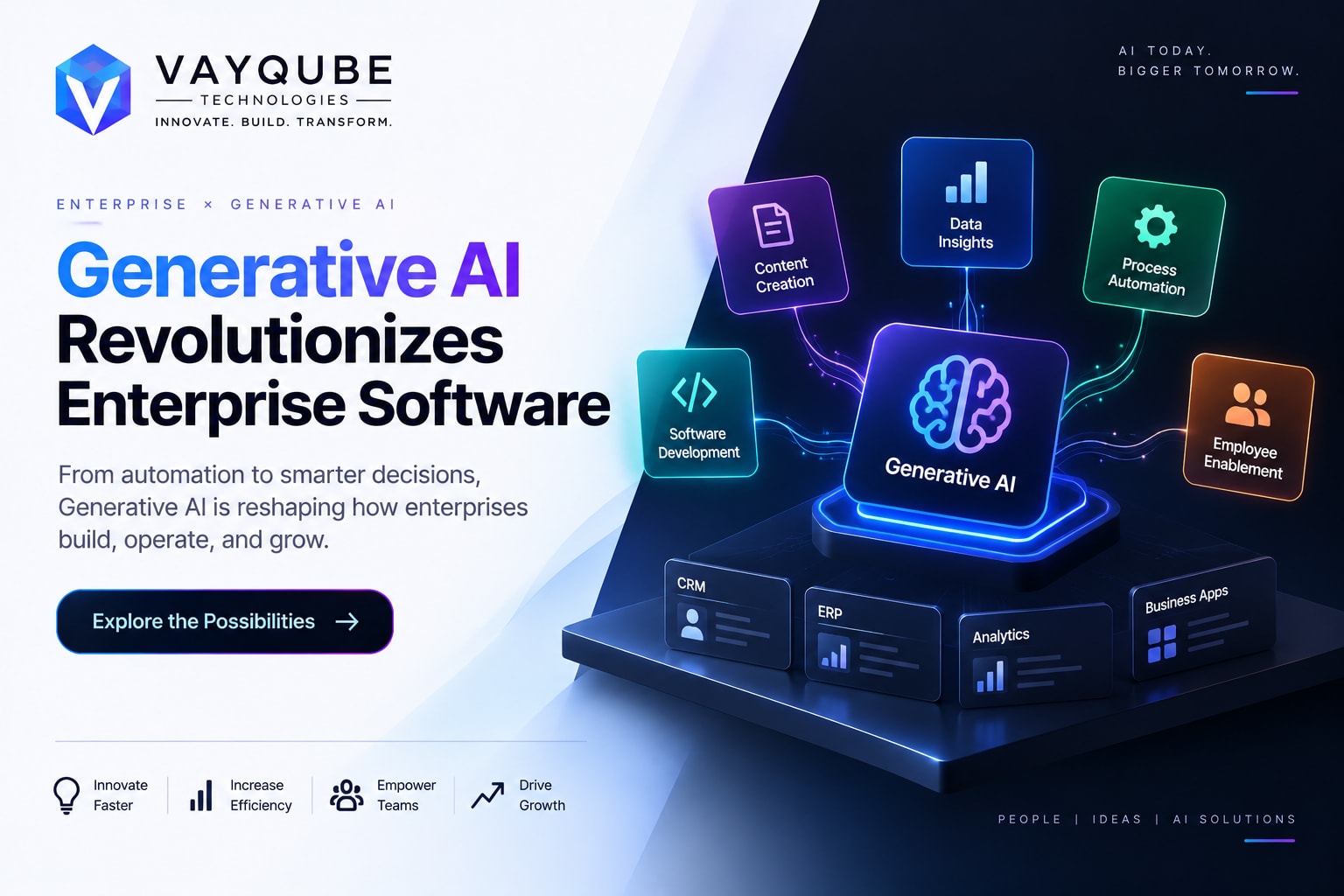
Overview of Generative AI in Enterprise Software
Generative AI is transforming the enterprise software landscape by enabling organizations to automate complex tasks, enhance user experiences, and uncover new business insights. This technology has the potential to revolutionize the way companies develop, deploy, and maintain software applications. With generative AI, enterprises can generate high-quality code, reduce manual errors, and increase development speed.
Current State of AI Adoption
The current state of AI adoption in enterprise software is characterized by a mix of excitement and caution. While some organizations are aggressively embracing AI-powered solutions, others are taking a more measured approach, citing concerns about data quality, model interpretability, and regulatory compliance. Despite these challenges, the benefits of generative AI are undeniable, and many companies are exploring ways to integrate this technology into their software development workflows.
Key areas where generative AI is making an impact include:
- Automated code generation
- Intelligent testing and validation
- Personalized user experiences
- Predictive analytics and maintenance
As enterprises continue to navigate the complexities of AI adoption, they must consider factors such as data governance, model training, and human oversight to ensure that generative AI solutions are both effective and responsible. By doing so, organizations can unlock the full potential of this technology and achieve significant business benefits, including improved efficiency, enhanced innovation, and increased competitiveness.
Implementation Considerations
When implementing generative AI in enterprise software, companies must consider a range of technical and organizational factors. These include the selection of appropriate AI frameworks and tools, the development of robust data governance policies, and the creation of cross-functional teams to support AI-powered software development. Additionally, enterprises must prioritize transparency, explainability, and accountability in their AI systems to build trust with users and stakeholders.
By taking a thoughtful and strategic approach to generative AI adoption, enterprises can minimize risks, maximize benefits, and achieve a competitive edge in the market. The next section will delve deeper into the technical aspects of generative AI and its applications in enterprise software development.
Why It Matters
The impact of generative AI on enterprise software is multifaceted, affecting various aspects of business operations.
Impact on Business Operations
Generative AI can automate tasks, enhance customer experiences, and improve overall efficiency. Some key areas where generative AI can make a significant difference include:
- Streamlining workflows and reducing manual labor
- Enhancing data analysis and insights
- Improving customer support and engagement
- Accelerating product development and testing
By leveraging generative AI, businesses can free up resources, reduce costs, and allocate more time to strategic decision-making. This, in turn, can lead to increased productivity, better decision-making, and improved competitiveness.
Competitive Advantage
In today's fast-paced business landscape, companies that adopt generative AI can gain a significant competitive advantage. By harnessing the power of AI, businesses can:
- Develop innovative products and services
- Improve operational efficiency and reduce costs
- Enhance customer experiences and build loyalty
- Make data-driven decisions and stay ahead of the curve
As generative AI continues to evolve, it's essential for businesses to stay ahead of the curve and explore ways to integrate this technology into their operations. By doing so, they can unlock new opportunities, drive growth, and maintain a competitive edge in the market.
The ability to leverage generative AI can be a key differentiator for businesses, setting them apart from competitors and enabling them to achieve their goals more effectively. As the technology continues to advance, it's likely that we'll see even more innovative applications of generative AI in enterprise software, leading to new opportunities and challenges for businesses to navigate.
To maximize the benefits of generative AI, businesses should focus on developing a strategic approach to implementation, considering factors such as data quality, talent acquisition, and process integration. By taking a thoughtful and intentional approach, companies can unlock the full potential of generative AI and achieve significant business impact.
Some potential applications of generative AI in enterprise software include:
- Automated content generation
- Intelligent chatbots and virtual assistants
- Predictive analytics and forecasting
- Personalized product recommendations
These are just a few examples of the many ways that generative AI can be used to drive business value. As the technology continues to evolve, it's likely that we'll see even more innovative applications emerge, leading to new opportunities and challenges for businesses to navigate.
The key to success will be in identifying the most promising use cases, developing a strategic approach to implementation, and continually monitoring and evaluating the effectiveness of generative AI solutions. By doing so, businesses can unlock the full potential of this technology and achieve significant benefits in terms of efficiency, innovation, and competitiveness.
Core Architecture
The core architecture of generative AI systems is built around several key components that work together to generate high-quality outputs.
Key Components of Generative AI Systems
The main components of generative AI systems include:
- Data ingestion layer: responsible for collecting and processing large amounts of data from various sources
- Model training layer: where the AI model is trained on the ingested data to learn patterns and relationships
- Model deployment layer: where the trained model is deployed to generate outputs based on input prompts or data
- Post-processing layer: where the generated outputs are refined and fine-tuned to meet specific requirements
These components are critical to the functioning of generative AI systems and must be carefully designed and integrated to ensure optimal performance.
Integration with Existing Infrastructure
To maximize the benefits of generative AI, it's essential to integrate these systems with existing infrastructure, such as:
- Cloud platforms: to leverage scalability and flexibility
- Data warehouses: to access large amounts of data for training and validation
- APIs and microservices: to enable seamless communication between different components and systems
- Security and governance frameworks: to ensure the secure and responsible use of generative AI
By integrating generative AI systems with existing infrastructure, enterprises can accelerate deployment, reduce costs, and improve overall efficiency.
Effective integration requires careful planning, execution, and monitoring to ensure that the generative AI system is aligned with business objectives and operates within established guidelines and regulations.
In real-world scenarios, generative AI systems have been successfully integrated with existing infrastructure to drive innovation and improvement in various industries, such as:
- Content creation: generative AI-powered content creation platforms have been integrated with content management systems to automate content generation and improve productivity
- Customer service: generative AI-powered chatbots have been integrated with customer relationship management systems to provide personalized and efficient customer support
- Software development: generative AI-powered code generation tools have been integrated with integrated development environments to accelerate software development and improve code quality
These examples demonstrate the potential of generative AI to transform various aspects of enterprise software and highlight the importance of careful integration with existing infrastructure to achieve optimal results.
Business Benefits
The integration of generative AI in enterprise software brings about a multitude of benefits that can transform the way businesses operate. At the forefront of these advantages is increased efficiency. Generative AI can automate repetitive and mundane tasks, freeing up valuable resources that can be allocated to more strategic and creative endeavors. This not only saves time but also reduces the likelihood of human error, thereby improving overall productivity.
Increased Efficiency
Key areas where generative AI enhances efficiency include:
- Automated data processing and analysis
- Streamlined content creation for marketing and customer engagement
- Intelligent system maintenance and updates By leveraging generative AI, enterprises can significantly reduce the workload on their personnel, allowing them to focus on high-value tasks that drive innovation and growth.
Improved Decision Making
Generative AI also plays a crucial role in improving decision-making processes within organizations. By analyzing vast amounts of data, generative AI can provide insights that might elude human analysts. This includes:
- Predictive analytics for forecasting market trends and customer behavior
- Personalized recommendations for product development and marketing strategies
- Enhanced risk assessment and mitigation planning With more accurate and data-driven insights, businesses can make informed decisions that are likely to yield better outcomes.
Enhanced Customer Experience
Moreover, generative AI can significantly enhance the customer experience by offering personalized interactions, instant responses to queries, and tailored product or service recommendations. This is achieved through:
- Chatbots and virtual assistants that provide 24/7 support
- Content generation that matches individual customer preferences
- Dynamic pricing and promotional strategies based on real-time demand and customer behavior By leveraging these capabilities, enterprises can foster deeper customer relationships, increase loyalty, and ultimately drive revenue growth.
Scalability
To ensure the successful implementation of generative AI in enterprise software, scalability is a critical factor. As the volume of data and user base grow, the system must be able to handle the increased load without compromising performance.
Handling Large Volumes of Data
Generative AI models require vast amounts of data to learn and improve. However, handling large volumes of data can be a significant challenge. Enterprises must consider the following strategies to overcome this hurdle:
- Distributed storage solutions to manage and process large datasets
- Data compression and encoding techniques to reduce storage requirements
- Implementing data sampling methods to reduce the amount of data used for training
Distributed Computing
Distributed computing is essential for scaling generative AI models. By distributing the computational load across multiple machines, enterprises can:
- Increase processing power and speed
- Improve model training times
- Enhance overall system reliability and fault tolerance Some key considerations for implementing distributed computing include:
- Selecting the right distributed computing framework
- Ensuring seamless communication between nodes
- Implementing load balancing and resource allocation strategies
Effective scalability is crucial for realizing the full potential of generative AI in enterprise software. By addressing the challenges associated with handling large volumes of data and implementing distributed computing, organizations can ensure their systems remain performant and reliable, even as they grow and evolve.
As enterprises continue to adopt generative AI, they must prioritize scalability to unlock the technology's true potential and drive business success. This involves careful planning, strategic investment, and ongoing monitoring to ensure the system can adapt to changing demands and requirements.
Implementation Challenges
Implementing generative AI in enterprise software poses significant challenges. Two key areas of concern are data quality and availability, as well as regulatory compliance.
Data Quality and Availability
High-quality and diverse data is essential for training accurate generative AI models. However, many enterprises struggle with data silos, inconsistent formatting, and limited access to relevant data sources. To overcome these challenges, organizations must invest in data integration and preprocessing techniques, such as data warehousing, ETL pipelines, and data normalization. Additionally, implementing data governance policies can help ensure data quality, security, and compliance.
Some common data-related challenges include:
- Inconsistent data formatting and quality
- Limited access to relevant data sources
- Insufficient data storage and processing infrastructure
- Difficulty in integrating data from multiple sources
Regulatory Compliance
Enterprises must also navigate complex regulatory landscapes when implementing generative AI. Depending on the industry and region, organizations may need to comply with regulations such as GDPR, HIPAA, or CCPA. These regulations often impose strict requirements on data handling, storage, and processing. To ensure compliance, organizations should conduct thorough risk assessments, implement robust data protection policies, and establish clear guidelines for AI model development and deployment.
Key considerations for regulatory compliance include:
- Data protection and privacy regulations
- Industry-specific regulations and standards
- Transparency and explainability requirements for AI models
- Regular audits and risk assessments to ensure ongoing compliance
Use Cases
The applications of generative AI in enterprise software are vast and varied. Some of the most significant use cases include:
- Automated Content Generation: generative AI can create high-quality content, such as product descriptions, user manuals, and marketing materials, at a fraction of the time and cost of human-generated content.
- Predictive Maintenance: generative AI can analyze equipment sensor data and predict when maintenance is required, reducing downtime and increasing overall efficiency.
- Personalized Customer Service: generative AI can power chatbots and virtual assistants that provide personalized support and recommendations to customers, improving their overall experience.
Automated Content Generation
Automated content generation is a significant use case for generative AI in enterprise software. By leveraging natural language processing (NLP) and machine learning algorithms, generative AI can create high-quality content that is often indistinguishable from human-generated content. This can include product descriptions, user manuals, and marketing materials, among other types of content.
Predictive Maintenance
Predictive maintenance is another critical use case for generative AI in enterprise software. By analyzing equipment sensor data and other relevant information, generative AI can predict when maintenance is required, reducing downtime and increasing overall efficiency. This can be particularly valuable in industries such as manufacturing, where equipment failure can have significant consequences.
Personalized Customer Service
Personalized customer service is a key use case for generative AI in enterprise software. By powering chatbots and virtual assistants, generative AI can provide personalized support and recommendations to customers, improving their overall experience. This can include helping customers troubleshoot issues, providing product recommendations, and offering personalized promotions and discounts.
Some real-world examples of companies using generative AI for personalized customer service include:
- Chatbots that use generative AI to provide personalized product recommendations
- Virtual assistants that use generative AI to help customers troubleshoot issues
- Personalized marketing campaigns that use generative AI to offer targeted promotions and discounts
Overall, the use cases for generative AI in enterprise software are numerous and varied, and are likely to continue to grow and evolve in the coming years.
Best Practices
To ensure a successful implementation of generative AI in enterprise software, several best practices must be followed.
Change Management
Effective change management is crucial when introducing generative AI into an organization. This involves communicating the benefits and potential disruptions to all stakeholders, including employees, customers, and investors. A well-planned change management strategy helps minimize resistance to change and ensures a smooth transition. Key aspects of change management include:
- Identifying and addressing potential risks and challenges
- Developing a clear communication plan
- Providing support and resources for employees to adapt to new processes and technologies
Employee Training
Generative AI requires a significant shift in how employees work and interact with technology. Therefore, comprehensive employee training is essential to ensure that employees can effectively utilize the new technology. Training programs should focus on:
- Building awareness of generative AI capabilities and limitations
- Developing skills to work effectively with AI-generated content and data
- Encouraging a culture of continuous learning and innovation
Continuous Monitoring
Continuous monitoring is critical to ensure that generative AI systems are functioning as intended and delivering the expected benefits. This involves:
- Tracking key performance indicators (KPIs) and metrics to measure the effectiveness of generative AI
- Monitoring for potential biases and errors in AI-generated content and data
- Conducting regular audits and assessments to identify areas for improvement and optimize system performance.
By following these best practices, organizations can maximize the benefits of generative AI and minimize the risks associated with its implementation. This enables them to stay competitive in a rapidly changing business landscape and achieve their strategic objectives.
FAQ
To address the growing interest in generative AI, we'll tackle common misconceptions and explore future developments.
Common Misconceptions about Generative AI
Some believe that generative AI will replace human developers, while others think it's only useful for generating code. However, the reality is more nuanced. Generative AI is designed to augment human capabilities, not replace them. It can help with tasks such as:
- Automating repetitive coding tasks
- Generating boilerplate code
- Assisting with debugging and testing
- Providing suggestions for improvement
Future Developments and Trends
As generative AI continues to evolve, we can expect to see significant advancements in the following areas:
- Increased accuracy: Future models will be trained on larger, more diverse datasets, leading to improved accuracy and reduced errors.
- Expanded capabilities: Generative AI will be applied to a broader range of tasks, including data analysis, visualization, and even creative writing.
- Improved explainability: Developers will prioritize creating models that provide clear explanations for their decisions, increasing trust and adoption.
- Enhanced collaboration: Generative AI will be designed to work seamlessly with human developers, enabling more efficient and effective collaboration.
The future of generative AI holds much promise, and its potential to revolutionize enterprise software is vast. As the technology continues to advance, we can expect to see significant improvements in productivity, efficiency, and innovation.
Some of the key trends to watch include the integration of generative AI with other emerging technologies, such as cloud computing and the Internet of Things (IoT). This convergence of technologies will enable the creation of even more powerful and sophisticated applications.
Moreover, the use of generative AI in enterprise software will also raise important questions about ethics, bias, and accountability. As the technology becomes more pervasive, it will be crucial to address these concerns and ensure that generative AI is developed and deployed in a responsible and transparent manner.
Ultimately, the success of generative AI in enterprise software will depend on its ability to deliver tangible business value and drive meaningful outcomes. As the technology continues to evolve, it will be exciting to see the innovative solutions and applications that emerge, and the impact they have on the industry as a whole.
Conclusion
The generative AI revolution is transforming the enterprise software landscape, offering unprecedented opportunities for innovation and growth. As we've explored throughout this article, the key to harnessing this potential lies in understanding the core architecture, business benefits, scalability, and implementation challenges of generative AI.
Summary of Key Takeaways
- Generative AI can automate complex tasks, enhance customer experiences, and drive business efficiency
- A well-designed core architecture is crucial for integrating generative AI into existing systems
- Scalability and implementation challenges can be overcome with careful planning and strategic partnerships
- Real-world use cases demonstrate the potential of generative AI to drive business value and competitive advantage
Call to Action for Enterprise Leaders
Enterprise leaders must take a proactive approach to embracing generative AI, recognizing its potential to revolutionize their industries. This requires:
- Investing in research and development to stay ahead of the curve
- Collaborating with AI experts and technology partners to design and implement effective solutions
- Fostering a culture of innovation and experimentation, encouraging employees to explore new applications and use cases for generative AI
- Developing strategic roadmaps to integrate generative AI into existing systems and processes, ensuring seamless adoption and maximum ROI
By taking these steps, enterprise leaders can position their organizations for success in a rapidly evolving landscape, leveraging the power of generative AI to drive growth, improve efficiency, and stay ahead of the competition.
Related Vayqube Resources
- Ai Powered Crm Systems Future Of Customer Management
- Startups Building Ai Products Without Large Teams
- Mastering Rbi Compliance For Fintech Products Strategic Guide
- The Real Cost Of Building Ai Products
- How To Build Fintech Application Payments Security Scaling
- Real Time Application Development
Next Step
If your systems are struggling with scalability, automation, architecture complexity, or operational efficiency, it's time to modernize your infrastructure and workflows.
👉 Talk to a Vayqube solution architect and build systems designed for long-term production growth: