
Kubernetes for Startups: Weighing the Benefits
Explore the potential of Kubernetes for startups, including its ability to enhance scalability, streamline implementation, and drive business growth.
Vayqube Team
Software architecture and product engineering
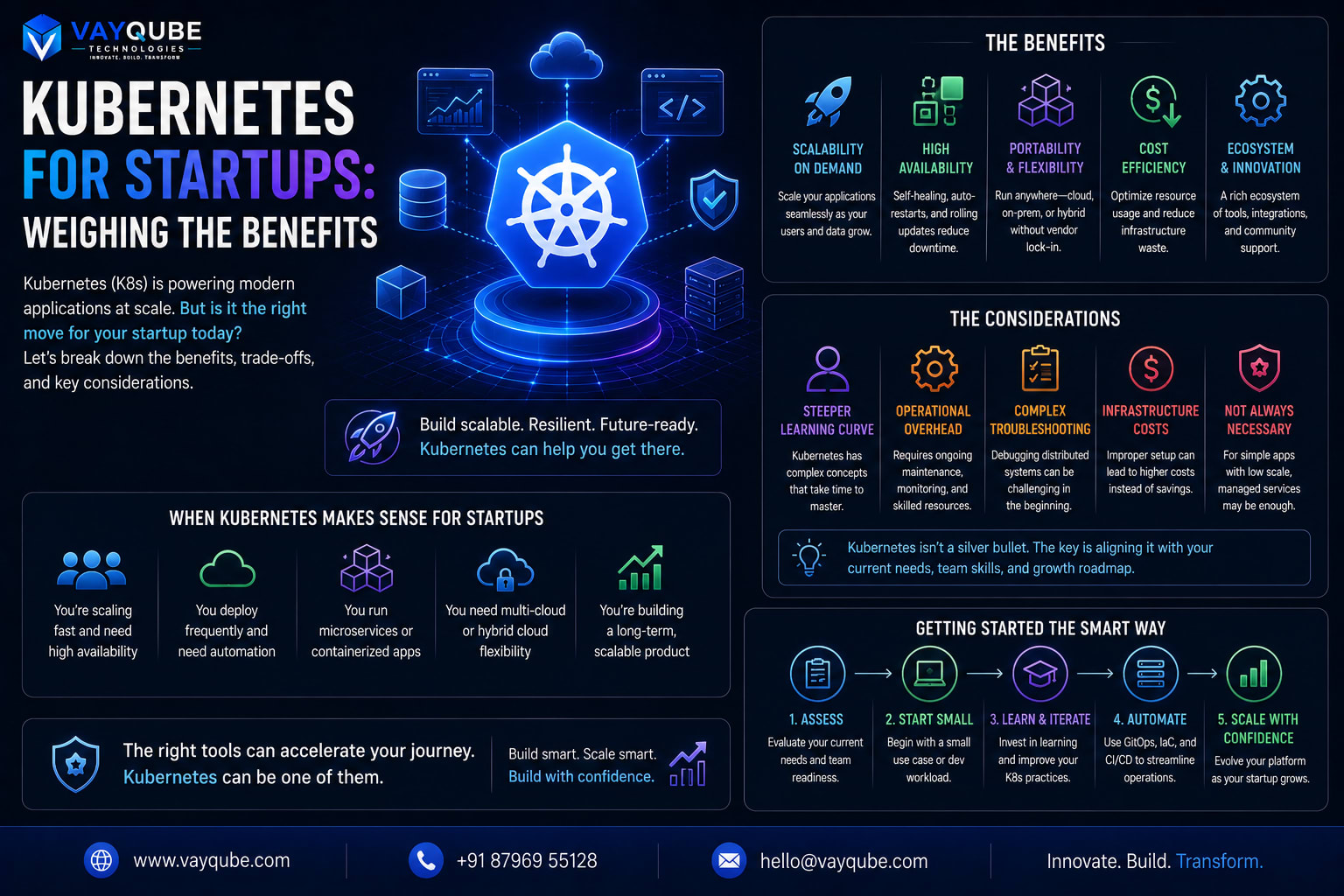
Introduction to Kubernetes for Startups
Kubernetes has become a crucial component in the infrastructure of many organizations, particularly startups. As these companies scale and grow, their infrastructure needs to adapt to meet increasing demands. Kubernetes offers a robust and scalable solution for managing containerized applications, making it an attractive option for startups looking to streamline their operations.
Overview of Kubernetes
At its core, Kubernetes is an open-source container orchestration system that automates the deployment, scaling, and management of containerized applications. It was originally designed by Google, and is now maintained by the Cloud Native Computing Foundation (CNCF). Kubernetes provides a flexible and extensible framework for managing containers, allowing developers to focus on writing code rather than managing infrastructure.
Relevance to Startups
Startups often face unique challenges when it comes to infrastructure management. They need to be able to scale quickly and efficiently, while also keeping costs under control. Kubernetes offers a number of benefits that make it particularly well-suited to startups, including:
- Scalability: Kubernetes allows startups to scale their applications quickly and efficiently, without having to worry about the underlying infrastructure.
- Flexibility: Kubernetes supports a wide range of container runtimes and frameworks, giving startups the flexibility to choose the tools that best fit their needs.
- Cost-effectiveness: By automating many of the tasks associated with container management, Kubernetes can help startups reduce their infrastructure costs.
Brief History and Evolution
Kubernetes has a rich history that dates back to the early 2000s, when Google began developing its own container orchestration system, known as Borg. Over time, Google open-sourced the project, and it eventually became the foundation for Kubernetes. Since its initial release in 2014, Kubernetes has evolved rapidly, with new features and functionality being added regularly. Today, Kubernetes is one of the most popular container orchestration systems in use, with a large and active community of developers and users.
The evolution of Kubernetes has been marked by a number of significant milestones, including the introduction of new features such as:
- Automated rolling updates
- Self-healing capabilities
- Resource monitoring and management These features have helped to make Kubernetes an even more attractive option for startups, and have contributed to its widespread adoption in the industry.
Why It Matters
Container orchestration is crucial for startups as it enables them to manage and deploy multiple containers efficiently. This is particularly important for startups that need to scale quickly and reliably.
The Importance of Container Orchestration
Container orchestration helps startups to:
- Improve resource utilization and reduce waste
- Enhance scalability and reliability
- Streamline deployment and management processes
- Increase development speed and efficiency
Key Challenges in Managing Containers
Without a robust container orchestration system, startups face several challenges, including:
- Complexity in managing multiple containers and services
- Difficulty in scaling and load balancing
- Limited visibility and monitoring capabilities
- Increased risk of errors and downtime
How Kubernetes Addresses These Challenges
Kubernetes provides a comprehensive solution to these challenges by offering:
- Automated deployment, scaling, and management of containers
- Self-healing and rolling updates for improved reliability
- Built-in monitoring and logging capabilities for enhanced visibility
- Flexible and extensible architecture for seamless integration with other tools and services
By addressing these challenges, Kubernetes enables startups to focus on developing and delivering their applications, rather than managing the underlying infrastructure. This, in turn, helps startups to accelerate their time-to-market, improve customer satisfaction, and gain a competitive edge in the market.
Real-World Implications
In real-world scenarios, Kubernetes can help startups to:
- Quickly scale their applications to meet changing demand
- Ensure high availability and reliability of their services
- Simplify their development and deployment processes
- Improve collaboration and communication among development teams
By leveraging Kubernetes, startups can overcome the complexities of container management and focus on driving business growth and innovation. This is particularly important for startups that need to move quickly and adapt to changing market conditions.
Core Architecture
To fully leverage the benefits of Kubernetes, it's essential to understand the core components and architecture of a Kubernetes cluster. A Kubernetes cluster consists of several key components that work together to provide a scalable and highly available platform for deploying and managing applications.
Components of a Kubernetes Cluster
The main components of a Kubernetes cluster include:
- Pods: The basic execution unit in Kubernetes, representing a logical host for one or more containers.
- Nodes: Machines that run pods, providing the necessary resources such as CPU, memory, and storage.
- Control Plane: The central management component responsible for maintaining the cluster's state, scheduling pods, and managing node resources.
Role of Pods, Nodes, and Control Plane
Pods are the smallest unit of deployment in Kubernetes, and they can contain one or more containers. Nodes provide the necessary resources for pods to run, and the control plane ensures that the cluster is running as intended. The control plane consists of several components, including the API server, scheduler, and controller manager, which work together to manage the cluster's state and ensure that pods are running as expected.
Networking and Storage in Kubernetes
Networking in Kubernetes is based on a flat network architecture, where all pods can communicate with each other without the need for NAT or port mapping. This is achieved through the use of a pod network, which provides a unique IP address to each pod. Storage in Kubernetes is provided through persistent volumes, which allow data to be persisted even if a pod is deleted or recreated. This ensures that data is not lost in the event of a pod failure or restart.
In a real-world scenario, a startup might use Kubernetes to deploy a web application, with multiple pods running on different nodes to provide scalability and high availability. The control plane would ensure that the pods are running as expected, and the networking and storage components would provide a reliable and efficient way to manage data and communication between pods. By understanding the core architecture of Kubernetes, startups can design and implement scalable and efficient applications that meet their business needs.
Implementation Considerations
When implementing a Kubernetes cluster, startups should consider factors such as node sizing, pod placement, and network configuration. Node sizing is critical to ensure that the cluster has sufficient resources to run the application, while pod placement is important to ensure that pods are running on the right nodes to meet performance and availability requirements. Network configuration is also crucial to ensure that pods can communicate with each other and with external services. By carefully considering these factors, startups can ensure a smooth and successful implementation of their Kubernetes cluster.
Production Readiness
To ensure production readiness, startups should focus on implementing robust monitoring and logging, as well as automated deployment and rollback processes. This includes setting up tools such as Prometheus and Grafana for monitoring, and using tools like Kubernetes Dashboard for deployment and management. By having these processes in place, startups can quickly identify and resolve issues, ensuring that their application is always available and running as expected.
Business Benefits
The implementation of Kubernetes can have a significant impact on a startup's bottom line and overall success. By leveraging the power of Kubernetes, startups can experience a range of benefits that can help them scale and grow more efficiently.
Improved Scalability and Reliability
Kubernetes enables startups to scale their applications more efficiently, allowing them to handle increased traffic and demand without a decrease in performance. This is achieved through the automated deployment and management of containers, which can be easily scaled up or down as needed. With Kubernetes, startups can ensure high availability and reliability, even in the face of unexpected spikes in traffic or demand.
Enhanced Security and Compliance
Kubernetes provides a range of security features that can help startups protect their applications and data from potential threats. These features include network policies, secret management, and role-based access control, among others. By implementing Kubernetes, startups can ensure that their applications are secure and compliant with relevant regulations, such as GDPR and HIPAA.
Increased Efficiency and Reduced Costs
The use of Kubernetes can also help startups reduce their costs and improve their overall efficiency. By automating many of the tasks associated with deployment and management, Kubernetes can help startups reduce their labor costs and minimize the risk of human error. Additionally, Kubernetes can help startups optimize their resource utilization, reducing waste and improving their overall return on investment.
Some of the key ways that Kubernetes can help startups achieve these benefits include:
- Automated deployment and management of containers
- Self-healing and automated rolling updates
- Resource utilization optimization
- Integrated logging and monitoring
- Support for multi-cloud and hybrid environments
By leveraging these features and capabilities, startups can create a more efficient, scalable, and secure infrastructure that is better equipped to handle the demands of a rapidly growing business.
Real-World Examples
Many startups have already seen significant benefits from implementing Kubernetes, including improved scalability, enhanced security, and increased efficiency. For example, companies like Pinterest and Dropbox have used Kubernetes to scale their applications and improve their overall reliability. Similarly, companies like Airbnb and Uber have used Kubernetes to improve their security and compliance posture.
Production Considerations
When implementing Kubernetes in a production environment, there are several key considerations that startups should keep in mind. These include:
- Ensuring adequate monitoring and logging
- Implementing robust security measures
- Optimizing resource utilization
- Developing a comprehensive backup and disaster recovery strategy
- Providing ongoing training and support for development teams
By carefully considering these factors and leveraging the power of Kubernetes, startups can create a highly scalable, secure, and efficient infrastructure that is well-equipped to handle the demands of a rapidly growing business.
Scalability
Scalability is a critical aspect of any startup's infrastructure, and Kubernetes offers a robust solution to meet the demands of growing applications. By leveraging Kubernetes, startups can achieve seamless horizontal scaling, ensuring their infrastructure can handle increased traffic and workload without compromising performance.
Horizontal Scaling
Horizontal scaling with Kubernetes allows startups to easily add or remove nodes as needed, enabling them to quickly respond to changes in demand. This approach ensures that applications can handle increased traffic, and startups can avoid the costs associated with over-provisioning resources. With Kubernetes, startups can scale their infrastructure in real-time, ensuring optimal resource utilization and minimizing downtime.
Automated Rolling Updates and Self-Healing
Kubernetes provides automated rolling updates and self-healing capabilities, enabling startups to deploy new versions of their applications without disrupting service. This ensures that applications remain available and responsive, even during updates or when nodes fail. Automated rolling updates and self-healing also reduce the risk of human error, minimizing downtime and ensuring that applications are always available to users.
Multi-Cloud and Hybrid Environments
Kubernetes supports multi-cloud and hybrid environments, providing startups with the flexibility to deploy their applications across different cloud providers or on-premises infrastructure. This enables startups to avoid vendor lock-in, ensuring they can choose the best infrastructure for their specific needs. With Kubernetes, startups can deploy their applications in a variety of environments, including:
- Public clouds, such as AWS, GCP, or Azure
- Private clouds, such as on-premises infrastructure or hosted private clouds
- Hybrid environments, combining public and private clouds
By supporting multi-cloud and hybrid environments, Kubernetes provides startups with the flexibility to deploy their applications in a way that meets their specific needs, ensuring they can scale and grow their infrastructure as required. This flexibility also enables startups to take advantage of the unique features and pricing models offered by different cloud providers, optimizing their infrastructure costs and performance.
Implementation Challenges
Implementing Kubernetes can be a complex and daunting task, especially for startups with limited resources and expertise. Several challenges can arise during the implementation process, which can hinder the adoption of Kubernetes.
Complexity of Setup and Configuration
Setting up and configuring a Kubernetes cluster can be a time-consuming and labor-intensive process. It requires a deep understanding of the underlying infrastructure, network configurations, and security settings. Additionally, configuring the various components of a Kubernetes cluster, such as pods, services, and deployments, can be overwhelming for developers without prior experience.
Steep Learning Curve for Developers
Kubernetes has a steep learning curve, and developers need to acquire new skills to work effectively with the platform. This can be a significant challenge for startups, as it may require significant investment in training and development. Moreover, the complexity of Kubernetes can lead to a longer time-to-market for applications, which can be a critical factor for startups that need to quickly respond to changing market conditions.
Integration with Existing Infrastructure and Tools
Integrating Kubernetes with existing infrastructure and tools can be a significant challenge. Startups may have existing investments in infrastructure, such as virtual machines, storage systems, and networking equipment, which need to be integrated with the Kubernetes cluster. Furthermore, integrating Kubernetes with existing development tools, such as continuous integration and continuous deployment (CI/CD) pipelines, can be complex and require significant customization.
Some of the key considerations for startups when implementing Kubernetes include:
- Evaluating the trade-offs between managed Kubernetes services and self-managed clusters
- Assessing the need for additional tools and services, such as monitoring and logging solutions
- Developing strategies for managing and optimizing Kubernetes resources, such as cluster autoscaling and resource allocation
- Ensuring security and compliance with industry regulations and standards
By understanding these implementation challenges, startups can better plan and prepare for the adoption of Kubernetes, and ensure a smoother transition to a containerized and microservices-based architecture.
Real-World Examples
Many startups have successfully implemented Kubernetes, and their experiences can provide valuable lessons for others. For example, companies like Pinterest and Dropbox have used Kubernetes to scale their applications and improve their development workflows. By studying these examples, startups can gain insights into the benefits and challenges of implementing Kubernetes, and develop strategies for overcoming common obstacles.
Production Considerations
When implementing Kubernetes in production, startups need to consider several key factors, including:
- High availability and disaster recovery
- Security and access control
- Monitoring and logging
- Backup and restore procedures By carefully evaluating these factors, startups can ensure that their Kubernetes implementation is production-ready and can support the needs of their business.
Use Cases
Kubernetes offers a wide range of use cases that can benefit startups in various ways.
Web Application Deployment and Management
Startups can leverage Kubernetes to streamline the deployment and management of web applications. By automating the rollout of new versions, Kubernetes enables startups to quickly respond to changing market conditions and customer needs. This leads to improved customer satisfaction and reduced downtime.
- Simplified deployment and management of web applications
- Automated rollout of new versions
- Improved customer satisfaction and reduced downtime
Microservices Architecture and Service Mesh
Kubernetes is well-suited for microservices architecture, allowing startups to break down monolithic applications into smaller, independent services. This approach enables greater flexibility, scalability, and fault tolerance.
- Break down monolithic applications into smaller services
- Greater flexibility, scalability, and fault tolerance
- Improved ability to manage complex applications
Big Data and Analytics Workloads
Startups dealing with large amounts of data can utilize Kubernetes to manage big data and analytics workloads. By providing a scalable and efficient platform, Kubernetes enables startups to process and analyze large datasets quickly and effectively.
- Scalable and efficient platform for big data and analytics workloads
- Quick and effective processing and analysis of large datasets
- Improved insights and decision-making capabilities
In real-world scenarios, startups have successfully implemented Kubernetes to improve their web application deployment and management, microservices architecture, and big data analytics workloads. For instance, a startup can use Kubernetes to deploy a web application, manage its microservices, and analyze user behavior data to inform product decisions. By leveraging Kubernetes, startups can focus on developing innovative products and services, rather than managing complex infrastructure.
Kubernetes provides a robust and scalable platform for startups to build and deploy applications, making it an attractive choice for companies looking to accelerate their growth and innovation. As startups continue to grow and evolve, Kubernetes can help them scale their infrastructure, improve efficiency, and reduce costs. With its ability to support a wide range of use cases, Kubernetes is an essential tool for startups looking to stay competitive in today's fast-paced business landscape.
Startups can begin by identifying areas where Kubernetes can add value, such as web application deployment, microservices architecture, or big data analytics. By understanding the benefits and challenges of implementing Kubernetes, startups can make informed decisions about how to leverage this powerful technology to drive their business forward. Ultimately, the key to successful Kubernetes adoption lies in careful planning, execution, and ongoing management. By prioritizing these factors, startups can unlock the full potential of Kubernetes and achieve their business goals.
Best Practices
To ensure a successful Kubernetes implementation, startups must adopt best practices that address key aspects of the platform.
Monitoring and Logging
Effective monitoring and logging are crucial for identifying issues, debugging, and optimizing Kubernetes deployments. This involves setting up tools like Prometheus, Grafana, and Fluentd to collect and analyze metrics, logs, and performance data. By doing so, startups can proactively detect potential problems, reduce downtime, and improve overall system reliability.
Security and Access Control
Security is a top priority in Kubernetes, and startups must implement robust access control measures to protect their clusters. This includes:
- Implementing role-based access control (RBAC) to restrict user permissions
- Using network policies to control traffic flow between pods
- Encrypting sensitive data with tools like Kubernetes Secret Management
- Regularly updating and patching dependencies to prevent vulnerabilities
Continuous Integration and Delivery (CI/CD) Pipelines
CI/CD pipelines are essential for streamlining the development, testing, and deployment of applications in Kubernetes. Startups can leverage tools like Jenkins, GitLab CI/CD, or CircleCI to automate the build, test, and deployment process. This enables faster time-to-market, improved code quality, and reduced errors. By integrating CI/CD pipelines with Kubernetes, startups can achieve:
- Automated rollouts and rollbacks
- Continuous monitoring and feedback
- Improved collaboration between development and operations teams
By adopting these best practices, startups can unlock the full potential of Kubernetes, ensure a smooth and efficient deployment process, and ultimately drive business success.
Implementation Considerations
When implementing these best practices, startups should consider their specific use cases, scalability requirements, and production readiness. This involves:
- Evaluating the trade-offs between different monitoring and logging tools
- Assessing the security risks and compliance requirements for their application
- Designing CI/CD pipelines that integrate with their existing development workflows
- Continuously monitoring and optimizing their Kubernetes deployment for performance, scalability, and reliability.
Real-World Examples
Many startups have successfully implemented Kubernetes using these best practices. For example, a cloud-native startup might use Prometheus and Grafana to monitor their application's performance, while implementing RBAC and network policies to ensure security and access control. By leveraging CI/CD pipelines, they can automate the deployment process, reduce errors, and improve collaboration between teams.
Production Readiness
To ensure production readiness, startups must carefully evaluate their Kubernetes deployment for scalability, performance, and reliability. This involves:
- Conducting thorough testing and quality assurance
- Implementing automated scaling and self-healing mechanisms
- Ensuring seamless integration with existing infrastructure and tools
- Continuously monitoring and optimizing the deployment for optimal performance.
By following these best practices and considering their specific implementation requirements, startups can ensure a successful Kubernetes deployment that drives business growth and success.
Frequently Asked Questions
As startups consider adopting Kubernetes, several questions often arise. This section aims to address some of the most common queries, providing clarity on the benefits and implementation of Kubernetes.
Kubernetes vs. Docker
A common point of confusion for many is the difference between Kubernetes and Docker. While both are used for containerization, they serve distinct purposes:
- Docker is a containerization platform that allows you to package, ship, and run applications in containers.
- Kubernetes, on the other hand, is an orchestration system for automating the deployment, scaling, and management of containerized applications. In essence, Docker is used for containerizing applications, whereas Kubernetes is used for managing and orchestrating those containers.
Support for Stateful Applications
Kubernetes provides support for stateful applications through its StatefulSet resource. This allows for the deployment and management of stateful applications, ensuring that each replica has a unique identity and can maintain its state even in the event of a restart or failure. Some key features of StatefulSets include:
- Stable network identities
- Stable storage
- Ordered deployment and scaling
- Automated rolling updates
System Requirements for Running Kubernetes
To run Kubernetes, your system must meet certain requirements. These include:
- A compatible operating system, such as Linux or Windows
- A minimum of 2 CPU cores
- At least 4 GB of RAM
- A compatible container runtime, such as Docker It's also important to consider the resources required for your specific workload, as these can vary significantly depending on the application and its requirements.
Additional Considerations
When evaluating Kubernetes for your startup, it's essential to consider the following:
- The complexity of your application and its requirements
- The resources and expertise available to your team
- The potential benefits and trade-offs of adopting Kubernetes By carefully weighing these factors, you can make an informed decision about whether Kubernetes is the right choice for your startup.
Conclusion
In evaluating Kubernetes for their infrastructure needs, startups must carefully consider the benefits and challenges associated with its adoption. Key takeaways from this analysis include the importance of scalability, the complexity of implementation, and the potential for significant business benefits.
Summary of Key Takeaways
- Kubernetes offers unparalleled scalability and flexibility, making it an attractive option for startups with rapidly evolving infrastructure needs.
- The core architecture of Kubernetes, while complex, provides a robust foundation for automating deployment, scaling, and management of containerized applications.
- Business benefits of Kubernetes adoption include enhanced reliability, improved resource utilization, and accelerated time-to-market for new applications and services.
- Implementation challenges, such as the need for specialized expertise and significant upfront investment, must be carefully weighed against potential benefits.
Future Outlook and Trends
The future of Kubernetes adoption looks promising, with trends indicating increasing demand for containerization and orchestration solutions. Startups that successfully navigate the challenges of Kubernetes implementation are likely to reap significant rewards in terms of scalability, reliability, and competitiveness. As the ecosystem continues to evolve, we can expect to see further simplification of implementation processes, enhanced security features, and expanded support for emerging technologies like serverless computing and edge computing.
Recommendations for Startups
For startups evaluating Kubernetes, the following recommendations are key:
- Carefully assess current infrastructure needs and future growth projections to determine whether Kubernetes is a good fit.
- Invest in developing the necessary expertise, either through internal training programs or external partnerships.
- Start small, with a limited-scale pilot project, to test and refine Kubernetes implementation before broader rollout.
- Leverage community resources, such as open-source tools and forums, to streamline implementation and troubleshooting.
- Continuously monitor and evaluate the effectiveness of Kubernetes in achieving business objectives, making adjustments as needed to optimize performance and ROI.
Related Vayqube Resources
- Startups Building Ai Products Without Large Teams
- Why Most Ai Projects Fail Before Production
- How To Build Fintech Application Payments Security Scaling
- Real Time Application Development
- Case Study Saas Platform Scaling
- Common Architecture Mistakes In Startup Products
Next Step
If your systems are struggling with scalability, automation, architecture complexity, or operational efficiency, it's time to modernize your infrastructure and workflows.
👉 Talk to a Vayqube solution architect and build systems designed for long-term production growth: