
Multi-Tenant SaaS Architecture Explained
Discover the ins and outs of multi-tenant SaaS architecture and how it can benefit your business. Learn about the key components, advantages, and best practices for implementation.
Vayqube Team
Author
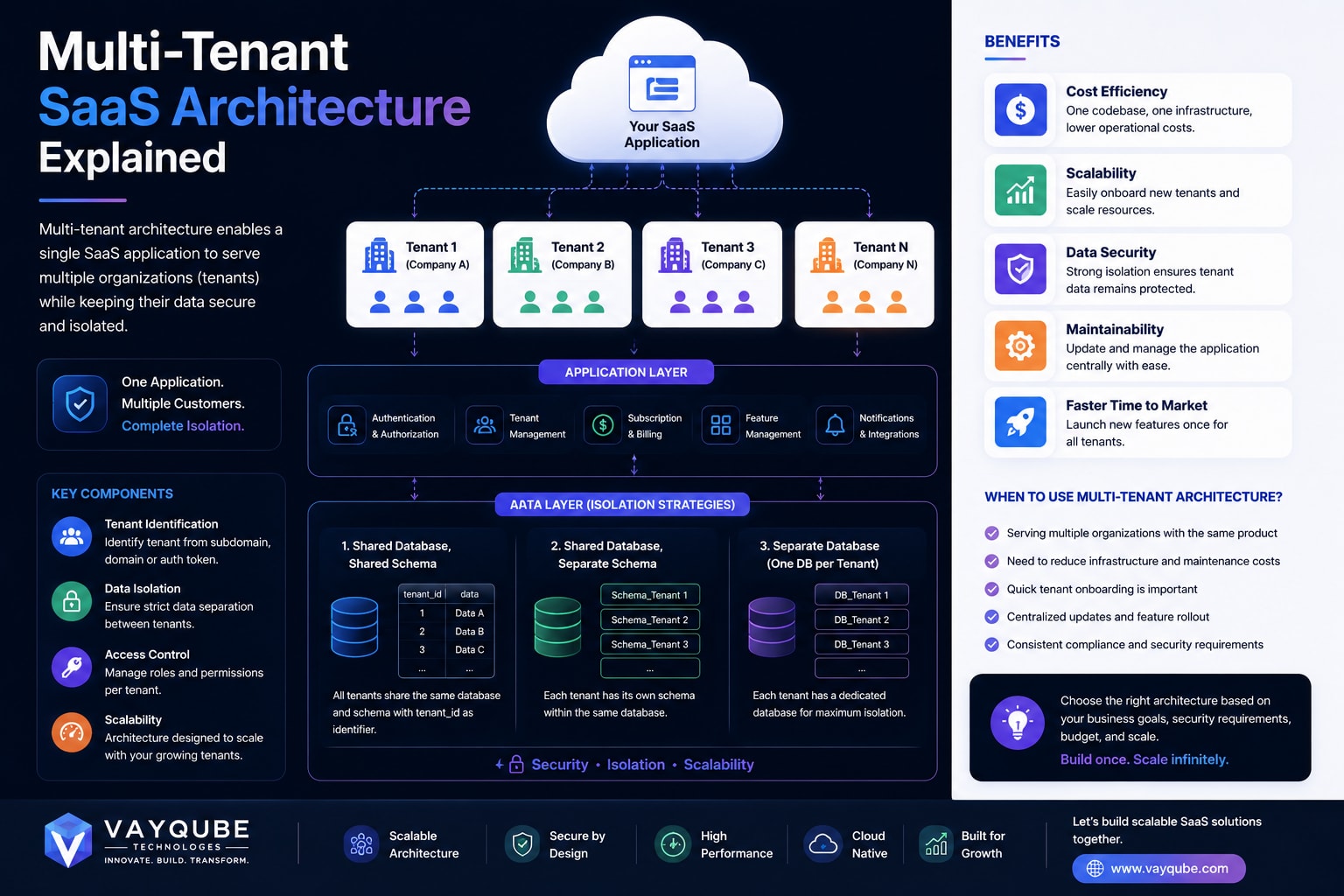
Introduction to Multi-Tenant SaaS Architecture
Multi-tenant SaaS architecture is a software design pattern that enables a single instance of an application to serve multiple tenants, each with their own dedicated space. This approach has gained popularity in recent years due to its scalability, cost-effectiveness, and ease of maintenance.
Key Characteristics
The key characteristics of a multi-tenant SaaS architecture include:
- A shared infrastructure and resources
- A single instance of the application serving multiple tenants
- Isolation of tenant data and configurations
- Customization and branding capabilities for each tenant
- Scalability and performance optimization
Benefits of Multi-Tenant SaaS
The benefits of a multi-tenant SaaS architecture are numerous. Some of the most significant advantages include:
- Reduced costs: With a shared infrastructure, the costs of development, maintenance, and support are spread across multiple tenants.
- Increased scalability: A multi-tenant architecture allows for easy scaling to meet the needs of growing tenants.
- Simplified maintenance: With a single instance of the application, updates and patches can be applied once, reducing the maintenance burden.
Real-World Examples
Real-world examples of multi-tenant SaaS architectures can be seen in popular applications such as Salesforce, Microsoft 365, and Google Workspace. These applications provide a shared platform for multiple tenants, each with their own dedicated space and customization options.
Implementation Considerations
When implementing a multi-tenant SaaS architecture, there are several key considerations to keep in mind. These include:
- Data isolation and security
- Customization and branding capabilities
- Scalability and performance optimization
- Tenant onboarding and support processes
Production Readiness
To ensure production readiness, it's essential to carefully plan and test the multi-tenant SaaS architecture. This includes:
- Conducting thorough security audits and penetration testing
- Implementing robust monitoring and logging capabilities
- Developing a comprehensive disaster recovery plan
- Establishing clear tenant onboarding and support processes
By carefully considering these factors and implementing a well-designed multi-tenant SaaS architecture, businesses can reap the benefits of this scalable and cost-effective approach.
Why It Matters
Scalability and efficiency are crucial for SaaS providers, as they directly impact the ability to onboard new customers and handle increased traffic. A well-designed multi-tenant architecture enables companies to scale more efficiently, reducing the risk of performance degradation and downtime. This, in turn, leads to improved customer satisfaction and reduced churn rates.
Cost Savings and Resource Optimization
By consolidating resources and infrastructure, multi-tenant SaaS providers can achieve significant cost savings. With a single instance of the application serving multiple customers, the costs associated with maintenance, updates, and support are substantially reduced. Additionally, resource optimization enables companies to allocate resources more effectively, ensuring that each customer receives the necessary level of service without wasting valuable resources.
Some key benefits of a multi-tenant architecture include:
- Reduced infrastructure costs
- Improved resource utilization
- Enhanced scalability and performance
- Simplified maintenance and updates
- Increased customer satisfaction and reduced churn rates
Implementation Considerations
When implementing a multi-tenant SaaS architecture, companies must consider several key factors, including data isolation, security, and customization. Data isolation is critical to ensure that each customer's data is kept separate and secure. Security measures, such as encryption and access controls, must be implemented to protect sensitive customer data. Customization options, such as branding and configuration, can also be provided to meet the unique needs of each customer.
By understanding the importance of scalability, efficiency, and cost savings, SaaS providers can design and implement a multi-tenant architecture that meets the needs of their customers while driving business growth and success.
Real-World Examples
Real-world examples of successful multi-tenant SaaS implementations can be seen in companies such as Salesforce and Dropbox. These companies have designed their architectures to scale efficiently, providing a high level of service to their customers while minimizing costs and maximizing resource utilization. By studying these examples, SaaS providers can gain valuable insights into the design and implementation of a successful multi-tenant architecture.
Production Considerations
In a production environment, a multi-tenant SaaS architecture must be designed to handle large volumes of traffic and data. This requires careful consideration of factors such as load balancing, caching, and database optimization. By optimizing these factors, SaaS providers can ensure that their application performs well under heavy loads, providing a high level of service to their customers.
Core Architecture
The core architecture of a multi-tenant SaaS application is designed to efficiently manage shared resources and infrastructure, while maintaining tenant isolation and data security. This is achieved through a combination of key components and technologies.
Shared Resources and Infrastructure
Shared resources and infrastructure are crucial in a multi-tenant SaaS architecture, as they enable cost-effective scalability and reduced operational overhead. Some of the shared resources include:
- Computing resources, such as servers and storage
- Network infrastructure, including firewalls and load balancers
- Database management systems, which provide a centralized repository for tenant data
- Security and authentication mechanisms, such as identity and access management systems
Tenant Isolation and Data Security
Tenant isolation and data security are critical considerations in a multi-tenant SaaS architecture. To ensure the confidentiality, integrity, and availability of tenant data, the following measures are typically implemented:
- Data encryption, both in transit and at rest
- Access controls, including role-based access control and multi-factor authentication
- Network segmentation, using techniques such as virtual local area networks (VLANs) and subnets
- Regular security audits and penetration testing, to identify and remediate vulnerabilities
Key Components and Technologies
The key components and technologies used in a multi-tenant SaaS architecture include:
- Cloud infrastructure, such as Amazon Web Services (AWS) or Microsoft Azure
- Containerization, using technologies like Docker and Kubernetes
- Orchestration tools, such as Apache Mesos and Marathon
- Database management systems, including relational databases like MySQL and PostgreSQL, as well as NoSQL databases like MongoDB and Cassandra
- Security and authentication mechanisms, such as OAuth and OpenID Connect
These components and technologies work together to provide a scalable, secure, and efficient multi-tenant SaaS architecture. By leveraging shared resources and infrastructure, while maintaining tenant isolation and data security, businesses can reduce costs, improve agility, and enhance the overall user experience.
Business Benefits
The multi-tenant SaaS architecture offers numerous benefits that can significantly impact a business's bottom line.
Increased Agility and Flexibility
One of the primary advantages of a multi-tenant architecture is its ability to provide increased agility and flexibility. With a single instance of the application serving multiple tenants, updates and new features can be rolled out quickly and efficiently, without the need for duplicated effort. This enables businesses to respond rapidly to changing market conditions and customer needs, staying ahead of the competition.
Improved Customer Experience
A multi-tenant SaaS architecture also enables businesses to provide a more consistent and high-quality customer experience. By sharing resources and infrastructure across multiple tenants, businesses can invest more in the development of features and functionality that directly benefit their customers. This can include advanced security measures, improved performance, and enhanced support services, all of which contribute to increased customer satisfaction and loyalty.
Enhanced Competitiveness
The scalability and cost-effectiveness of a multi-tenant SaaS architecture can also enhance a business's competitiveness. By reducing the need for duplicated infrastructure and resources, businesses can keep their costs lower and pass the savings on to their customers. This can be a major differentiator in crowded markets, where businesses are constantly looking for ways to stand out from the competition and attract price-sensitive customers. Some key benefits of this approach include:
- Reduced time-to-market for new features and updates
- Improved resource utilization and reduced waste
- Increased ability to scale and meet growing demand
- Enhanced security and compliance through shared resources and expertise
Scalability
To achieve scalability in a multi-tenant SaaS architecture, several strategies can be employed.
Horizontal Scaling and Load Balancing
Horizontal scaling involves adding more servers or instances to handle increased traffic, while load balancing distributes the workload across these instances to ensure efficient resource utilization. This approach allows the system to scale out rather than up, reducing the risk of single-point failures and improving overall system resilience. By using load balancers, traffic can be directed to the most available or least busy instance, minimizing response times and maximizing throughput.
Automated Provisioning and Deployment
Automated provisioning and deployment are critical for scalability, as they enable the rapid deployment of new instances or servers in response to changing demand. This can be achieved through the use of containerization (e.g., Docker), orchestration tools (e.g., Kubernetes), and infrastructure-as-code (IaC) solutions. These technologies automate the provisioning, deployment, and scaling of resources, reducing the time and effort required to respond to changes in workload.
Performance Monitoring and Optimization
Performance monitoring and optimization are essential for ensuring the scalability of a multi-tenant SaaS architecture. This involves collecting metrics on system performance, identifying bottlenecks, and applying optimizations to improve efficiency. Key performance indicators (KPIs) such as response times, throughput, and error rates should be monitored, and alerts should be triggered when thresholds are exceeded. By continuously monitoring and optimizing system performance, potential issues can be identified and addressed before they impact users, ensuring a high-quality experience even at scale.
Some key considerations for implementing these strategies include:
- Selecting the right cloud provider or infrastructure platform to support scalability
- Implementing automated testing and continuous integration/continuous deployment (CI/CD) pipelines to ensure rapid and reliable deployment of changes
- Using data analytics and machine learning to predict demand and optimize resource allocation
- Ensuring that the architecture is designed with scalability in mind from the outset, rather than attempting to retrofit it later.
By prioritizing scalability and implementing these strategies, multi-tenant SaaS applications can efficiently handle growing workloads, provide a high-quality user experience, and support the business goals of the organization.
Implementation Challenges
Implementing a multi-tenant SaaS architecture can be complex, and several challenges must be addressed to ensure a successful deployment.
Data Management and Security
Data management and security are critical concerns in a multi-tenant environment. Each tenant's data must be isolated and protected from unauthorized access. This can be achieved through various measures, such as:
- Encrypting data at rest and in transit
- Implementing role-based access control and multi-factor authentication
- Using secure data storage solutions, like encrypted databases or object storage
Tenant Onboarding and Support
Tenant onboarding and support are essential for a seamless user experience. A well-designed onboarding process should include:
- Automated provisioning and configuration
- Personalized welcome messages and tutorials
- Access to knowledge bases, FAQs, and community forums
- Dedicated support channels, like email, phone, or live chat
Customization and Integration
Customization and integration are key to meeting the diverse needs of tenants. A flexible architecture should allow for:
- Custom branding and white-labeling
- Integration with third-party services, like payment gateways or CRM systems
- Support for multiple deployment models, such as cloud, on-premises, or hybrid
- APIs and SDKs for custom development and extension
Effective management of these challenges requires careful planning, execution, and ongoing monitoring. By prioritizing data security, tenant experience, and customization, SaaS providers can build trust with their customers and establish a strong foundation for long-term success.
Key considerations for production environments include:
- Load balancing and autoscaling to ensure high availability
- Monitoring and logging to detect and respond to security incidents
- Regular security audits and compliance assessments to maintain regulatory adherence
- Continuous testing and validation to ensure consistent quality and reliability
By addressing these implementation challenges and considerations, SaaS providers can create a robust and scalable multi-tenant architecture that meets the needs of their customers and drives business growth.
Use Cases
Multi-tenant SaaS architecture is widely adopted in various industries, offering numerous benefits. Some notable use cases include:
- Enterprise software as a service: Companies like Salesforce and Microsoft provide SaaS solutions to businesses, leveraging multi-tenancy to reduce costs and increase scalability.
- Cloud-based productivity suites: Google Workspace and Microsoft 365 are examples of cloud-based productivity suites that utilize multi-tenant architecture to deliver a range of applications and services to users.
- E-commerce and online marketplaces: Platforms like Shopify and Amazon Web Services (AWS) use multi-tenant SaaS architecture to support thousands of online stores and marketplaces, providing a scalable and secure environment for merchants and customers.
Enterprise Software as a Service
In the enterprise software as a service sector, multi-tenant SaaS architecture enables companies to provide a single instance of their application to multiple customers, reducing the need for duplicate infrastructure and minimizing maintenance costs. This approach also facilitates easier updates and patches, as changes can be applied to a single instance rather than multiple instances.
Cloud-Based Productivity Suites
Cloud-based productivity suites benefit from multi-tenant SaaS architecture in several ways. For instance, Google Workspace's multi-tenant approach allows businesses to create and manage multiple domains, each with its own set of users and settings, while sharing the same underlying infrastructure. This not only reduces costs but also simplifies administration and enhances collaboration among users.
E-Commerce and Online Marketplaces
In the e-commerce and online marketplaces sector, multi-tenant SaaS architecture is crucial for supporting large numbers of merchants and customers. By providing a scalable and secure environment, platforms like Shopify can handle massive traffic and transaction volumes, ensuring a seamless shopping experience for customers and reliable sales processing for merchants. Additionally, multi-tenancy enables these platforms to offer customized storefronts and branding options to merchants, enhancing their overall customer experience.
Best Practices
To ensure a successful multi-tenant SaaS architecture, it's essential to follow best practices that prioritize scalability, security, and performance.
Designing for Scalability and Flexibility
Designing for scalability and flexibility is critical in a multi-tenant SaaS architecture. This involves using cloud-based infrastructure, containerization, and microservices to enable easy scaling and updates. Some key considerations include:
- Using load balancers to distribute traffic efficiently
- Implementing autoscaling to adjust resources based on demand
- Utilizing container orchestration tools like Kubernetes to manage and scale containers
Implementing Robust Security Measures
Robust security measures are vital in a multi-tenant SaaS architecture to protect sensitive customer data. Some key security considerations include:
- Implementing encryption for data in transit and at rest
- Using secure authentication and authorization protocols
- Conducting regular security audits and penetration testing to identify vulnerabilities
Monitoring and Optimizing Performance
Monitoring and optimizing performance is crucial in a multi-tenant SaaS architecture to ensure a seamless user experience. Some key performance considerations include:
- Using monitoring tools to track key performance metrics like latency and throughput
- Implementing caching and content delivery networks (CDNs) to reduce latency
- Conducting regular performance testing and optimization to identify bottlenecks and areas for improvement
By following these best practices, organizations can ensure their multi-tenant SaaS architecture is scalable, secure, and high-performing, which is essential for delivering a great user experience and driving business success.
Some real-world examples of successful multi-tenant SaaS architectures include companies like Salesforce and Dropbox, which have implemented scalable and secure architectures to support millions of users.
In terms of implementation strategy, it's essential to take a phased approach, starting with a small pilot group and gradually rolling out the architecture to larger groups of users. This approach helps to identify and address any issues early on, reducing the risk of downtime and data loss.
Production considerations are also critical, including ensuring that the architecture is designed for high availability and disaster recovery, and that regular backups and testing are performed to ensure business continuity.
Overall, a well-designed multi-tenant SaaS architecture can provide a competitive advantage for organizations, enabling them to deliver scalable, secure, and high-performing applications to their customers.
FAQ
To address common questions and concerns about multi-tenant SaaS architecture, we've compiled a list of frequently asked questions.
What is Multi-Tenancy in SaaS?
Multi-tenancy in SaaS refers to a software architecture where a single instance of the application serves multiple tenants, or customers, with each tenant's data isolated and secure. This approach allows SaaS providers to efficiently manage and maintain a single codebase, reducing costs and improving scalability.
How Does Multi-Tenancy Impact Security?
Multi-tenancy can introduce unique security challenges, as a single vulnerability can potentially affect all tenants. However, a well-designed multi-tenant architecture can also provide enhanced security features, such as:
- Data encryption and isolation
- Access controls and authentication
- Regular security audits and updates By implementing robust security measures, SaaS providers can mitigate risks and ensure the confidentiality, integrity, and availability of tenant data.
What Are the Key Benefits of Multi-Tenant SaaS?
The key benefits of multi-tenant SaaS include:
- Cost savings: Reduced infrastructure and maintenance costs
- Scalability: Easy to scale up or down to meet changing tenant demands
- Faster deployment: New features and updates can be quickly deployed to all tenants
- Improved reliability: Centralized management and monitoring enable faster issue detection and resolution
- Enhanced security: Robust security features and regular updates protect tenant data By understanding the benefits and challenges of multi-tenant SaaS, businesses can make informed decisions about their software architecture and strategy.
Conclusion
In summary, a well-designed multi-tenant SaaS architecture is crucial for businesses looking to scale and provide a seamless user experience. Key points to consider include the core architecture components, such as data isolation, resource pooling, and scalability.
Summary of Key Points
- Data isolation and security are top priorities in a multi-tenant environment
- Scalability and performance are critical for handling increased traffic and user growth
- Business benefits include reduced costs, increased agility, and improved customer satisfaction
- Implementation challenges can be overcome with careful planning, testing, and monitoring
Future of Multi-Tenant SaaS Architecture
As the SaaS industry continues to evolve, we can expect to see advancements in areas like artificial intelligence, machine learning, and cloud computing. These technologies will enable even more efficient and scalable multi-tenant architectures, allowing businesses to better serve their customers and stay ahead of the competition.
Final Thoughts and Recommendations
When implementing a multi-tenant SaaS architecture, it's essential to consider the unique needs and requirements of your business and customers. Some final recommendations include:
- Start with a solid foundation and iteratively build upon it
- Monitor and analyze performance regularly to identify areas for improvement
- Prioritize security and data isolation to protect your customers' sensitive information
- Stay up-to-date with the latest industry trends and technologies to stay competitive
- Consider seeking guidance from experienced professionals or consulting firms to ensure a successful implementation.
By following these guidelines and staying focused on the key considerations, businesses can create a robust and scalable multi-tenant SaaS architecture that drives growth, improves customer satisfaction, and sets them up for long-term success.
Related Vayqube Resources
- Multi Tenant Saas Vs Single Tenant Architecture
- Cloud Cost Optimization Strategies For Saas Startups
- Case Study Saas Platform Scaling
- Ai Powered Crm Systems Future Of Customer Management
- Why Most Ai Projects Fail Before Production
- How To Build Fintech Application Payments Security Scaling
Next Step
If your systems are struggling with scalability, automation, architecture complexity, or operational efficiency, it's time to modernize your infrastructure and workflows.
👉 Talk to a Vayqube solution architect and build systems designed for long-term production growth: