
Compare OpenAI vs Claude vs Gemini APIs
Explore the differences between OpenAI, Claude, and Gemini APIs to determine which one suits your business needs. Learn how to integrate these APIs for enhanced productivity and efficiency.
Vayqube Team
Software architecture and product engineering
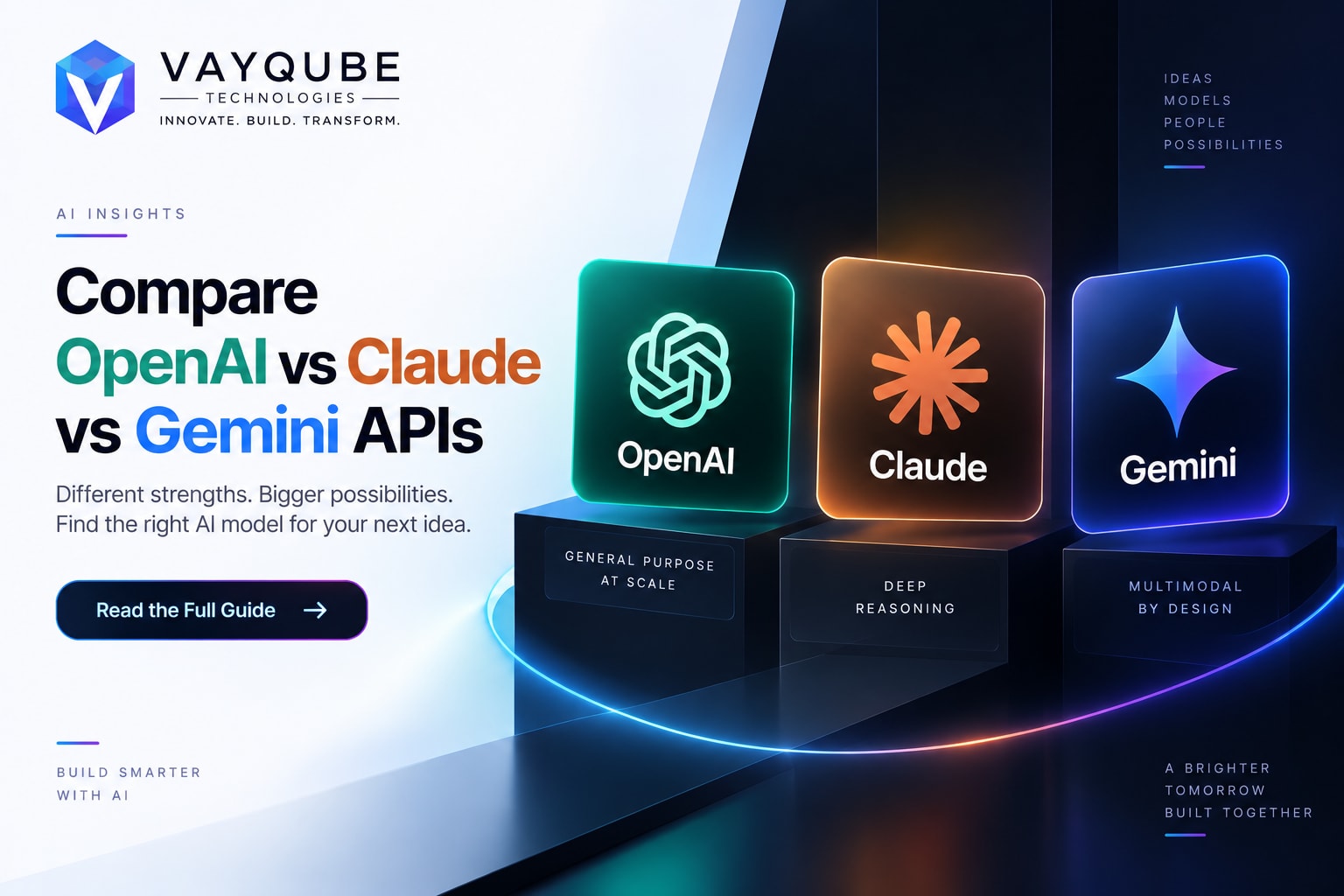
Introduction to AI APIs
The AI landscape is rapidly evolving, with numerous APIs emerging to cater to diverse business needs. OpenAI, Claude, and Gemini are three prominent players in this space, each offering unique strengths and capabilities. Understanding the differences between these APIs is crucial for businesses seeking to leverage AI to drive innovation and growth.
Overview of OpenAI, Claude, and Gemini APIs
OpenAI is a well-established player in the AI market, known for its versatile API that supports a wide range of applications, from chatbots to content generation. Claude, on the other hand, is a more recent entrant, focusing on conversational AI and offering a more specialized set of capabilities. Gemini, developed by Google, boasts an API that excels in handling complex, nuanced queries, making it an attractive option for enterprises requiring advanced AI-driven insights.
Importance of Comparing AI APIs
Comparing OpenAI, Claude, and Gemini APIs is essential for several reasons. Firstly, each API has its own set of strengths and weaknesses, and understanding these differences is vital for selecting the most suitable API for a specific business use case. Secondly, the choice of API can significantly impact the scalability, reliability, and maintainability of AI-powered applications. Finally, with the AI landscape continuously evolving, staying informed about the latest developments and advancements in AI APIs can help businesses stay ahead of the curve and capitalize on emerging opportunities.
Key considerations when evaluating these APIs include:
- Scalability: How well can the API handle large volumes of requests and data?
- Customizability: To what extent can the API be tailored to meet specific business requirements?
- Integration: How seamlessly can the API be integrated with existing systems and infrastructure?
- Cost: What are the total costs of ownership, including any upfront fees, usage charges, and support expenses?
- Security: What measures are in place to ensure the secure handling and storage of sensitive data?
By carefully evaluating these factors and understanding the unique value propositions of OpenAI, Claude, and Gemini APIs, businesses can make informed decisions about which API to use, ultimately driving more effective and efficient AI adoption.
Why It Matters
The comparison of OpenAI, Claude, and Gemini APIs has significant implications for businesses, particularly in terms of decision-making and strategy development.
Impact on Business Decision-Making
The choice of AI API can substantially influence business outcomes, as it affects the quality and reliability of insights generated. For instance, a company relying on AI-driven market analysis may opt for OpenAI's robust language processing capabilities. In contrast, another company focused on customer service chatbots might prefer Claude's more nuanced understanding of human language.
Key considerations include:
- Data quality and availability
- Model training and adaptability
- Integration with existing systems
- Scalability and performance
Role in Shaping AI Strategies
The selection of an AI API also plays a crucial role in shaping a company's overall AI strategy. By choosing an API that aligns with their goals and use cases, businesses can:
- Enhance operational efficiency
- Improve customer engagement
- Foster innovation and competitiveness
- Mitigate potential risks and biases associated with AI adoption
Real-world examples illustrate the importance of careful API selection. For example, a company like Salesforce might leverage Gemini's capabilities to develop more sophisticated customer relationship management tools. Meanwhile, a startup focused on content generation might find OpenAI's API more suitable for their needs.
Ultimately, the decision to use OpenAI, Claude, or Gemini APIs depends on a company's specific requirements, industry, and vision for AI integration. By understanding the strengths and limitations of each API, businesses can make informed decisions that drive growth, improve decision-making, and foster long-term success.
Core Architecture
The core architecture of OpenAI, Claude, and Gemini APIs differs significantly, impacting their performance, scalability, and overall functionality.
Technical Differences
Key technical differences between the three APIs include:
- Model architecture: OpenAI's API is built on top of its own transformer-based models, while Claude's API utilizes a combination of transformer and graph-based models. Gemini's API, on the other hand, is based on a proprietary model that combines elements of both transformer and graph-based architectures.
- Training data: The training data used by each API also varies. OpenAI's models are trained on a massive dataset that includes a wide range of texts from the internet, while Claude's models are trained on a more curated dataset that includes a higher proportion of high-quality, human-generated text. Gemini's training data is not publicly disclosed.
- Inference engine: The inference engines used by each API also differ. OpenAI's API uses a custom-built inference engine that is optimized for its own models, while Claude's API uses a more general-purpose inference engine that can handle a wider range of models. Gemini's API uses a proprietary inference engine that is designed to work seamlessly with its own models.
Key Features and Functionalities
In terms of key features and functionalities, the three APIs offer:
- Text generation: All three APIs offer text generation capabilities, although the quality and coherence of the generated text can vary significantly.
- Text classification: OpenAI and Claude's APIs offer text classification capabilities, while Gemini's API offers more advanced natural language understanding capabilities.
- Conversational AI: Claude's API is particularly well-suited for conversational AI applications, thanks to its ability to understand and respond to natural language inputs in a highly contextual and coherent manner.
- Customization: OpenAI's API offers a high degree of customization, allowing developers to fine-tune its models and inference engine to suit their specific use cases. Gemini's API also offers some customization options, although these are more limited than those offered by OpenAI. Claude's API offers the least amount of customization, although its models and inference engine are highly optimized for conversational AI applications.
Business Benefits
The OpenAI, Claude, and Gemini APIs offer a range of business benefits that can help organizations improve their operations and increase revenue.
Enhanced Customer Experience
By leveraging these APIs, businesses can create more personalized and engaging experiences for their customers. For example, chatbots powered by these APIs can provide 24/7 support, helping to resolve customer queries and issues more efficiently. This can lead to increased customer satisfaction and loyalty, which can have a positive impact on revenue and growth.
Improved Operational Efficiency
The APIs can also help businesses streamline their operations and reduce costs. Automated processes, such as data analysis and content generation, can free up staff to focus on higher-value tasks. Additionally, the APIs can help reduce the risk of human error, which can lead to costly mistakes and reputational damage.
Increased Revenue Potential
By leveraging the capabilities of the OpenAI, Claude, and Gemini APIs, businesses can create new revenue streams and increase their competitiveness. For example, they can use the APIs to develop new products and services, such as AI-powered content generation or virtual assistants. They can also use the APIs to improve their marketing and sales efforts, such as by analyzing customer data and developing more targeted campaigns. Some key benefits include:
- Improved customer insights
- More effective marketing and sales strategies
- Increased agility and competitiveness
- New revenue streams and business models
Overall, the OpenAI, Claude, and Gemini APIs offer a range of business benefits that can help organizations improve their operations, increase revenue, and enhance the customer experience. By leveraging these APIs, businesses can stay ahead of the competition and achieve their goals.
Implementation Considerations
When implementing these APIs, businesses should consider several key factors, including:
- Integration with existing systems and processes
- Data quality and availability
- Security and compliance
- Scalability and performance
- Ongoing maintenance and support
By carefully considering these factors, businesses can ensure a successful implementation and maximize the benefits of the OpenAI, Claude, and Gemini APIs.
Scalability
To ensure seamless performance under heavy loads, it's crucial to evaluate the scalability of OpenAI, Claude, and Gemini APIs.
Handling High-Volume Requests
When handling high-volume requests, the API's ability to process and respond to a large number of concurrent requests becomes a critical factor.
- OpenAI's API is designed to handle a large volume of requests, leveraging its robust infrastructure and distributed architecture.
- Claude's API also supports high-volume requests, utilizing its cloud-based infrastructure to scale and adapt to changing demand.
- Gemini's API, while capable of handling a significant volume of requests, may require additional configuration and optimization to achieve the same level of scalability as its competitors.
Support for Large-Scale Deployments
For large-scale deployments, the API must be able to support a wide range of use cases, from small-scale applications to enterprise-level solutions.
- OpenAI's API offers a range of features and tools to support large-scale deployments, including support for multiple models, batch processing, and advanced analytics.
- Claude's API also provides features such as automated scaling, load balancing, and advanced security measures to support large-scale deployments.
- Gemini's API, while suitable for smaller-scale deployments, may require additional development and customization to support the needs of large-scale enterprise applications.
In terms of scalability, all three APIs have their strengths and weaknesses.
- OpenAI's API excels in handling high-volume requests and supporting large-scale deployments, making it a popular choice for enterprise-level applications.
- Claude's API offers a strong balance between scalability and ease of use, making it a suitable option for a wide range of applications.
- Gemini's API, while requiring more customization and optimization, can still provide a high level of scalability and performance for smaller-scale applications.
Ultimately, the choice of API will depend on the specific needs and requirements of the application or use case. By carefully evaluating the scalability of each API, developers can make informed decisions and ensure that their applications are able to handle the demands of a rapidly changing and increasingly complex technological landscape.
When evaluating the scalability of these APIs, consider the following key factors:
- Request latency and throughput
- Support for batch processing and concurrent requests
- Automated scaling and load balancing capabilities
- Advanced security measures and access controls
- Customization and optimization options for large-scale deployments
By considering these factors and carefully evaluating the strengths and weaknesses of each API, developers can ensure that their applications are able to scale and perform optimally, even in the most demanding environments.
Implementation Challenges
When implementing OpenAI, Claude, or Gemini APIs, several challenges arise that can impact the success of the project. Two key areas of concern are integration complexities and data quality and preparation.
Integration Complexities
Integrating these APIs into existing systems can be a daunting task. The complexity of the integration process depends on various factors, such as the architecture of the system, the programming languages used, and the availability of APIs and SDKs. Some of the common integration challenges include:
- Handling different data formats and protocols
- Managing authentication and authorization
- Ensuring seamless communication between systems
- Dealing with API rate limits and quotas
- Handling errors and exceptions
Data Quality and Preparation
Data quality and preparation are crucial for the effective use of OpenAI, Claude, or Gemini APIs. The accuracy and reliability of the results depend on the quality of the input data. Some of the data-related challenges include:
- Ensuring data consistency and accuracy
- Handling missing or incomplete data
- Preprocessing data for API consumption
- Dealing with data privacy and security concerns
- Ensuring compliance with relevant regulations and standards
To overcome these challenges, it is essential to have a thorough understanding of the APIs, their strengths and weaknesses, and the specific use case. Additionally, careful planning, design, and testing are necessary to ensure a successful implementation. By acknowledging and addressing these challenges, organizations can unlock the full potential of OpenAI, Claude, and Gemini APIs and achieve their business goals.
In real-world scenarios, the implementation of these APIs often requires significant resources and expertise. For instance, a company may need to invest in data engineering and science teams to ensure the quality and preparation of the data. Furthermore, the integration process may require collaboration between different departments, such as IT, product, and engineering.
The choice of API also depends on the specific requirements of the project. For example, OpenAI's API may be more suitable for natural language processing tasks, while Claude's API may be more suitable for conversational AI applications. Gemini's API, on the other hand, may be more suitable for tasks that require a high degree of precision and accuracy.
Ultimately, the success of the implementation depends on the organization's ability to navigate the complexities of the APIs, prepare high-quality data, and integrate the APIs into their existing systems. By doing so, organizations can harness the power of AI and achieve significant business benefits, such as improved customer experience, increased efficiency, and enhanced decision-making capabilities.
Use Cases
The OpenAI, Claude, and Gemini APIs have various applications across industries, with some of the most notable use cases including:
- Virtual assistants: integrating these APIs into virtual assistants can enhance their ability to understand and respond to user queries, providing more accurate and helpful responses.
- Content generation: the APIs can be used to generate high-quality content, such as articles, social media posts, and product descriptions, saving time and resources for businesses.
- Sentiment analysis: the APIs can analyze user feedback and sentiment, providing valuable insights for businesses to improve their products and services.
Virtual Assistants
Virtual assistants, such as chatbots and voice assistants, can greatly benefit from the integration of these APIs. By leveraging the natural language processing capabilities of the OpenAI, Claude, and Gemini APIs, virtual assistants can better understand user queries and provide more accurate responses. This can lead to improved user experiences, increased customer satisfaction, and reduced support queries.
Content Generation
Content generation is another significant use case for these APIs. By utilizing the language generation capabilities of the OpenAI, Claude, and Gemini APIs, businesses can automate the creation of high-quality content, such as blog posts, social media posts, and product descriptions. This can save time and resources, while also improving the consistency and quality of the content.
Sentiment Analysis
Sentiment analysis is a critical application of the OpenAI, Claude, and Gemini APIs. By analyzing user feedback and sentiment, businesses can gain valuable insights into their products and services, identifying areas for improvement and optimizing their offerings to meet customer needs. This can lead to improved customer satisfaction, increased loyalty, and reduced churn.
Some real-world examples of sentiment analysis include:
- Analyzing customer reviews to identify trends and patterns
- Monitoring social media conversations to gauge public opinion
- Evaluating customer support queries to identify areas for improvement
These use cases demonstrate the potential of the OpenAI, Claude, and Gemini APIs to drive business value and improve customer experiences. By leveraging these APIs, businesses can unlock new opportunities for growth, innovation, and competitiveness.
Best Practices
To maximize the potential of OpenAI, Claude, and Gemini APIs, it's essential to follow best practices in API selection and implementation.
API Selection Criteria
When choosing an API, consider the following factors:
- Model architecture: Assess the underlying model architecture and its suitability for your specific use case.
- Language support: Evaluate the API's language support and ensure it aligns with your application's requirements.
- Scalability: Consider the API's ability to handle increased traffic and large volumes of data.
- Pricing: Compare pricing models and choose the one that best fits your budget and usage needs.
- Integration complexity: Assess the complexity of integrating the API with your existing infrastructure.
Effective Implementation Strategies
To ensure successful implementation, follow these strategies:
- Start with a clear use case: Define a specific use case and ensure the API aligns with your goals.
- Develop a robust testing framework: Create a comprehensive testing framework to validate API performance and accuracy.
- Monitor and analyze API performance: Continuously monitor API performance and analyze metrics to identify areas for improvement.
- Implement robust error handling: Develop a robust error handling mechanism to handle API errors and exceptions.
- Ensure security and compliance: Implement proper security measures and ensure compliance with relevant regulations and standards.
By following these best practices and considering the unique characteristics of each API, you can make an informed decision and ensure successful implementation.
Real-World Examples
Consider the example of a chatbot application that requires advanced language understanding and generation capabilities. In this case, OpenAI's API might be the best choice due to its advanced model architecture and language support. On the other hand, a simple Q&A application might be better suited for Gemini's API, which offers a more straightforward and easy-to-integrate solution.
Production Considerations
When deploying APIs in production, consider the following factors:
- Traffic management: Develop a strategy to manage increased traffic and ensure the API can handle large volumes of requests.
- Load balancing: Implement load balancing to distribute traffic evenly and prevent single points of failure.
- Caching and content delivery: Implement caching and content delivery networks to reduce latency and improve performance.
- Security and authentication: Ensure proper security measures are in place, including authentication, authorization, and encryption.
FAQ
The OpenAI, Claude, and Gemini APIs have garnered significant attention in the tech community, leading to a multitude of questions and misconceptions. Here, we address some of the most common queries and provide troubleshooting tips for a smoother integration experience.
Common Questions and Misconceptions
Some of the frequently asked questions about these APIs include:
- What are the primary differences between OpenAI, Claude, and Gemini APIs?
- How do their pricing models compare, and what are the cost implications for businesses?
- Which API offers the most advanced features and capabilities?
- Are there any significant security or compliance concerns when using these APIs?
Troubleshooting Tips
When integrating these APIs into your application or service, you may encounter several issues. Here are some troubleshooting tips to help you overcome common problems:
- API Key Issues: Ensure that your API keys are correctly formatted and not expired. Double-check the documentation for each API to understand their specific key requirements.
- Rate Limiting: Be mindful of the rate limits imposed by each API. Implementing queueing or caching mechanisms can help mitigate the risk of hitting these limits.
- Data Quality: The quality of the input data significantly affects the output. Ensure that your data is clean, well-formatted, and relevant to the task at hand.
- Error Handling: Implement robust error handling mechanisms to catch and manage API errors effectively. This will help prevent application crashes and improve overall user experience.
- Documentation and Support: Leverage the official documentation and support channels provided by each API. These resources often contain valuable information, examples, and community-driven solutions to common issues.
Conclusion
The comparison of OpenAI, Claude, and Gemini APIs reveals distinct strengths and weaknesses in their core architecture, business benefits, scalability, and implementation challenges.
Key Takeaways
- Each API has unique features, such as OpenAI's general-purpose AI model, Claude's focus on conversational AI, and Gemini's emphasis on search and retrieval.
- Business benefits vary, with OpenAI offering flexibility, Claude providing ease of integration, and Gemini delivering high accuracy in search results.
- Scalability and implementation challenges differ, with OpenAI requiring significant computational resources, Claude needing careful tuning for conversational flows, and Gemini demanding precise query formulation.
Future Outlook
The future of AI APIs looks promising, with ongoing advancements in natural language processing, machine learning, and cloud computing. As these technologies continue to evolve, we can expect AI APIs to become even more sophisticated, accessible, and integral to various industries and applications.
Some potential developments on the horizon include:
- Increased adoption of multimodal interaction, where AI APIs can seamlessly process and respond to different forms of input, such as text, voice, and images.
- Greater emphasis on explainability and transparency in AI decision-making, enabling more trustworthy and accountable AI systems.
- Further expansion of AI APIs into new domains, such as education, healthcare, and finance, where they can drive meaningful innovation and improvement.
By understanding the current landscape and future directions of AI APIs, businesses and developers can better navigate the complex and rapidly changing world of artificial intelligence, making informed decisions about which APIs to leverage and how to integrate them into their products and services.
The choice between OpenAI, Claude, and Gemini ultimately depends on specific use cases, scalability requirements, and implementation considerations. As the AI ecosystem continues to mature, it is essential to stay informed about the latest advancements and to carefully evaluate the trade-offs and opportunities presented by each API.
Related Vayqube Resources
- Common Architecture Mistakes In Startup Products
- Ai Powered Crm Systems Future Of Customer Management
- Openai Vs Claude Vs Gemini Ai Model Comparison
- Cloud Cost Optimization Strategies For Saas Startups
- Best Mobile App Development Company In Usa
- Best Mobile App Development Company In New York
Next Step
If your systems are struggling with scalability, automation, architecture complexity, or operational efficiency, it's time to modernize your infrastructure and workflows.
👉 Talk to a Vayqube solution architect and build systems designed for long-term production growth: