
SaaS Architecture Trends for Startups in 2026
Stay ahead of the curve with the top SaaS architecture trends of 2026, designed to drive scalability, security, and growth for startups and businesses alike.
Vayqube Team
Author
Introduction to SaaS Architecture Trends
The SaaS landscape is evolving rapidly, driven by advancements in technology and changing user expectations. Startups must stay ahead of the curve to remain competitive, and understanding the latest SaaS architecture trends is crucial for success.
Overview of Current Trends
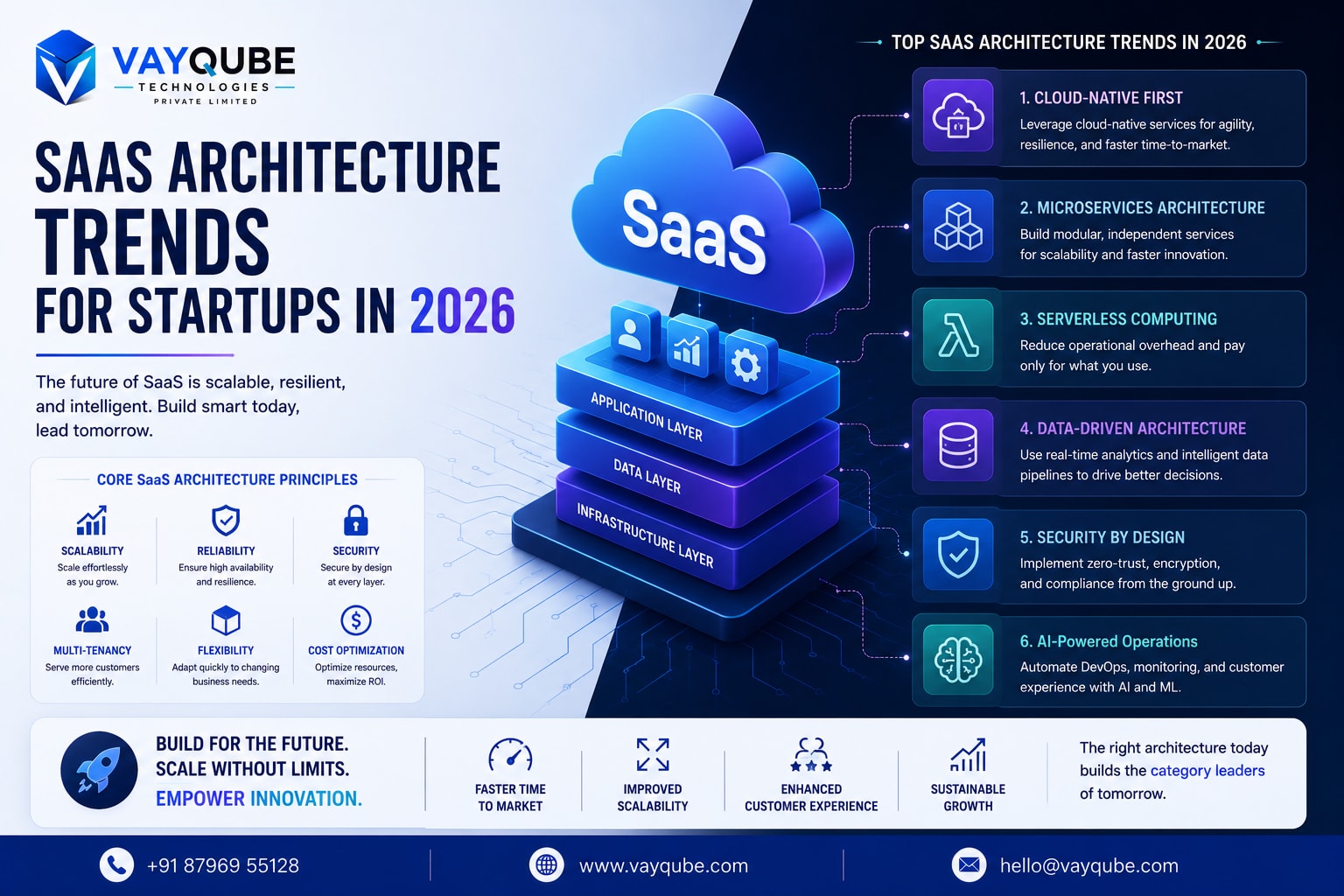
SaaS architecture trends in 2026 are focused on scalability, security, and flexibility. With the rise of cloud-native applications, startups are adopting microservices-based architectures, serverless computing, and containerization to improve application performance and reduce costs. These trends enable businesses to respond quickly to changing market conditions and customer needs.
Importance of Adapting to Change
The technology landscape is constantly shifting, with new innovations and breakthroughs emerging regularly. Startups that fail to adapt to these changes risk being left behind, losing market share to more agile competitors. By embracing the latest SaaS architecture trends, startups can improve their time-to-market, reduce operational complexity, and enhance customer satisfaction.
Current State of SaaS in 2026
In 2026, the SaaS market is characterized by increased adoption of artificial intelligence, machine learning, and the Internet of Things (IoT). Startups are leveraging these technologies to create more personalized and interactive user experiences, driving engagement and loyalty. The current state of SaaS is also marked by a growing emphasis on security, compliance, and data privacy, as businesses navigate complex regulatory environments and mitigate potential risks.
Key considerations for startups in 2026 include:
- Developing scalable and secure architectures to support growing user bases and increasingly complex applications
- Integrating emerging technologies, such as AI and IoT, to drive innovation and differentiation
- Ensuring compliance with evolving regulatory requirements and industry standards
- Fostering a culture of continuous innovation and experimentation to stay ahead of the competition
As the SaaS landscape continues to evolve, startups must prioritize flexibility, agility, and customer-centricity to succeed. By understanding and embracing the latest SaaS architecture trends, businesses can position themselves for long-term growth and success in an increasingly competitive market.
Implementation Considerations
When implementing the latest SaaS architecture trends, startups should consider the following factors:
- Technical debt and the potential impact on future development and maintenance
- The need for ongoing training and upskilling to ensure that development teams have the necessary expertise
- The importance of monitoring and evaluating the effectiveness of new technologies and architectures
- The potential risks and challenges associated with adopting emerging technologies, such as security vulnerabilities and integration complexities.
Why It Matters
The SaaS architecture of a startup has a profound impact on its business growth. A well-designed architecture can be the difference between a startup that scales efficiently and one that falters under the weight of its own success.
Business Growth Implications
A SaaS architecture that is modular, flexible, and adaptable can facilitate faster time-to-market for new features and services, thereby driving revenue growth. On the other hand, a rigid and inflexible architecture can hinder innovation and slow down the development process, ultimately affecting the bottom line.
Scalability and Reliability
The role of architecture in ensuring scalability and reliability cannot be overstated. A startup with a scalable architecture can handle increased traffic and user demand without a significant decrease in performance, thereby ensuring high uptime and reliability. This, in turn, leads to higher customer satisfaction and retention rates.
Consequences of Poor Architecture
The consequences of poor SaaS architecture on startup success can be severe. Some of the potential consequences include:
- Increased maintenance costs due to technical debt
- Reduced scalability, leading to decreased performance under load
- Higher risk of downtime and data loss
- Decreased ability to innovate and adapt to changing market conditions
- Negative impact on customer experience and retention
Real-World Examples
Many successful startups have attributed their success to a well-designed SaaS architecture. For example, companies like Netflix and Airbnb have built scalable and reliable architectures that have enabled them to handle massive user growth without compromising performance. On the other hand, startups with poor architectures have often struggled to scale and have ultimately failed to achieve their full potential.
Production Considerations
When designing a SaaS architecture, startups must consider production readiness from the outset. This includes factors such as:
- Infrastructure provisioning and management
- Monitoring and logging
- Security and compliance
- Backup and disaster recovery
- Continuous integration and delivery
By prioritizing these considerations and designing a scalable and reliable architecture, startups can set themselves up for success and achieve their business goals.
Core Architecture
The core architecture of a SaaS application is crucial for its scalability, reliability, and maintainability. When designing the core architecture, startups must consider several factors, including the trade-offs between microservices and monolithic architecture, the benefits of cloud-native design principles, and the role of service-oriented architecture (SOA).
Microservices vs Monolithic Architecture
Microservices architecture has gained popularity in recent years due to its ability to provide greater flexibility, scalability, and fault tolerance. In a microservices architecture, the application is broken down into smaller, independent services that communicate with each other through APIs. This approach allows for easier maintenance, updates, and scaling of individual services without affecting the entire application. On the other hand, monolithic architecture is a traditional approach where the entire application is built as a single, self-contained unit. While monolithic architecture can be simpler to develop and deploy, it can become cumbersome and rigid as the application grows.
Cloud-Native Design Principles
Cloud-native design principles are essential for building scalable and efficient SaaS applications. These principles include designing for scalability, using cloud-based services, and leveraging automation and orchestration tools. By adopting cloud-native design principles, startups can build applications that are optimized for the cloud, reducing the need for manual intervention and minimizing the risk of downtime. Some key benefits of cloud-native design principles include:
- Reduced infrastructure costs
- Improved scalability and performance
- Enhanced security and compliance
- Faster time-to-market
Service-Oriented Architecture (SOA)
Service-oriented architecture (SOA) is an architectural style that structures an application as a collection of services that communicate with each other. SOA provides a number of benefits, including:
- Improved reusability and modularity
- Enhanced flexibility and scalability
- Simplified integration with other applications and services
- Better alignment with business processes and goals By adopting SOA, startups can build applications that are more agile, responsive, and aligned with their business needs. Additionally, SOA enables startups to leverage existing services and applications, reducing the need for redundant development and improving overall efficiency.
Business Benefits
The SaaS architecture trends emerging in 2026 offer numerous benefits for startups, particularly in terms of increased agility, improved customer experience, and enhanced collaboration.
Agility and Time-to-Market
Startups can leverage SaaS architecture to accelerate their development cycles, allowing for faster deployment of new features and services. This increased agility enables them to respond quickly to changing market conditions and customer needs, ultimately reducing the time-to-market for new products and services. Key advantages include:
- Rapid deployment of new applications and services
- Faster iteration and improvement of existing offerings
- Increased competitiveness in the market
Personalized Customer Experience
SaaS architecture also enables startups to provide personalized services to their customers, leading to improved customer satisfaction and loyalty. By leveraging data analytics and AI-powered tools, startups can offer tailored experiences that meet the unique needs of each customer. This includes:
- Customized user interfaces and workflows
- Targeted marketing and advertising efforts
- Proactive support and issue resolution
Collaboration and Operational Efficiency
Furthermore, SaaS architecture facilitates enhanced collaboration among teams and reduces operational costs. With SaaS, startups can provide secure, role-based access to critical applications and data, ensuring that teams can work together seamlessly. Additional benefits include:
- Automated workflows and processes
- Reduced infrastructure and maintenance costs
- Improved data security and compliance
By adopting these SaaS architecture trends, startups can position themselves for success in 2026 and beyond, driving business growth and competitiveness through increased agility, improved customer experience, and enhanced collaboration.
Scalability
To ensure the long-term success of a SaaS application, scalability is a critical factor that must be considered from the outset. As the user base grows, the application must be able to handle increased traffic and data storage without compromising performance.
Horizontal vs Vertical Scaling Strategies
When it comes to scaling, there are two primary strategies: horizontal and vertical scaling. Horizontal scaling involves adding more servers or instances to distribute the load, while vertical scaling involves increasing the power of existing servers.
- Horizontal scaling is often preferred as it allows for more flexibility and can be more cost-effective in the long run.
- Vertical scaling, on the other hand, can be more complex and may require significant upgrades to existing infrastructure.
Load Balancing and Autoscaling Techniques
To ensure efficient scaling, load balancing and autoscaling techniques are essential. Load balancing distributes incoming traffic across multiple servers to prevent any one server from becoming overwhelmed.
- Autoscaling allows the application to automatically add or remove servers as needed, ensuring that resources are utilized efficiently.
- By implementing load balancing and autoscaling, startups can ensure their application remains performant even during periods of high traffic.
Database Scaling and Performance Optimization
Database scaling is another critical aspect of ensuring the overall scalability of a SaaS application. As the amount of data stored grows, the database must be able to handle increased queries and transactions without compromising performance.
- Techniques such as sharding, replication, and caching can be used to optimize database performance and ensure scalability.
- Additionally, startups should consider using cloud-based database services that offer automatic scaling and performance optimization, reducing the need for manual intervention.
By considering these scalability strategies and techniques, startups can ensure their SaaS application is well-equipped to handle growth and provide a high-quality user experience. This, in turn, can drive business success and help the startup to establish a strong presence in the market.
Real-World Examples and Production Considerations
In real-world scenarios, startups have successfully implemented scalable architectures to support their growth.
- For example, companies like Netflix and Uber have used horizontal scaling and load balancing to handle massive traffic and user bases.
- When implementing a scalable architecture, startups should consider production readiness and ensure that their application can handle real-world traffic and usage patterns.
- This includes testing the application under various loads and scenarios to identify potential bottlenecks and areas for optimization.
By prioritizing scalability and implementing the right strategies and techniques, startups can set themselves up for success and create a SaaS application that can handle growth and provide a high-quality user experience.
Implementation Challenges
Implementing a SaaS architecture can be a complex and daunting task, especially for startups. Several challenges must be addressed to ensure a successful transition.
Technical Debt Management
Technical debt management and refactoring are critical aspects of SaaS implementation. As the architecture evolves, technical debt can accumulate, leading to increased maintenance costs and decreased system performance. To mitigate this, startups must prioritize refactoring and technical debt management, ensuring that the architecture remains scalable and maintainable. This can be achieved by:
- Implementing a continuous integration and continuous deployment (CI/CD) pipeline
- Conducting regular code reviews and refactorings
- Establishing a culture of technical excellence and accountability
Cultural and Organizational Shifts
SaaS adoption requires significant cultural and organizational shifts. Startups must be willing to adapt to a more agile and iterative development process, prioritizing customer feedback and continuous improvement. This may involve:
- Embracing a DevOps culture and mindset
- Establishing cross-functional teams and collaboration
- Fostering a culture of experimentation and learning
Security and Compliance Considerations
Security and compliance are paramount in SaaS implementation. Startups must ensure that their architecture meets the required security and compliance standards, such as GDPR, HIPAA, or PCI-DSS. This can be achieved by:
- Implementing robust security measures, such as encryption and access controls
- Conducting regular security audits and penetration testing
- Establishing a compliance framework and governance structure
To overcome these implementation challenges, startups must be proactive and strategic in their approach. By prioritizing technical debt management, cultural and organizational shifts, and security and compliance considerations, startups can ensure a successful SaaS implementation and position themselves for long-term success.
Real-World Examples
Real-world examples of successful SaaS implementations can provide valuable insights and lessons learned. For instance, companies like Salesforce and Zendesk have demonstrated the importance of prioritizing scalability, security, and customer feedback in their SaaS architectures. By studying these examples and applying the lessons learned, startups can navigate the complexities of SaaS implementation and achieve their business goals.
Production Readiness
Production readiness is a critical aspect of SaaS implementation. Startups must ensure that their architecture is designed for production, with adequate monitoring, logging, and analytics in place. This enables startups to quickly identify and resolve issues, ensuring high availability and performance. By prioritizing production readiness, startups can minimize downtime and ensure a seamless customer experience.
Use Cases
Successful SaaS implementations can be seen in various industries, with real-world examples providing valuable insights for startups.
Industry-Specific Implementations
Some notable examples include:
- Healthcare: Telemedicine platforms that enable remote patient consultations and medical record management
- Finance: Digital payment processing systems that facilitate secure transactions and compliance with regulatory requirements
- E-commerce: Personalized product recommendation engines that drive sales and enhance customer experience
These implementations demonstrate the versatility and potential of SaaS solutions in addressing industry-specific challenges.
Lessons from Failed Projects
Failed SaaS projects can also provide valuable lessons for startups, highlighting common pitfalls to avoid. Some key takeaways include:
- Insufficient market research and understanding of customer needs
- Inadequate scalability and infrastructure planning
- Poor security and data protection measures
- Ineffective change management and user adoption strategies
By learning from these mistakes, startups can develop more effective implementation strategies and mitigate potential risks.
Real-World Examples
Real-world examples of successful SaaS implementations can be seen in companies such as:
- Zoom, which has revolutionized the video conferencing landscape with its scalable and user-friendly platform
- Salesforce, which has dominated the CRM market with its comprehensive and customizable solution
- Dropbox, which has simplified file sharing and collaboration with its intuitive and secure platform
These examples demonstrate the potential of SaaS solutions to drive business growth, improve customer experience, and establish market leadership.
Implementation Strategies
To achieve successful SaaS implementations, startups should focus on developing a deep understanding of their target market and customer needs. This can be achieved through:
- Conducting thorough market research and analysis
- Engaging with customers and gathering feedback
- Developing a robust and scalable architecture
- Implementing effective security and data protection measures
- Fostering a culture of innovation and continuous improvement
By following these strategies, startups can increase their chances of success and establish a strong foundation for growth and expansion.
Best Practices
To ensure a robust and efficient SaaS architecture, startups must adopt best practices that prioritize scalability, reliability, and maintainability.
Designing for Scalability and Reliability
Designing a SaaS architecture that scales with the business is crucial for startups. This involves selecting the right cloud infrastructure, designing microservices that can be easily updated and maintained, and implementing load balancing and autoscaling to handle increased traffic. By doing so, startups can ensure their application remains performant and reliable, even as the user base grows.
Implementing Continuous Integration and Delivery (CI/CD)
Implementing CI/CD pipelines is essential for SaaS startups, as it enables them to quickly release new features and updates while ensuring the quality and stability of the application. Key components of a CI/CD pipeline include automated testing, continuous integration, and continuous deployment. By automating the testing and deployment process, startups can reduce the risk of errors and improve the overall quality of their application.
Monitoring and Logging Strategies
Effective monitoring and logging strategies are critical for identifying and resolving issues in SaaS applications. This includes implementing metrics and logging tools to track performance, errors, and user behavior. By monitoring key metrics and logs, startups can quickly identify issues, optimize their application, and improve the overall user experience. Some key monitoring and logging strategies include:
- Implementing application performance monitoring (APM) tools to track performance and errors
- Using log aggregation tools to collect and analyze logs from multiple sources
- Setting up alerts and notifications to inform teams of issues and errors
- Conducting regular security audits and penetration testing to identify vulnerabilities
By adopting these best practices, SaaS startups can ensure their application is scalable, reliable, and maintainable, ultimately driving business growth and success.
Real-World Examples
Many successful SaaS startups have adopted these best practices to drive their growth and success. For example, companies like Netflix and Airbnb have implemented CI/CD pipelines and monitoring strategies to ensure the quality and reliability of their applications. By leveraging these strategies, startups can improve their time-to-market, reduce errors, and deliver a better user experience.
Production Considerations
When implementing these best practices in production, startups must consider several key factors, including:
- Ensuring the scalability and reliability of the application
- Implementing robust security measures to protect user data
- Conducting regular backups and disaster recovery planning
- Providing training and support for development teams to ensure they can effectively use CI/CD pipelines and monitoring tools.
FAQ
The SaaS architecture landscape can be complex, and startups often have questions about how to navigate it. Here are some common questions and concerns about SaaS architecture and implementation.
Security Concerns
Security is a top priority for any SaaS startup. Some common questions include:
- How do I ensure the security of my users' data?
- What measures can I take to prevent unauthorized access to my application?
- How do I comply with industry standards and regulations, such as GDPR and HIPAA?
Scalability and Cost
Scalability and cost are also major concerns for SaaS startups. Some common questions include:
- How do I scale my application to meet growing demand?
- What are the costs associated with scaling my application, and how can I optimize them?
- How do I balance the need for scalability with the need to control costs?
Additional Resources
For startups looking to learn more about SaaS architecture and implementation, there are many additional resources available. Some recommended resources include:
- Industry reports and research studies on SaaS trends and best practices
- Online courses and tutorials on SaaS development and deployment
- Communities and forums for SaaS founders and developers to connect and share knowledge
Addressing Concerns
Addressing concerns about security, scalability, and cost is crucial for SaaS startups. By prioritizing security, optimizing scalability, and controlling costs, startups can build a strong foundation for their application and set themselves up for success. Some key strategies for addressing these concerns include:
- Implementing robust security measures, such as encryption and access controls
- Using cloud-based infrastructure to scale efficiently and cost-effectively
- Monitoring and optimizing application performance to minimize downtime and errors
Real-World Examples
Real-world examples of successful SaaS startups can provide valuable insights and lessons for founders and developers. For example, companies like Salesforce and Dropbox have built highly scalable and secure applications that meet the needs of millions of users. By studying these examples and learning from their experiences, SaaS startups can gain a better understanding of how to build and deploy successful applications.
Further Learning
For further learning, startups can explore topics such as:
- Microservices architecture and its benefits for scalability and flexibility
- DevOps practices and tools for streamlining development and deployment
- Cloud-based services and platforms for building and deploying SaaS applications.
Conclusion
As we reflect on the SaaS architecture trends for startups in 2026, it's clear that the landscape is evolving rapidly. Key takeaways from our discussion include the importance of cloud-native designs, microservices architecture, and DevOps practices. These elements are crucial for building scalable, secure, and efficient SaaS applications that meet the demands of modern users.
Recap of Key Takeaways
- Cloud-native designs enable greater flexibility and scalability
- Microservices architecture allows for more agile development and deployment
- DevOps practices bridge the gap between development and operations teams
- Real-time data analytics and AI-driven insights are becoming essential for competitive advantage
- Security and compliance remain top priorities in SaaS architecture
Future Outlook
Looking ahead, we can expect even more emphasis on serverless computing, edge computing, and hybrid cloud environments. Startups that adapt to these trends will be better positioned to innovate, disrupt markets, and capture new opportunities. The future of SaaS architecture will be shaped by the need for greater agility, resilience, and customer-centricity.
Call to Action
For startups aiming to thrive in 2026, it's essential to prioritize SaaS architecture that is modular, scalable, and aligned with business goals. This requires a deep understanding of the latest trends, technologies, and best practices. By embracing cloud-native designs, microservices architecture, and DevOps practices, startups can build a strong foundation for growth, innovation, and success. The time to adapt and evolve is now – startups that do so will be well-positioned to lead the next wave of SaaS innovation and disruption.
Production Readiness
To ensure production readiness, startups should focus on implementing automated testing, continuous integration, and continuous deployment (CI/CD) pipelines. This will enable them to respond quickly to changing market conditions, customer needs, and emerging trends. By prioritizing production readiness, startups can minimize downtime, reduce errors, and maximize the value of their SaaS applications.
Real-World Examples
Companies like Netflix, Airbnb, and Uber have already demonstrated the power of modern SaaS architecture. These organizations have built scalable, secure, and efficient applications that meet the needs of millions of users worldwide. By studying these examples and applying the lessons learned, startups can create their own success stories and thrive in the competitive SaaS landscape of 2026.
Next Steps
To get started, startups should assess their current SaaS architecture and identify areas for improvement. This may involve conducting a thorough review of their technology stack, development processes, and operational practices. By taking a proactive and strategic approach to SaaS architecture, startups can set themselves up for long-term success and create a strong foundation for growth and innovation.
Related Vayqube Resources
- Case Study Saas Platform Scaling
- Startups Building Ai Products Without Large Teams
- Ai Agents Changing Customer Support Operations 2026
- Businesses Replacing Manual Workflows With Ai Agents 2026
- The Real Cost Of Building Ai Products
- How To Build Fintech Application Payments Security Scaling
Next Step
If your systems are struggling with scalability, automation, architecture complexity, or operational efficiency, it's time to modernize your infrastructure and workflows.
👉 Talk to a Vayqube solution architect and build systems designed for long-term production growth: