
SEO vs AEO vs GEO 2026: What’s Really Changing in Search
SEO, AEO, and GEO aren’t replacements — they’re evolving layers of visibility in an AI-first search world. Learn how to align your content strategy for 2026 without chasing hype.
Vayqube Team
Software architecture and product engineering
Introduction: The Search Landscape in 2026
Search in 2026 is driven by large language models that interpret intent, retrieve relevant passages, and generate attributed answers. Zero‑click results and AI overviews now dominate informational queries, shifting visibility from “ranking on page one” to “being cited, understood, and trusted by an AI‑generated response.”
AEO (Answer Engine Optimization) and GEO (Generative Engine Optimization) emerged to address the new realities of LLM‑powered search. AEO focuses on making content directly quotable for AI summaries; GEO ensures that content is semantically rich and structured so LLMs can synthesize and attribute it accurately. Traditional SEO remains the foundation that guarantees content is crawlable, fast, and semantically clear enough for LLMs to access in the first place.
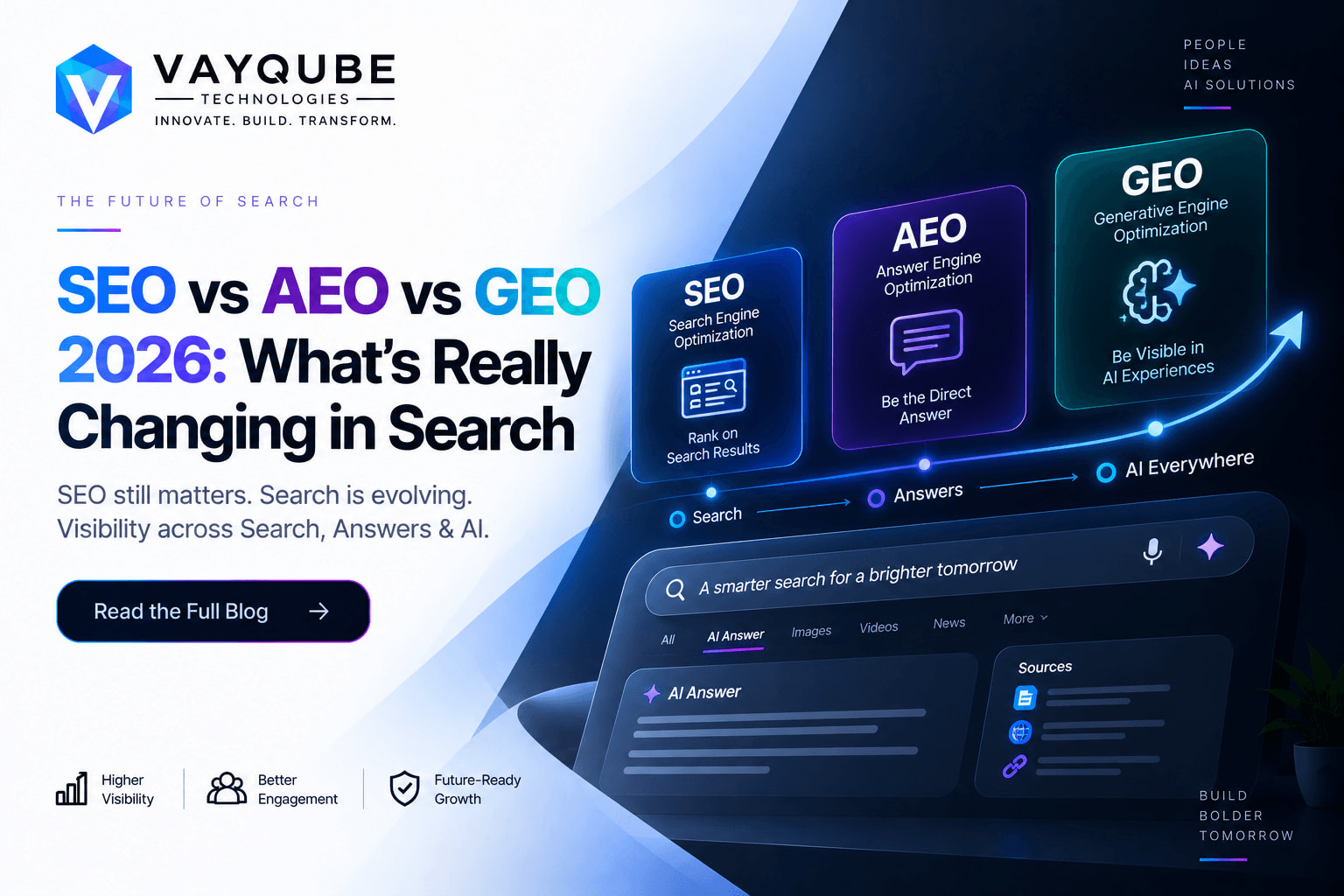
Strategically, the three approaches form a pipeline: SEO brings content into the model’s retrieval pool, AEO increases the chance of being selected for a direct answer, and GEO improves the quality and attribution of that answer. Neglecting any layer creates blind spots—great content that never gets seen, seen content that isn’t used, or used content that is misattributed. The goal is to become a reliable source that LLMs repeatedly cite in their generated answers.
SEO: Foundation Still Matters — But Changed
Technical health still gates LLM access. Crawlability, server response times, mobile‑first design, clean HTML, proper HTTP status codes, and XML sitemaps ensure retrieval‑augmented generation pipelines can fetch content without friction.
On‑page optimization now serves semantic clarity. Title tags, headings, and meta descriptions should convey clear subject‑verb‑object relationships rather than stuffing exact‑match keywords. Semantic HTML elements (<article>, <section>, <nav>) help LLMs map content blocks to entities and relationships in their internal knowledge graphs.
E‑E‑A‑T carries more weight in model training. Author bios, citations to reputable sources, and transparent publishing dates influence how LLMs weigh sources during retrieval and synthesis.
Keyword targeting has evolved into topic clustering and intent modeling. Comprehensive hub‑and‑spoke structures that cover sub‑questions, related concepts, and contextual nuances reinforce topical authority and give LLMs multiple pathways to understand a query’s full context.
Backlinks persist as trust signals, but LLMs evaluate the relevance and credibility of linking domains and the semantic context of anchor text to distinguish genuine endorsements from manipulative patterns.
In practice, audit for crawl errors, tighten semantic markup, showcase author credentials, organize content around user‑intent clusters, and earn links from authoritative, topically aligned sources. When these foundations are solid, content becomes a reliable source that LLMs can retrieve, attribute, and synthesize.
AEO: Optimizing for Direct Answers in AI Overviews
AEO shapes content so LLMs can pull a precise, attributable answer and surface it in AI‑generated overviews. Success is measured by impression share in those summaries, not by click‑through rate.
Effective formats
- Concise definitional blocks (one‑ to two‑sentence answers to “what is X?”).
- FAQ sections with short, factual answers; FAQPage schema helps LLMs recognize the pattern.
- Step‑by‑step summaries (numbered or bulleted procedures) for “how to” queries; HowTo schema reinforces structure.
- Comparison tables with clear headers and uniform units for “X vs Y” queries.
- Quote‑ready snippets containing a clear subject‑verb‑object structure.
How LLMs select direct answers
- Query‑answer alignment: the model favors text that mirrors the intent and phrasing of the user’s question, especially exact subject‑verb‑object matches.
- Authority signals: E‑E‑A‑T cues increase trustworthiness.
- Schema clarity: structured data (FAQPage, HowTo, Q&A) provides explicit answer‑ready markers.
- Contextual uniqueness: when multiple pages offer similar information, the model selects the one with least ambiguity and clearest attribution.
- Length and readability: answers under 30 words with plain language are preferred; dense jargon or nested clauses reduce extractability.
By engineering content to meet these criteria, you increase the odds that a generative engine will surface your information as the definitive answer.
GEO: Structuring Content for Generative Engine Citation
GEO optimizes content for LLM comprehension, synthesis, and accurate attribution. It goes beyond extractability to ensure the model can reason with the material and credit it correctly.
Key practices
- Prioritize semantic richness over keyword density: cover related concepts, synonyms, and entity relationships in natural language.
- Increase entity density with clear disambiguation: name specific products, standards, regulations, and people, pairing each with contextual descriptors so the model links to the correct knowledge‑graph node.
- Mirror the LLM’s internal reasoning flow: structure sections as premise → evidence → conclusion, matching how models retrieve passages and generate coherent responses.
- Maintain consistent terminology and hierarchy: use the same phrasing for a concept throughout and employ logical heading hierarchies (H2 → H3 → H4) that reflect subtopic relationships.
- Leverage schema markup for machine‑readable context: JSON‑LD implementations of Schema.org types (Article, FAQPage, HowTo, Organization, Person) provide explicit triples that reduce ambiguity and aid attribution.
Schema markup remains important in 2026. While LLMs can infer meaning from raw text, structured data acts as a verification layer that confirms entity identities, clarifies relationships, and signals authoritative definitions or step‑by‑step instructions. Search‑generative experiences frequently pull cited snippets directly from schema‑enriched blocks, making markup a practical prerequisite for reliable attribution.
How SEO, AEO, and GEO Interact — Not Compete
The three approaches form a sequential pipeline rather than competing tactics.
Discoverability (SEO)
- Technical health (crawlability, speed, mobile responsiveness) ensures LLMs can reach content during retrieval‑augmented generation passes.
- Semantic on‑page elements (clear headings, entity‑rich copy, Schema.org markup) help models understand topical relevance and authority.
- Backlinks and brand mentions continue to serve as trust signals, evaluated through contextual reasoning rather than raw link counts.
Extractability (AEO)
- Once accessible, AEO raises the likelihood that a specific answer will be pulled for AI overviews or featured snippets.
- Content that directly matches conversational queries with a clear subject‑verb‑object structure, concise definitions, or step‑by‑step summaries is more likely to be selected.
- FAQPage, HowTo, and Q&A schema act as explicit signals that a block contains answer‑ready information.
Citability (GEO)
- GEO optimizes how well extracted information is synthesized and credited in the final AI response.
- Dense, accurately linked entities, logical premise‑evidence‑conclusion flow, and consistent terminology reduce hallucination risk and improve attribution.
- Deep topical coverage and hierarchical organization allow LLMs to trace the provenance of a fact back to the source, increasing citation likelihood.
Pipeline view
- SEO gets the content into the LLM’s retrieval pool.
- AEO makes that content pick‑able for direct answer slots.
- GEO ensures the answer is accurate, well‑attributed, and positively reflected in the generated text.
Neglecting any layer creates blind spots: excellent content that never gets crawled (weak SEO), content that is found but never chosen for an answer (weak AEO), or content that is used but misrepresented or unattributed (weak GEO). A balanced investment across all three maintains visibility as search continues to shift from link‑based ranking to AI‑mediated answer generation.
Practical Framework: Aligning Content Strategy Across All Three
- Audit technical foundations – run crawl reports, fix server errors, improve page speed, validate mobile usability, and ensure XML sitemaps are up to date.
- Implement semantic markup – add JSON‑LD for Article, FAQPage, HowTo, Organization, and Person where appropriate; use semantic HTML tags to reinforce hierarchy.
- Build topic clusters – identify core pillars, create comprehensive hub pages, and develop spoke content that answers sub‑questions; interlink hub and spokes with descriptive anchor text.
- Engineer answer‑ready blocks – insert concise definitional statements, FAQ sections, step‑by‑step summaries, and comparison tables; apply FAQPage or HowTo schema to these blocks.
- Enhance entity richness – name specific products, standards, regulations, and experts; provide contextual descriptors and link to authoritative sources when possible.
- Strengthen E‑E‑A‑T – publish detailed author bios, cite reputable references, and display clear publication dates; consider adding structured data for Author and Review.
- Earn topical backlinks – pursue links from industry‑relevant sites, research publications, and trusted directories; focus on relevance and contextual anchor text rather than sheer volume.
- Monitor and iterate – use server logs to confirm LLM bot access, track impression share in AI overviews via available search console reports, and refine content based on which answer‑ready blocks are being cited.
This framework treats SEO, AEO, and GEO as interconnected layers, ensuring each builds on the previous one to maximize the chances of being selected, synthesized, and credited by generative search systems.
What to Measure (and What Not To) in 2026
Useful metrics
- Crawl error rate and average page load time (technical SEO health).
- Impression share in AI overviews or answer engines (AEO performance).
- Frequency of citations in generated answers (GEO performance).
- Growth in topical authority signals: internal link depth, hub‑spoke traffic, and referral domains from authoritative sources.
- Engagement on answer‑ready blocks (time on fragment, scroll depth) as a proxy for relevance.
Metrics to de‑emphasize
- Traditional keyword rankings alone – they no longer reflect visibility in AI‑driven results.
- Raw click‑through rates from SERPs – many queries end without a click when the answer is satisfied in the overview.
- Total backlink count without relevance weighting – LLMs evaluate link quality, not quantity.
Focus on indicators that show your content is being discovered, extracted, and credited by the models that power modern search.
Considerations and Limitations
While optimizing for SEO, AEO, and GEO improves visibility, several factors warrant attention:
- Limitations of current LLM attribution – LLMs may synthesize information from multiple sources without clear citation, making it difficult to trace which specific passage contributed to an answer. Attribution reliability varies by model and implementation.
- Variability in LLM behavior across providers – Google’s SGE, Bing Chat, Perplexity, Claude, and Gemini each apply different weighting to signals such as freshness, authority, and schema. A piece that performs well in one environment may not yield the same results elsewhere.
- Risks of over‑optimizing for AI summaries – Prioritizing brevity and schema for answer extraction can compromise depth, readability, or user experience on the destination page. Content that serves only the AI overview may fail to engage visitors who click through.
- Role of multimodal search – Image, video, and audio inputs are increasingly integrated into generative results. Text‑only optimization may miss opportunities where visual or auditory content satisfies the query.
- Impact of regulatory changes – Emerging guidelines on AI‑generated content attribution, data provenance, and copyright could affect how LLMs cite sources and what markup is required for compliance.
Addressing these considerations involves maintaining a balance between AI‑friendly structure and human‑centric value, monitoring performance across platforms, and staying informed about evolving search modalities and policy developments.
Conclusion: Building Resilient Visibility in the AI Search Era
SEO, AEO, and GEO are not competing tactics; they are complementary layers of a unified visibility strategy. Strong technical SEO ensures LLMs can reach your content. Effective AEO increases the odds that a specific answer will be pulled for AI overviews. Robust GEO guarantees that the extracted information is synthesized accurately and attributed to your source.
By aligning content creation, technical optimization, and measurement practices across these three layers, B2B marketers can future‑proof their organic presence in an AI‑first search landscape without chasing hype or making unverified claims. The goal is simple: become a trusted source that LLMs repeatedly choose to cite in their generated answers.
[Download our 2026 Search Visibility Framework to align your content with AI‑driven search behaviors.]
Frequently Asked Questions
How do I know if my content is being cited by LLMs in AI-generated answers when there’s no click-through?
Track impression share in AI overviews via Google Search Console’s ‘AI Overviews’ report (when available), monitor server logs for LLM‑specific user agents like Google‑Extended or PerplexityBot, and use third‑party tools that estimate citation frequency in generative responses. Direct attribution remains limited, so combine these signals with topical authority growth and answer‑ready block engagement as proxies for visibility.
Should I create separate content for AEO and GEO, or can one piece serve both purposes?
A single piece of content can effectively support both AEO and GEO when structured intentionally: lead with concise, quotable answer blocks (AEO) at the top—such as a one‑sentence definition or FAQ—and follow with semantically rich, entity‑dense sections that explain context, relationships, and reasoning (GEO). This layered approach satisfies extractability for direct answers while enabling accurate synthesis and attribution.
Is investing in schema markup still worth it if LLMs can understand raw text?
Yes. While LLMs can infer meaning from unstructured content, schema markup (especially JSON‑LD for FAQPage, HowTo, Article, and Organization) reduces ambiguity, confirms entity identities, and provides explicit triples that improve attribution accuracy. Search‑generative experiences frequently pull cited snippets directly from schema‑enriched blocks, making it a practical verification layer for reliable citation in AI responses.
How do I optimize for conversational queries without sacrificing topical depth or sounding unnatural?
Match the phrasing of common user questions in your headings and answer blocks (e.g., ‘What is X?’ or ‘How does Y work?’) while maintaining natural, authoritative language throughout. Use topic clusters to cover related concepts in depth, and place concise, subject‑verb‑object answers near the top of the page—supported by detailed explanations below. This serves both AEO (extractability) and GEO (synthesis) without keyword stuffing or awkward phrasing.
Related Vayqube Resources
- Startups Building Ai Products Without Large Teams
- Cloud Cost Optimization Strategies For Saas Startups
- The Real Cost Of Building Ai Products
- System Design Services
- Saas Analytics Pipelines Work
- Modern Cloud Security Best Practices
Next Step
Talk to a Vayqube solution architect about a production‑ready implementation plan.